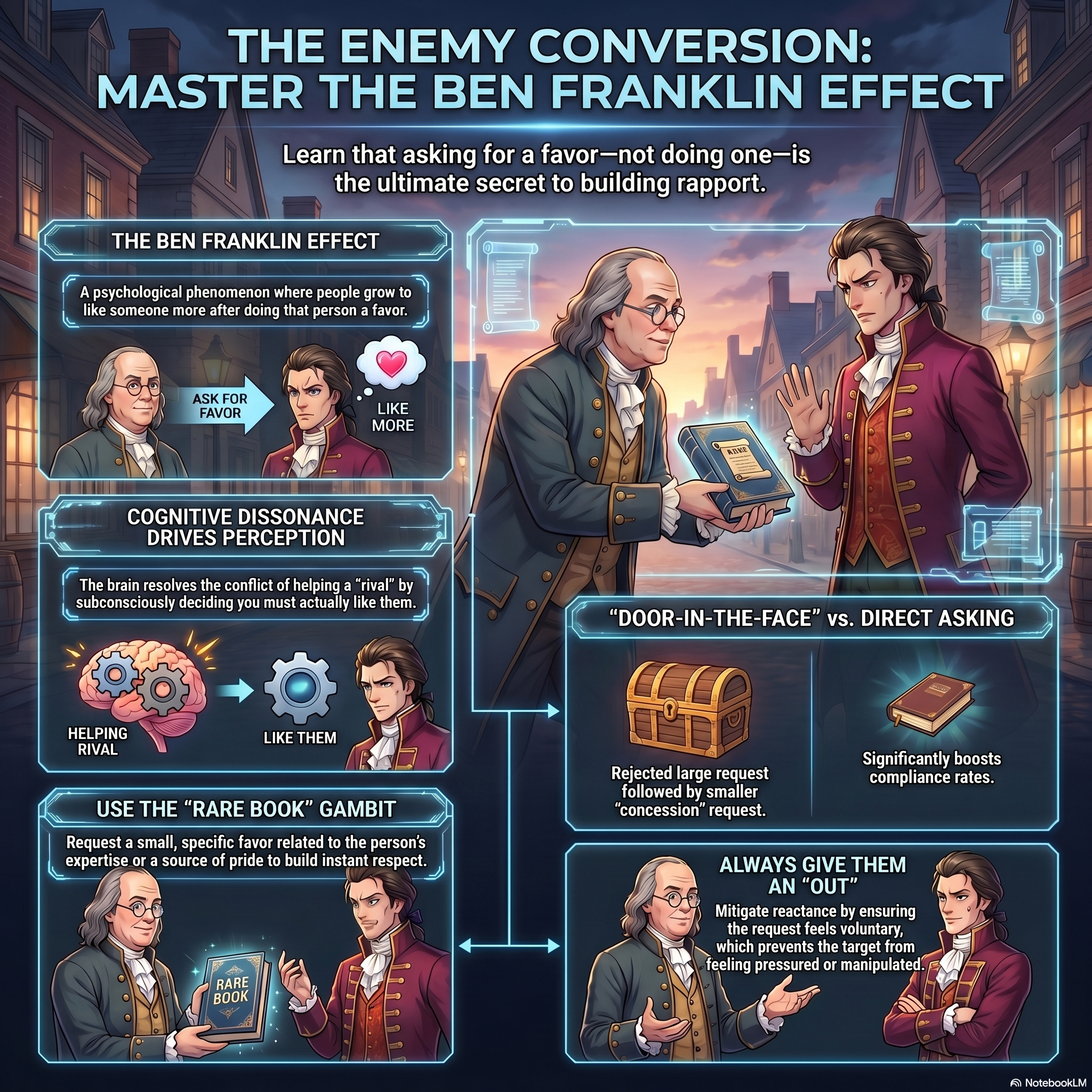
In high-stakes professional environments, mastering social influence is crucial for achieving cooperation and shifting perceptions. This article delves into powerful sequential request techniques, specifically the Door-in-the-Face (DITF) and Ben Franklin effects. These strategies offer a unique approach to influence, moving beyond traditional persuasion to directly impact behavior and mend adversarial relationships.
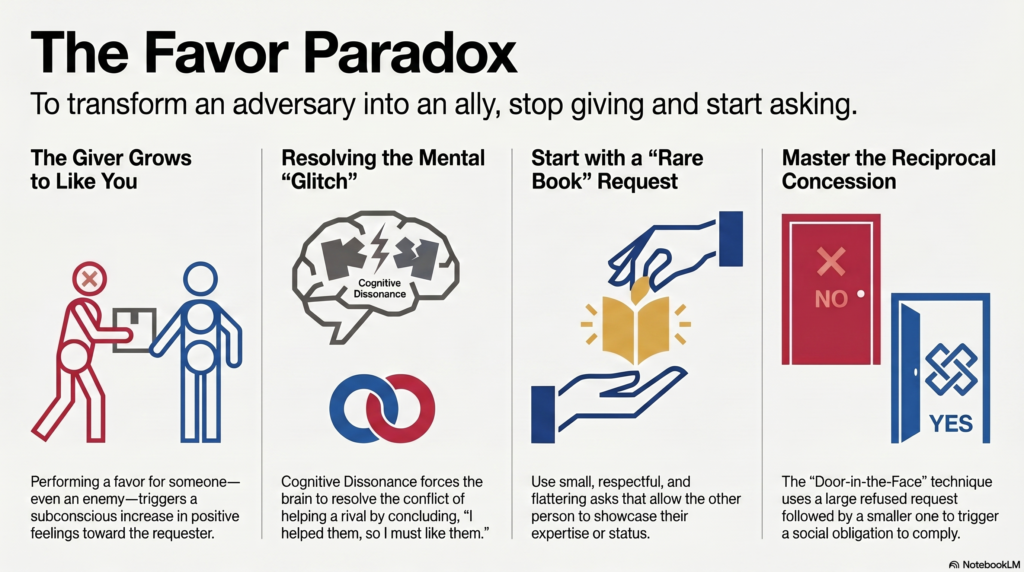
The DITF technique involves an initial, extreme request likely to be rejected, followed by a more moderate, target request. This sequence triggers a sense of reciprocal concession, making the moderate request more palatable. Conversely, the Ben Franklin Effect posits that asking someone for a favor can resolve cognitive dissonance. By helping you, they unconsciously begin to view you more favorably to justify their own kind behavior.
Understanding these psychological mechanisms and their practical applications is key for professionals seeking to enhance compliance in business, social, and personal contexts.
1. Theoretical Framework: The Psychology of Sequential Influence
Senior strategists often find that traditional persuasion, which focuses on altering internal beliefs through logic and data, can be slow and ineffective. Instead, the goal shifts to Behavioral Induction: bypassing cognitive skepticism to trigger direct action. Sequential request techniques, such as the Ben Franklin and Door-in-the-Face (DITF) effects, provide a ‘speed-to-result’ advantage.
This approach doesn’t require reshaping a counterpart’s worldview. Instead, it leverages existing psychological shortcuts to secure immediate cooperation. The focus is on influencing behavior directly, rather than waiting for a change in attitude.
Core Mechanism Synthesis: Evidence-Based Parameters
| Feature | Ben Franklin Effect | Door-in-the-Face (DITF) |
|---|---|---|
| Primary Theory | Cognitive Dissonance & Self-Perception | Norm of Reciprocal Concessions |
| Operational Logic | Soliciting a minor favor to build rapport. | Retreating from an extreme to a moderate request. |
| Psychological Trigger | Counterpart rationalizes their kindness to resolve dissonance. | Counterpart feels obligated to return a “social gift” (the concession). |
| Client Perception | “I am supporting this person because I find them worthy.” | “The requester made a retreat; it is only professional that I reciprocate.” |
Mental Dissonance Resolution: The Ego Protection Mediator
A fundamental driver behind these techniques is Ego Protection. Humans inherently strive to maintain a consistent self-concept as ‘helpful’ and ‘reasonable.’ When a counterpart refuses to reciprocate a concession (in DITF) or acts inconsistently with previous helpful behavior (in the Ben Franklin Effect), they experience mental dissonance.
Compliance serves as a way to avoid the discomfort of internal contradiction. By agreeing to the target request, clients are not just conceding to you; they are defending their own ego and maintaining a positive self-perception, avoiding the feeling of being inconsistent or socially irresponsible.
2. The Ben Franklin Effect: Strategic Rapport and Rival Conversion
Counter to conventional business wisdom, which often suggests that offering favors is the best way to build alliances, behavioral data reveals a more powerful truth: asking for a favor is exponentially more effective for building professional rapport. This is particularly true when dealing with neutral or even hostile counterparts.
When an individual performs a positive act for someone they perceive as a rival, their brain must resolve the resulting cognitive dissonance. The internal logic shifts: “I wouldn’t help a person I dislike; therefore, I must actually respect this person.” This process can strategically convert rivals into allies.
The Favor-Asking Workflow: C-Suite Application
To effectively leverage the Ben Franklin Effect and convert a rival into an ally, requests must follow a precise tactical sequence:
- Direct and Respectful Tone: Approach the counterpart with professionalism, acknowledging their standing without being subservient.
- Strategic Flattery (Source of Pride): Identify and target a resource, skill, or area of expertise that the counterpart is genuinely proud of. Benjamin Franklin famously requested a “very scarce and curious book” from a rival who prided himself on his extensive library.
- Quantified Reciprocal Gratitude: After the favor is granted, express sincere and warm thanks. This reinforces the positive self-perception the counterpart has now associated with helping you.
Operational Risk: Reactance
The primary pitfall in favor solicitation is Reactance. This psychological rebellion occurs when an individual feels their freedom of choice is restricted. If your request is perceived as a “trap” or manipulative, the counterpart will likely refuse to protect their autonomy.
To mitigate this risk, always provide a “perceived out.” Phrases like “No pressure, I just thought of your expertise first” or “No worries if it’s not feasible at the moment” affirm the client’s freedom to decline, which counterintuitively increases the likelihood of a “yes.”
3. The Door-in-the-Face (DITF) Methodology: Engineering Concessions
The Door-in-the-Face (DITF) technique is a cornerstone for high-stakes negotiation, especially when isolated solicitations often fail. By beginning with an initial request so extreme it invites refusal, and then retreating to a moderate target request, the strategist creates a perceived “social gift.” This concession triggers the norm of reciprocity, compelling the counterpart to reciprocate by agreeing to the smaller request.
Success Parameters: Request Symmetry
Research by Mowen & Cialdini (Study II) highlights a critical factor for DITF success: the target request must be a clearly defined subset of the initial, larger request. Using divergent requests — for example, asking for a year-long volunteer commitment then switching to a request for health insurance enrollment — will fail to produce the desired effect.
Conversely, moving from a “two-hour survey” to a “15-minute survey” (on the same topic) is a visible and clear retreat that engages the reciprocity norm, making a “yes” more likely for the smaller request.
The Actionable Quantifiable Retreat
While Feeley’s meta-analysis shows general weighted effects of r = 0.14 for verbal and r = 0.08 for behavioral compliance, the impact of Concession Size is profound. Research indicates correlations as high as r = 0.68 when the retreat is unambiguous.
- Strategic Requirement: The retreat must be framed as a tangible financial or temporal loss to the requester. A vague “how about this instead?” lacks the social weight of a specific reduction in price, time commitment, or scope. The concession must be clear and perceived as a genuine reduction from your original ask.
4. Navigating Business Contexts: Overcoming Suspicion and Ceiling Effects
In commercial environments, standard psychological triggers often encounter a “Salesperson Wariness” defense. Strategists must carefully calibrate their requests to bypass these ingrained defensive mechanisms and ensure efficacy.
The 35% Rule and Ceiling Effect Analysis
A common error in DITF implementation is overlooking Ceiling Effects. Mowen & Cialdini found that if baseline (control) compliance is already high — typically between 50% and 60% — the DITF technique shows no significant improvement. In such scenarios, the technique is unlikely to move the needle.
- Strategic Window: For DITF to be effective, the control compliance rate for your target request should ideally be 35% or less. If your moderate request is already receiving 50% agreement, it is considered “too easy.” To find an operative window for behavioral influence, you would need to increase the “toughness” or perceived value of the target request.
Establishing Request Legitimacy
To overcome the suspicion that a concession is merely a sales tactic, strategists must engage the Social Responsibility Norm. Studies at the California Mutual Insurance Company showed that emphasizing how a request would “really help out” the organization significantly increased compliance.
- Critical Constraint: Legitimacy only holds if the salesperson’s motive is perceived as exceeding simple commission-seeking. Framing the request as a contribution to research, a wider mission, or a collective benefit can effectively counteract a client’s natural distrust of commercial motives.
5. Implementation Matrix: Configuration Framework
The optimal choice of sequential request strategy depends heavily on cultural definitions and situational urgency. Use the following framework to configure your request sequences effectively:
- Sequential (Foot-in-the-Door – FITD): Progress from a simple request to a more complex one. This builds long-term momentum and commitment.
- Reversal (Door-in-the-Face – DITF): Move from a complex, extreme request to a simple, moderate one. This is ideal when the primary goal is a moderate request that would likely be rejected in isolation.
- Doubling: Repeat requests to demonstrate persistence and signal the high importance of the objective. This can wear down resistance over time.
- Four-Wall: Guide the target through multiple “Yes” responses to simple, undeniable questions. This leverages Consistency Theory, making them more likely to agree to a final, complex request.
Cultural Context: Amae and Preference-Expectation Reversal
In interdependent cultures, such as Japan, strategists must understand “amae” — the act of making an inappropriate request with an underlying expectation of acceptance due to a presumed closeness. While seemingly “inappropriate” by Western standards, this can be a highly adaptive social dynamic.
- Tactical Shift: In these contexts, a “Preference-Expectation Reversal” often occurs. Clients might personally prefer independent action but expect society to reward interdependent behavior. Align your request strategy with the client’s desire to be perceived as a helpful, group-oriented member by their peers, rather than solely focusing on their individual preferences.
6. Ethical Governance and Long-Term Relationship Maintenance
The pursuit of influence always carries the risk of being perceived as manipulative, which can severely damage Client Lifetime Value (LTV). For sustainable success and enduring relationships, preserving the perception of integrity through strategic guardrails is paramount.
Executive Guardrails: The Franklin Maxims
Drawing from Benjamin Franklin’s enduring leadership philosophy, these maxims can help manage long-term alliances and maintain trust:
- Practice Strategic Self-Effacement: Prioritize the project or objective over personal ego. Frame initiatives as a “scheme of a number of friends” rather than solely your own idea to mitigate envy and encourage collective ownership.
- Forbear Fixed Opinions: Adopt modest and open language such as “I imagine” or “it so appears to me at present.” Avoiding dogmatic statements like “undoubtedly” makes counterparts more willing to reconsider their positions and align with your proposals.
- Doubt Your Own Infallibility: As Franklin urged at the Constitutional Convention, professionals must “doubt a little of their own infallibility.” This intellectual humility maintains the flexibility required to foster consensus and adapt strategies.
The Long-Term Allied State
While the Door-in-the-Face (DITF) technique excels at securing a single compliant act, the Ben Franklin Effect is a superior engine for long-term Client Lifetime Value (LTV). When a client rationalizes a favor done for you, they internally adopt a new identity: that of your ally.
Genuine gratitude for that initial favor further transforms a one-time compliant act into a foundation for a lasting advocacy relationship. Mastering these sequential techniques enables professionals to fundamentally transform adversaries into lasting allies, ensuring that every interaction not only achieves immediate targets but also builds a sustainable platform for future influence and collaboration.