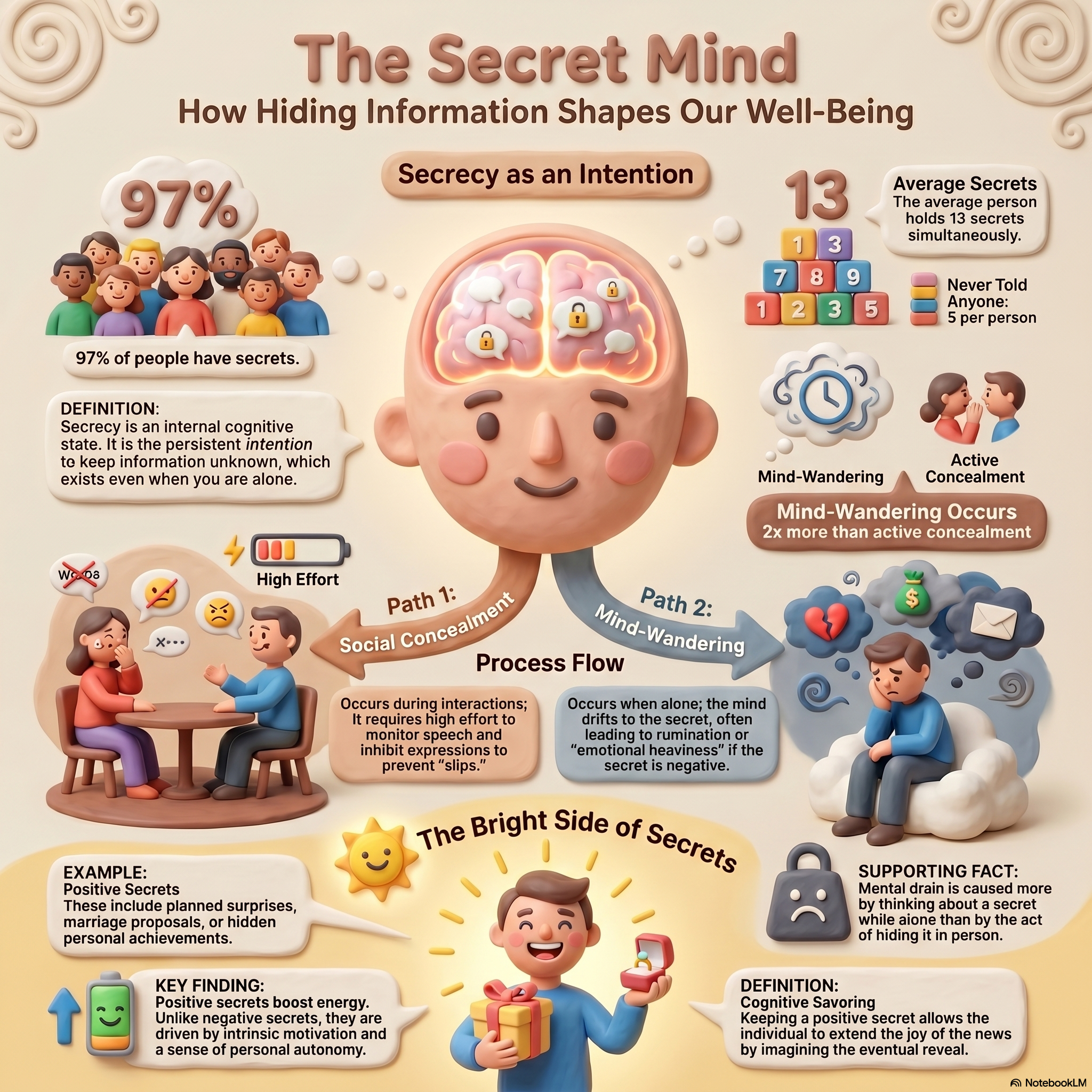
Imagine your mind as a city map, but with the most crucial roads invisible. This is the hidden geography of our unspoken thoughts, the private world of secrets we keep. We are all silent cartographers of this internal landscape. Fascinating research reveals that nearly 97% of us are currently holding a secret. According to a new model of the mind, pioneered by Michael Slepian of Columbia Business School, the average person carries 13 secrets, and five of these have never been shared with anyone.
These aren’t just minor undisclosed details. They span 38 common categories, ranging from significant issues like infidelity, hidden debt, or illegal behavior, to deeply personal matters such as a hidden pregnancy, a private ambition, or a planned surprise. Understanding the psychology of secrets can help us transform what often feels like a burden into a source of psychological resilience.
We often picture secrecy as dramatic, high-stress moments – the nervous sweat of a lie or the panicked avoidance of a direct question. However, behavioral science teaches us that secrecy is far more enduring. It’s not a fleeting performance; it’s a persistent state of being. Let’s explore five surprising truths about the impact of secrets on our lives.
1. Secrecy is a State of Mind, Not a Performance
For decades, the study of secrecy focused on “concealment” – the active effort to hide information during a conversation. Michael Slepian’s groundbreaking “Process Model of Secrecy” has fundamentally changed this definition. Secrecy isn’t just about the moment you choose not to speak; it’s a deep cognitive commitment that begins with an intention.
This means a secret exists the moment you decide someone else shouldn’t know a particular piece of information, even if that person is thousands of miles away. If you have a hidden debt, that secret remains active while you walk alone in a park, completely independent of any social interaction. It’s a fundamental state of being rather than a mere social tactic.
Slepian explains: “Rather than define secrecy as an action (active concealment), the model defines secrecy as an intention to keep information unknown by one or more others. Like any other intention, secrecy increases sensitivity to internal or external cues related to the intention.”
2. The Real Harm Happens When You’re Alone
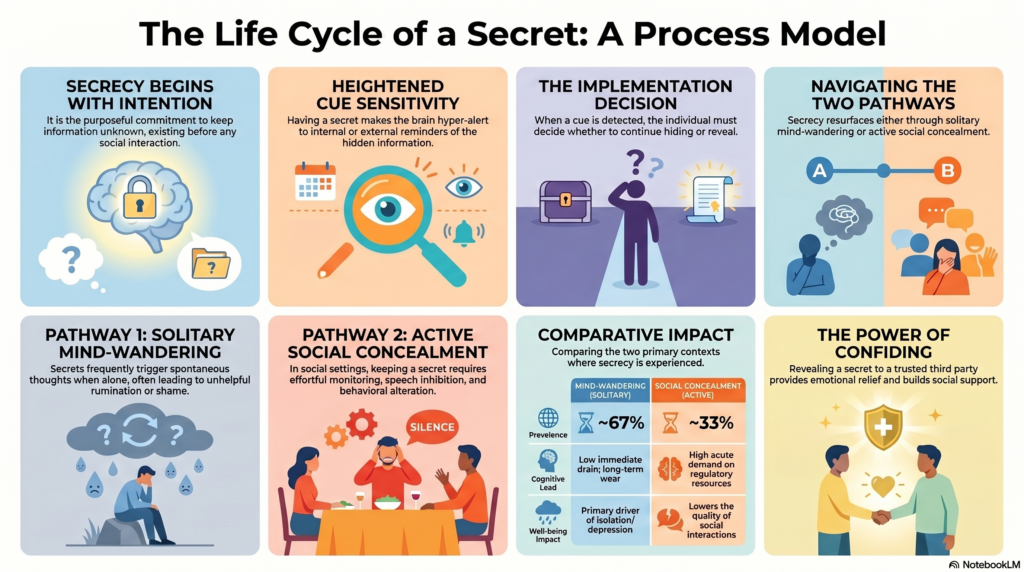
One of the most counter-intuitive findings in modern psychology is that the primary drain of keeping a secret isn’t the stress of actively lying. In fact, during “active concealment,” our minds are often too busy monitoring the conversation to truly feel the secret’s weight. The true damage occurs in the quiet moments of our own company, through “mind-wandering.”
Our brains are susceptible to the Zeigarnik effect: unfulfilled goals and unresolved intentions remain uniquely accessible and “sticky” in our memory. Because a secret represents an unresolved intention to keep information hidden, our minds return to it twice as often as we are ever forced to actively conceal it. This constant internal rehashing leads to rumination – a repetitive, solitary loop that fosters feelings of isolation and inauthenticity.
| Aspect of Secrecy | Description | Impact on Well-being |
|---|---|---|
| Social Concealment | An acute, effortful monitoring of speech and behavior during interactions. | Consumes regulatory resources in the moment but is relatively rare. |
| Solitary Mind-Wandering | The persistent, passive rehashing of the secret when alone. | Primary driver of reduced well-being and the feeling that a secret is “heavy.” |
3. The Surprising Energy of “Positive” Secrets
While we typically associate secrecy with feelings of shame or guilt, there’s a “bright side” driven entirely by motivation. A landmark study involving 2,800 participants explored “positive secrets” – joyful news such as an unannounced marriage proposal, a surprise gift, or a secret professional achievement.
The data revealed a startling insight: reflecting on these undisclosed joyful events produced significantly higher levels of subjective vitality and physical energy. Crucially, this revitalizing effect was statistically independent of the happiness of the news itself. It’s the act of keeping the secret that provides the energy boost.
This phenomenon occurs because positive secrets are often driven by “Intrinsic Motivation” – a self-aligned choice to privately savor a moment. In contrast, negative secrets are usually “Extrinsic,” driven by a fear of judgment or social cost. Keeping a positive secret allows for “cognitive savoring,” slowing down the process of becoming accustomed to good news and thereby extending the joy.
4. The “Transparency Trap” in Modern Workspaces
In the corporate world, the relentless pursuit of “transparency” led to the widespread adoption of open-plan offices, designed to foster collaboration. However, a Harvard Business School study utilizing “sociometric badges” (wearable devices with infrared sensors and microphones) uncovered a profound irony.
When physical walls were removed, employees didn’t become more open; they constructed psychological barriers instead. The study observed a substantial drop (often cited near 70%) in face-to-face interaction, accompanied by a corresponding surge in electronic communication like email and instant messaging. When individuals are placed in a modern “Panopticon” where every movement is visible, it triggers a natural human response to socially withdraw. This “Transparency Trap” demonstrates that when physical boundaries vanish, we often create even thicker internal fortifications to protect our private selves.
5. Strategy Over Silence—The Power of Confiding
If the true weight of a secret stems from rumination, the solution lies in altering our internal “hidden map.” However, it’s crucial to understand the difference between “Confession” (telling the person you’ve been hiding the news from) and “Confiding” (sharing with a neutral third party). Confession can be a high-stakes gamble with potentially relationship-ending consequences; confiding, on the other hand, is a strategic tool for mental health.
Confiding offers a “sounding board” that enables cognitive reappraisal – helping you transition the secret from a state of “unresolved rumination” to a state of “insight.” Research suggests that the act of sharing reduces the frequency of intrusive thoughts, but only if you choose the right container for your truth.
Pro-Tip: Choosing Your Confidant Wisely
The ideal confidant is a strategic choice, not a random one. Slepian’s research indicates you should seek someone who is:
- Compassionate: Able to empathize without judgment.
- Assertive: Capable of offering clear, helpful perspectives.
- Discreet: Trustworthy to keep the shared information private.
Sharing with a neutral third party who possesses these traits allows you to receive crucial emotional and instrumental support without the high-stakes fallout of a full confession.
Conclusion: The Boundary of the Self
Secrecy is more than just a social burden; it is a fundamental milestone of human development. It typically emerges around the age of five, signaling a child’s realization that their thoughts are uniquely their own. It marks the beginning of individuation and autonomy, shaping the very definition of the self.
Far from being a simple “lie,” a secret can be a “sacred covenant” with oneself – a private territory where we allow ourselves to grow without the interference of outside judgment. Ultimately, we must ask: Is your secret a wall that is isolating you, or a sacred space where you are simply allowing yourself to evolve in private? By mastering the map of our private lives, we don’t just keep secrets – we protect our souls and nurture our authentic selves.