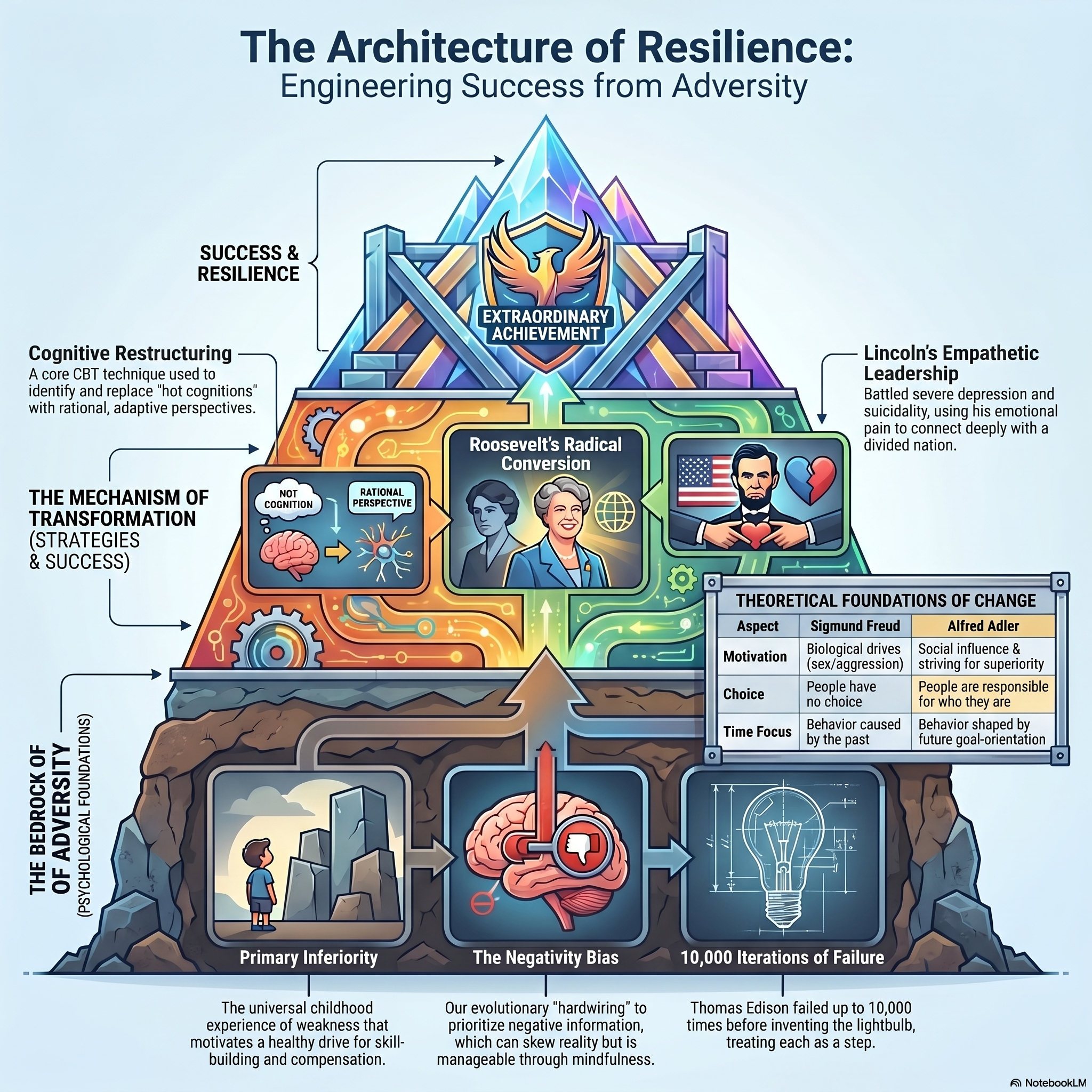
We often perceive personal adversity and perfectionism as insurmountable obstacles. However, a deeper look into the psychological and practical dimensions of overcoming these challenges reveals a different truth. Remarkable individuals, such as Thomas Edison and Walt Disney, achieved greatness not by avoiding failure, but by maintaining relentless persistence through repeated setbacks. Clinical perspectives highlight that trauma-driven perfectionism often functions as a survival mechanism, fueled by a negativity bias that prioritizes threats over positive experiences. To counteract these ingrained habits, experts recommend strategies like Cognitive Behavioral Therapy (CBT) and self-compassion, designed to rewire the brain’s response to mistakes. By transitioning from shame-based reactions to mindful self-acceptance, individuals can transform inherent weaknesses into sustainable strengths. Ultimately, this collection emphasizes that resilience is a learned skill, meticulously fostered through mental reframing and emotional regulation.
1. Understanding Resilience: From Obstacle to Opportunity
Resilience is not a predetermined trait but an active, ongoing process of transforming adversity into a powerful catalyst for personal growth. When we study those who have successfully overcome significant challenges, we discover that success rarely comes from avoiding hardship. Instead, it arises from a strategic and deliberate response to it. Every individual who triumphantly navigates profound obstacles employs a three-part framework for transformation:
- Mindset: This involves a cognitive refusal to accept a negative prognosis as a final destination. It means viewing “failure” not as a verdict on one’s worth, but as a methodology – a valuable source of data for future attempts.
- Action: Resilience demands the consistent application of deliberate effort. It requires a “Fortitude of Character” to persevere despite physical pain, social rejection, or limited resources.
- Support: Overcomers understand the importance of external anchors. Whether through close-knit peer groups, expert diagnoses, or mentors, they recognize that self-reliance is enhanced, not diminished, by seeking help.
Evolutionary biology has hardwired the human brain with a Negativity Bias, a survival mechanism that compels us to focus more on threats and failures than on successes. However, as educators and learners, we can reframe this perceived weakness into an adaptive advantage. By being hyper-aware of our challenges, we can consciously develop a unique strength of character that those without such obstacles may never be forced to discover.
While understanding the theory of resilience provides a roadmap, the true power of these concepts is vividly demonstrated in the biographies of those who fought to rewrite their stories in the face of daunting physical limitations.
2. Real-Life Examples of Physical Resilience
Glenn Cunningham: Stopping the Story of Limitation
At age seven, Glenn Cunningham’s legs were so severely burned in a schoolhouse explosion that doctors not only predicted he would never walk but also recommended immediate amputation. Glenn chose to “stop the story” that was being written for him. He refused the amputation and spent years dragging himself along a split-rail fence, determined to force his legs into motion.
| Expected Outcome | Actual Achievement |
|---|---|
| Amputation recommended; permanent reliance on a wheelchair. | 1936 Olympic Silver Medalist in the 1500 meters. |
| A life defined by total physical dependency and “ash-like” dreams. | 1938 World Record for the mile, clocked at 4:06. |
Bethany Hamilton: The Persistence of Purpose
At just thirteen, Bethany Hamilton lost her left arm in a shark attack. Her resilience was epitomized by an incredible recovery timeframe: she returned to her surfboard merely one month after the devastating incident. By refusing to let a physical loss dictate her identity, she won first place in the Explorer Women’s Division of the NSSA National Championships just two years later, providing a concrete benchmark for unwavering persistence.
Scott Hamilton: The Logic of Limited Options
Stunted by a brain tumor that led to years of hospitalizations and frailty, Scott Hamilton’s future appeared to be defined by weakness. Paradoxically, this led him to the ice rink—one of the few environments where he felt capable of functioning. For learners, Scott’s story offers a crucial insight: having limited options can be a blessing, as it often compels an individual to discover the unique talent they were destined to master.
The grit required to overcome physical pain frequently serves as the psychological foundation for visionaries who must endure the long, solitary journey of intellectual and creative rejection.
3. The Persistence of Visionaries: Overcoming Creative Obstacles
Thomas Edison: Failure as a Methodology for Innovation
Thomas Edison famously “failed” between 1,000 and 10,000 times before successfully inventing the light bulb. He famously reframed these events, steadfastly refusing to view them as defeats. To Edison, “trying again and again” was not a sign of futility, but rather a methodical blueprint for success. Each “failure” was simply the discovery of a way that did not work, making the final, successful result an inevitability of sheer persistence.
Overcoming Labels: Visionaries Redefine Expectations
For many visionaries, the primary obstacle is often the “label” unfairly placed upon them by others. Here’s how some defied these expectations:
| Visionary | The Label (Initial Obstacle) | The Final Result (Triumph) |
|---|---|---|
| Walt Disney | Fired by a newspaper editor for “lacking imagination and creativity”; later drove his first studio into bankruptcy. | Founded a global animation empire and became a pioneer of modern entertainment. |
| Stephen King | His first novel, Carrie, was rejected by 30 publishers; King initially threw the manuscript in the trash in despair. | Over 350 million copies sold; Carrie became a multi-media classic after his wife retrieved it from the bin. |
Vincent Van Gogh: The Power of Intrinsic Dedication
In a modern world often obsessed with instant monetization and external praise, Vincent Van Gogh offers a vital lesson in unwavering dedication to one’s “life plan.”
- Success Metric (Monetary): Van Gogh sold only one painting during his entire life, titled “Red Vineyard at Arles.”
- Legacy Metric: He produced over 900 paintings, creating an immortal body of work through sheer persistence without the validation of significant sales. For the modern student, Van Gogh represents the profound value of “intrinsic worth”—doing the work because it is a fundamental part of your purpose, regardless of whether the world notices or rewards it financially.
While external rejection is a heavy burden, the most difficult battles are often the invisible ones, fought within the corridors of the mind and spirit.
4. Navigating Mental and Social Barriers: Inner Resilience
Abraham Lincoln: Leading Through “Melancholy”
Abraham Lincoln battled severe, lifelong depression, including episodes so dark that his friends famously took away his knife to prevent him from self-harm. He did not lead despite his pain but rather through it, utilizing three specific mechanisms:
- Humor: Employing wit and storytelling to diffuse the crushing tension and immense pressure of the Civil War.
- Peer Support: Relying on close friends like Joshua Speed for emotional succor and active intervention during his darkest hours.
- Purposeful Action: Channeling his internal suffering into deep empathy for a nation in conflict, which profoundly shaped his compassionate and unifying leadership.
Albert Einstein: Rising Above Early Negativity
Albert Einstein did not speak at all for the first three years of his life, leading many teachers to assume he was “lazy” or overly “distracted” by abstract concepts. By rising above the negativity of these early labels, Einstein proved that a perceived intellectual “weakness” is often the sign of a mind operating on a much higher plane of focus and unconventional thought.
Strategies for Social Growth: Reframing Anxiety
Social anxiety and shyness can be reframed not as a handicap, but as a heightened social sense. Based on various experiences, we can identify four effective strategies for growth:
- Accept Yourself (Celia’s Lesson): Recognize the “gift” of shyness—a high degree of intuition and a sharp gut instinct about whom to trust, often born from years of careful observation.
- Join a Support Group (Marla’s Approach): Move beyond being merely a participant to becoming a facilitator. Taking on a leadership role in a supportive setting provides a powerful sense of agency over your fears.
- Blog About It (Social Accountability): Utilize public platforms to create a “blog family” that provides accountability and encourages you to actively confront your fears in a structured way.
- Seek Expert Help (Kayla’s Path): For persistent issues like Selective Mutism, professional diagnosis and specialized treatment are essential to unlocking the “hidden voice” that anxiety has silenced.
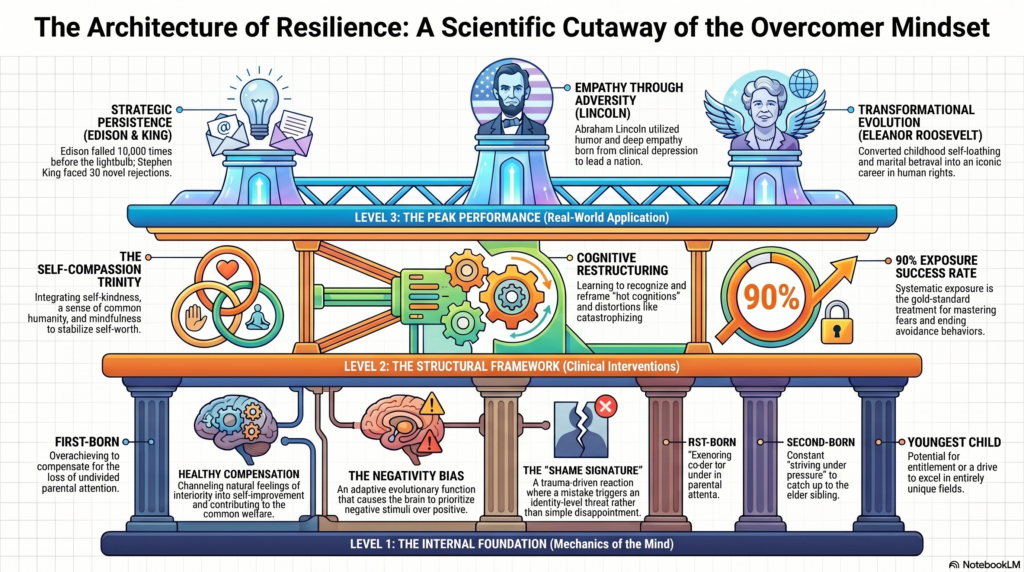
These biographical stories are undoubtedly inspiring, but resilience is a skill to be actively trained and developed, not just a trait to be admired. To replicate these powerful results, every learner must explore the psychological tools available to them.
5. The Learner’s Toolbelt: Scientific Strategies for Resilience and Growth
Reframing Weakness: Adler’s Individual Psychology
Alfred Adler’s “Individual Psychology” suggests that we are not defined by our limitations, but by how we choose to compensate for them. This framework offers a profound perspective:
| Concept | Definition & Outcome |
|---|---|
| Primary Inferiority | The real or perceived physical or social limitation (e.g., a speech impediment or physical frailty). |
| Secondary Inferiority | The emotional reaction to the limitation, such as shame or anxiety, which can lead to a paralyzing “complex” if left unaddressed. |
| Healthy Compensation | A positive, motivational force where the learner actively builds new skills or strengths specifically to balance or overcome their perceived weaknesses. |
CBT Techniques for the Learner: Actionable Steps for a Stronger Mind
Cognitive Behavioral Therapy (CBT) provides actionable steps that empower you to change your internal narrative starting today:
- Cognitive Restructuring: Identify and challenge “thinking errors” such as catastrophizing or overgeneralization.
- Practical Action Step: For one day, track your thoughts and label any distortions you find (e.g., replace “I’m a failure” with “I made a mistake”).
- Mindfulness: Disengage from ruminating about past failures or worrying excessively about future threats.
- Practical Action Step: Use the STOP technique (Stop, Take a breath, Observe, and Proceed) whenever you feel your Negativity Bias taking over.
- Activity Scheduling: Actively combat the low mood and procrastination that often follow setbacks.
- Practical Action Step: Schedule one specific behavior that provides a sense of Mastery or Pleasure (like a short walk or finishing a small task) for tomorrow morning.
The Power of Self-Compassion: Nurturing Your Inner Ally
Dr. Kristin Neff’s groundbreaking research highlights that we are more resilient when we treat ourselves with the same nurturing support and understanding we would readily extend to a close friend:
- Self-kindness: Replace harsh self-criticism with supportive internal dialogue. Speak to yourself with warmth and understanding, especially during difficult moments.
- Common humanity: Remind yourself that suffering, setbacks, and imperfection are a shared human experience, not an isolated personal failure. You are not alone in your struggles.
- Mindfulness: Observe your painful thoughts and emotions with balance and curiosity, without over-identifying with them or allowing them to overwhelm you.
By applying these powerful tools, you actively transform your personal narrative from a story of victimhood into a narrative of victory-in-progress, empowering you to move forward.
6. Conclusion: Your Narrative in Progress
The “Negativity Bias” is an ancient part of our biological history, deeply ingrained for survival, but it does not have to be the sole author of your future. As we have witnessed through the inspiring lives of presidents, athletes, and artists, the very obstacles that might make us feel “less than” are often the seeds of our greatest contributions and most profound strengths.
Today, you can actively leverage your perceived weaknesses by:
- Identifying the Strength Within: Ask yourself what unique skill or perspective your limitation has inadvertently forced you to develop (e.g., has shyness made you a more observant and empathetic listener?).
- Savoring Small Wins: Consciously focus on a positive moment, no matter how small, for 15–30 seconds longer than usual. This builds up your mental stores of success and positivity.
- Seeking Your “Joshua Speed”: Identify one trusted person you can lean on for active support, honest feedback, and accountability this week.
Remember that life—and God—often does its most transformative work in the midst of our perceived weaknesses. Your obstacles are not there to stop you; they are there to show you exactly what immense capabilities you possess for overcoming them.