We all feel it, don’t we? That subtle, yet undeniable pull. The familiar chime that electrifies your focus, the endless scroll that lulls you into a trance, and the growing whisper that the world beyond your screen is becoming a stranger, more fractured place. For so long, we’ve considered our minds to be unassailable fortresses, sovereign territories of thought. Yet, groundbreaking revelations from the academic halls of Yale, Princeton, and Cambridge whisper a more unsettling truth: our very cognitive architecture—the intricate blueprint for how we grasp truth, share empathy, and perceive status—is undergoing a profound, systematic re-wiring by the digital landscapes we so readily inhabit.
This isn’t merely a matter of ‘screen time’; it’s a deep, foundational shift in our neural responses. By journeying through the latest discoveries in neuroeconomics and social psychology, we can begin to discern the invisible scaffolding that now shapes our modern behaviors. Join us as we unveil five impactful insights from the frontiers of behavioral science, explaining how your brain is being meticulously re-coded.
1. Outrage: A Learned Performance (And Why the Middle Ground Crumbles First)
We often imagine moral outrage as a spontaneous eruption, a pure response to injustice. Yet, our first revelation takes us to the bustling digital town square, where something unexpected is unfolding. A landmark Yale University study, meticulously analyzing 12.7 million tweets, suggests that outrage is not merely organic, but a learned behavior, subtly reinforced by the very architecture of social media.
The Digital Dopamine Loop
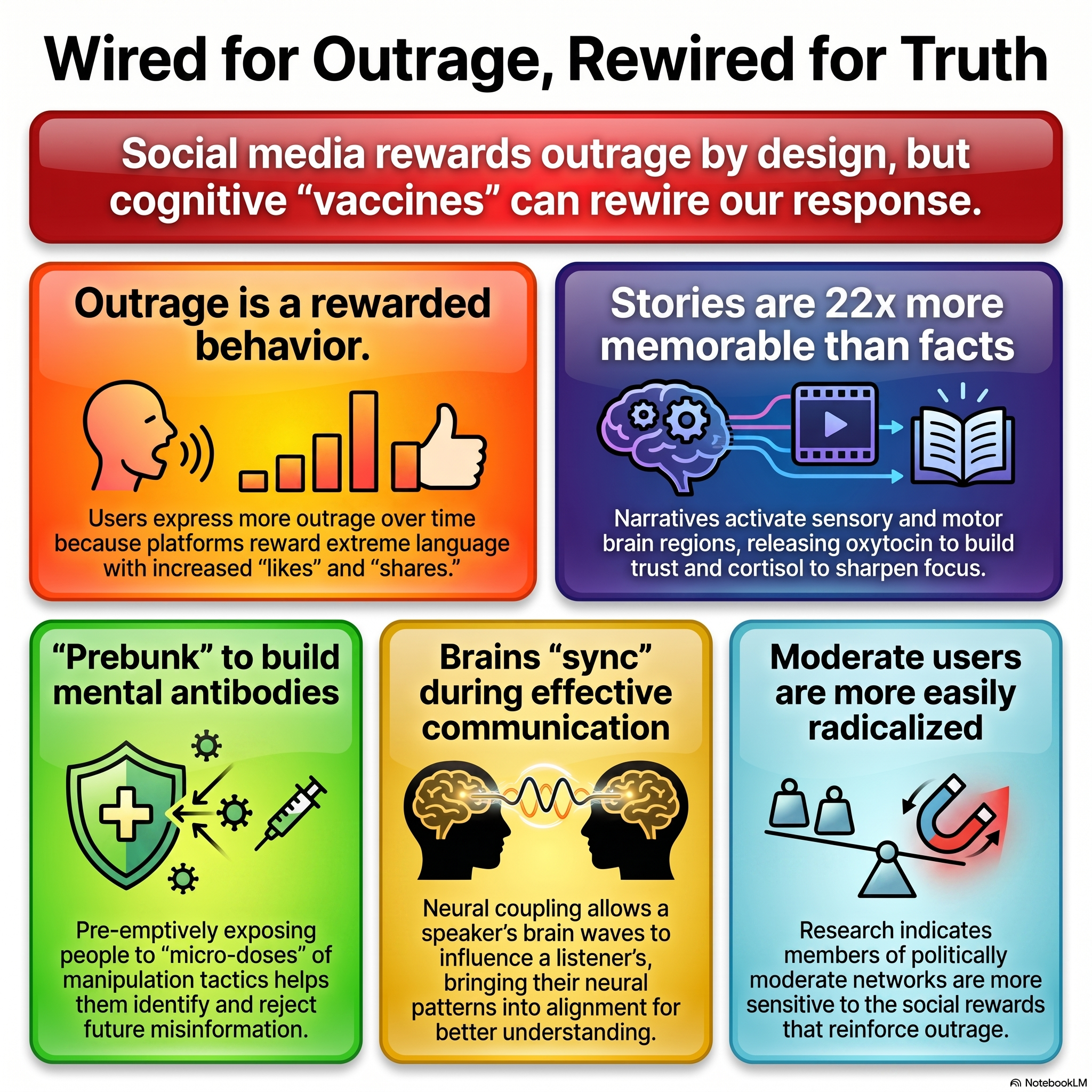
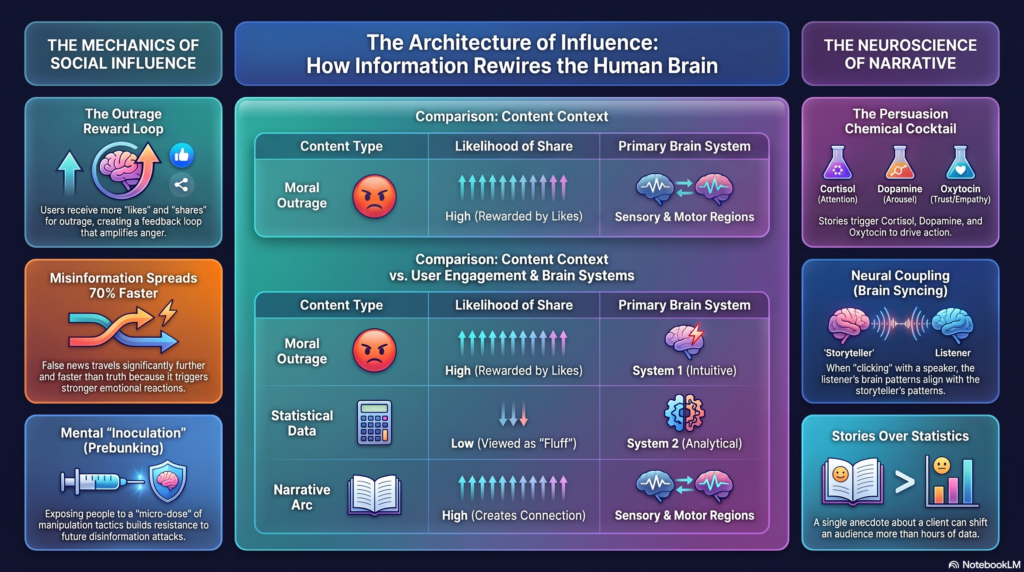
At its heart, the brain’s ancient reward system interprets ‘likes’ and ‘shares’ as potent digital dopamine hits. When a user expresses moral outrage and is met with a cascade of positive feedback, the brain quietly marks that behavior as successful. Over time, the platform transforms into an incentive machine, a silent instructor ‘teaching’ users that high-conflict language is the most efficient, most rewarded path to social status and validation.
The Unraveling of the Middle
Perhaps the most startling discovery, unearthed by researchers William Brady and Molly Crockett, is the particular vulnerability of politically moderate users. Because moderates typically navigate more diverse social networks, their occasional ventures into outrage generate a dramatically amplified shift in their behavioral baseline. When a moderate receives a powerful ‘hit’ of social validation for a polarized post, it acts as an extraordinarily potent reinforcer, igniting a feedback loop that accelerates their journey towards radicalization.
“Social media’s incentives are changing the tone of our political conversations online,” explains William Brady of the Yale Department of Psychology. “Our data show that social media platforms do not merely reflect what is happening in society. Platforms create incentives that change how users react to political events over time.” This revelation paints a vivid picture of how our collective discourse is being sculpted, tweet by tweet.
2. Storytelling: More Than Words, It’s ‘Brain-to-Brain Coupling’
Next, let’s journey into the very heart of human connection: the ancient art of storytelling. We often relegate stories to the realm of mere entertainment. But Princeton neuroscientist Uri Hasson has unveiled a profound secret: stories are a sophisticated mechanism for ‘clicking’—a mystical state where the speaker’s and listener’s brain waves align, merging into a single act of neural coupling.
The Sherlock Unveiling
Imagine the tension as Hasson’s team, using fMRI scans, tracked participants watching a gripping scene from the BBC series Sherlock—specifically, Sherlock in a cab, locked in a chilling conversation with a killer. What they found was astonishing: when a viewer later recounted this very scene to someone who hadn’t witnessed it, the listener’s brain activation patterns in higher-order regions mirrored those of the speaker. They weren’t just passively receiving words; they were actively, neurologically, constructing the memory as if they had lived it themselves.
The Narrative’s Predictive Power
This research fundamentally shifts our understanding of memory. As Hasson eloquently suggests, memory’s primary function isn’t simply to archive the past, but to share vital knowledge, helping others predict and navigate the future. While bare facts are processed in the logical language centers, stories ignite sensory and motor regions, orchestrating a rich chemical symphony described by researcher Paul Zak:
- Cortisol: A sharpens attention, building tension.
- Oxytocin: A deep trigger of empathy and trust.
- Dopamine: A thrilling fuel for the anticipation of a climax.
Because of this profound neurological engagement, stories are not merely remembered; they are absorbed and retained at rates roughly 22 times higher than isolated facts. They are the true conduits of shared experience.
3. The ‘Cognitive Miser’: Trapped in System 1’s Swift Currents
Our third insight pulls back the curtain on a fascinating, yet sometimes problematic, aspect of our own minds: the ‘cognitive miser.’ The human brain, a remarkably energy-intensive organ, has evolved a clever survival strategy: to conserve precious resources, it’s inherently ‘lazy’ when it can be. This leads us to Daniel Kahneman’s renowned framework of two operating modes: System 1 (fast, intuitive, and automatic) and System 2 (slow, analytical, and effortful).
The Heuristic Shortcut
Because the diligent System 2 demands significant mental energy, our brain often defaults to the swift System 1, guided by a rule known as WYSIATI (What You See Is All There Is). We seize upon whatever fragment of information is most immediately visible, quickly weaving a coherent—though often inaccurate—story around it, rather than undertaking the arduous work of thorough statistical analysis.
The Allure of the Vivid: Availability Heuristic
This inherent bias leads us to disproportionately value what is most vivid, most recent, or most easily recalled. We tremble at the thought of shark attacks or plane crashes, images vividly imprinted by news headlines, while often overlooking the statistically far greater risks of mundane car accidents. This distortion is the subtle crack in the door through which misinformation so easily slips. As highlighted by researchers at Penn LPS, this subjective lens means we frequently mistake our internal shortcuts for objective truth.
“Data is only as honest as its interpreter,” notes the Penn LPS framework on cognitive bias. “Cognitive biases are systematic errors in thinking that interfere with how we reason… they deviate our thinking away from objective reality and cause us to draw incorrect conclusions.”
4. A Psychological Shield: ‘Vaccinating’ Your Mind Against Misinformation
As the shadows of misinformation lengthen, exploiting our ‘lazy’ System 1’s vulnerability to fast-moving falsehoods, traditional debunking often arrives too late—after the ‘virus’ has already taken hold. But a glimmer of hope emerges from Cambridge and USAID researchers: a proactive alternative known as Inoculation Theory.
The Mental Antidote
Much like a biological vaccine, ‘prebunking’ involves gently exposing the mind to a weakened, recognizable dose of a manipulation tactic. By teaching the brain to identify the mechanics of a lie before the lie itself arrives, we develop robust ‘mental antibodies.’ This ingenious approach bypasses the need for the effortful System 2 to constantly fact-check, transforming the recognition of manipulation into an automatic, System 1 response—a cognitive shield against deceit.
The Misinformation Playbook
Effective inoculation focuses on two powerful fronts:
- Fact-based prebunks: Correcting a specific claim before it spirals into viral falsehood.
- Logic-based prebunks: Training the mind to spot the recurring ‘playbook’ of manipulative tactics, such as scapegoating, false dichotomies, ad hominem attacks, and emotionally charged language.
Large-scale YouTube experiments have demonstrated this power: viewers who watch concise 90-second inoculation videos become significantly more adept at identifying these deceptive tactics, regardless of their prior political leanings. It’s a testament to the mind’s ability to learn and adapt, given the right tools.
5. The Echo Chamber’s Crown: When Virality Overtakes Competence
Our final, perhaps most sobering, tale explores a disturbing shift in how we choose our guides, our leaders, in this new digital wilderness. A troubling trend suggests that social platforms are fundamentally altering our selection criteria, leading us to mistake fleeting virality for genuine competence. Research from the Doerr Institute for New Leaders at Rice University unveils this profound misdirection.
The Unyielding Structure
In a compelling study by the University of Amsterdam, researchers crafted a stripped-down social media environment populated by AI bots. Even in the absence of complex algorithms to ‘steer’ content, these bots naturally gravitated towards forming echo chambers and elevating ‘elites’ who posted the most extreme, most outrageous content. Crucially, interventions designed to diversify viewpoints or hide follower counts failed to halt the polarization. This suggests a sobering truth: the very structure of social interaction in digital spaces intrinsically favors the loudest, most provocative voices.
The Siren Song of Virality vs. True Leadership
Virality, in its essence, is the ultimate System 1 metric—impulsive, uncritical, and immediate. True leadership, however, demands the deliberate, sustained effort of System 2, the arduous, long-term commitment to nurturing a shared vision. We see a stark contrast:
- Real Leadership: Views controversy as a tool, a stepping stone to achieve a grander vision.
- Virality: Chases controversy as the end goal itself, an immediate surge of attention.
The real-world consequences of this ‘re-coding’ are now undeniably visible: CEOs and politicians, once beacons of considered strategy, increasingly mimic online provocateurs, prioritizing ‘owning’ their rivals over the profound, quiet work of effective management. The digital crowd, it seems, now dictates who wears the crown.
Conclusion: Reclaiming Your Narrative
And so, our journey through the re-coded mind brings us to a crucial crossroads. As our digital environments continue to meticulously optimize for our most impulsive, System 1 responses, the only true path forward lies in metacognition—the deliberate, conscious act of thinking about our own thinking.
We must cast aside the myth of neutral data and awaken to the profound truth that our digital choices are far from passive. Every ‘like,’ every ‘share,’ is not merely a fleeting interaction; it is a powerful vote for the architecture of our future, a signal that grants leadership and influence to the voices we choose to elevate.
The question we must now ask ourselves, simple yet urgent, echoes in the quiet spaces of our re-coded minds: Is your current media diet designed to nourish your cognitive health, fostering clarity and connection, or is it merely training your brain to stay perpetually outraged? Reclaiming your mind, your agency, begins with the courageous act of recognizing the code that now shapes us all.