Picture this: You’re at the grocery store, staring blankly at the milk carton. Suddenly, the price jumped four bucks. Your mind isn’t just thinking about groceries anymore; it’s instantly calculating: ‘Does this mean the electricity bill goes unpaid this month?’ Sound familiar? This isn’t just a financial headache; it’s a massive drain on your brainpower. When you’re living with scarcity, constantly juggling immediate needs with future worries creates a ‘mental switching cost’ – a relentless tax on your mind.
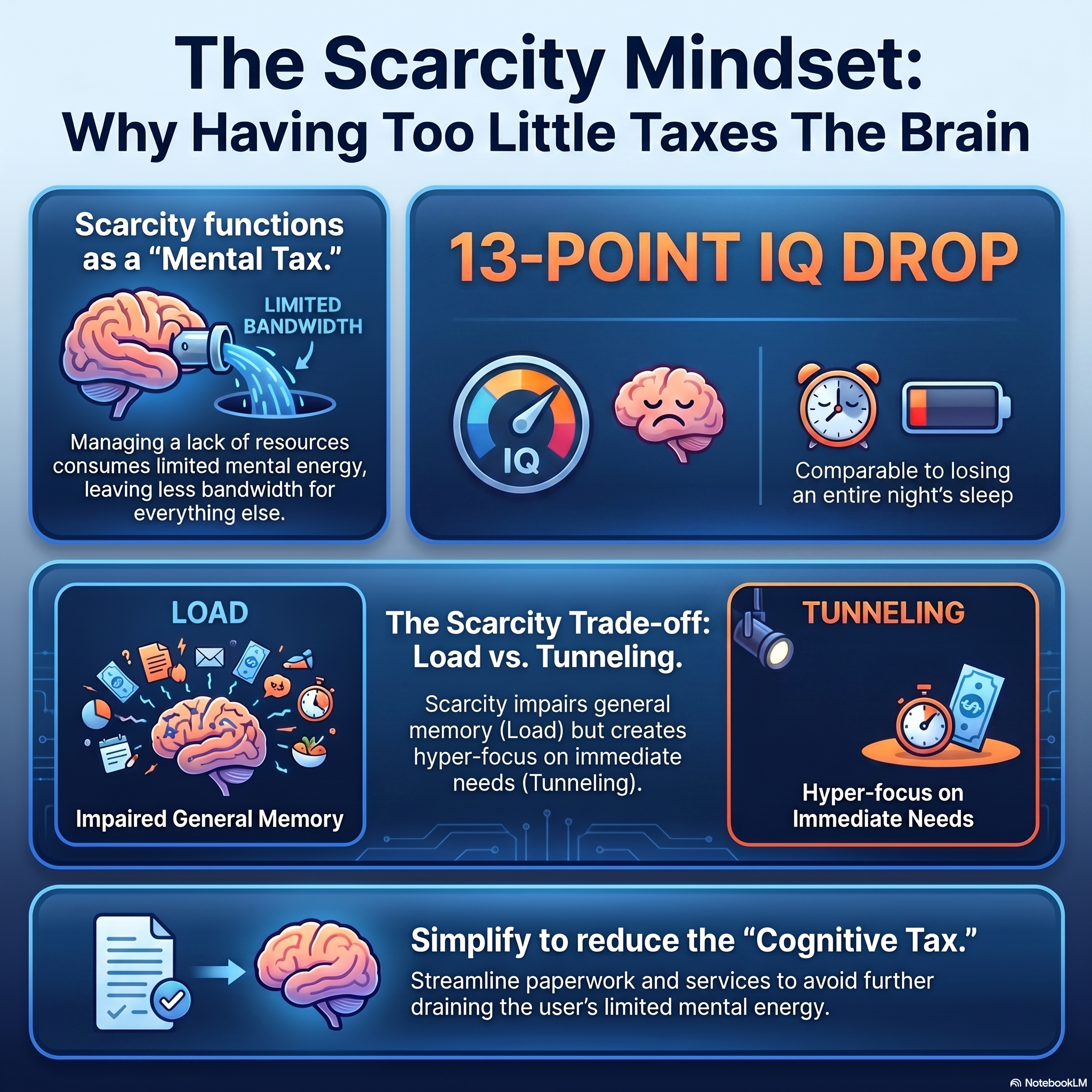
Behavioral scientists Sendhil Mullainathan and Eldar Shafir call this the ‘Scarcity Mindset,’ and it basically means that when we have ‘too little’ of anything – be it money, time, or even social connection – it takes over our brains. And listen, this isn’t about character flaws or a lack of smarts. It’s a systemic problem that drains your cognitive bandwidth. Think of it like your computer: when too many apps are running in the background, everything slows down, right? Well, your brain under scarcity is forced to use its precious processing power just to get through today, leaving less for… well, everything else.
Ever Wonder Why Scarcity Feels Like an IQ Tax? It’s Like Pulling an All-Nighter, Every Night.
One of the most eye-opening studies proving this ‘bandwidth tax’ happened in a New Jersey shopping center, followed by field work by Mani et al. (2013). Researchers threw financial curveballs, like a surprise car repair bill, at people. For folks with plenty of money, it was just a minor annoyance. But for those with low incomes? The mere thought of a big bill triggered a cognitive meltdown. Imagine that!
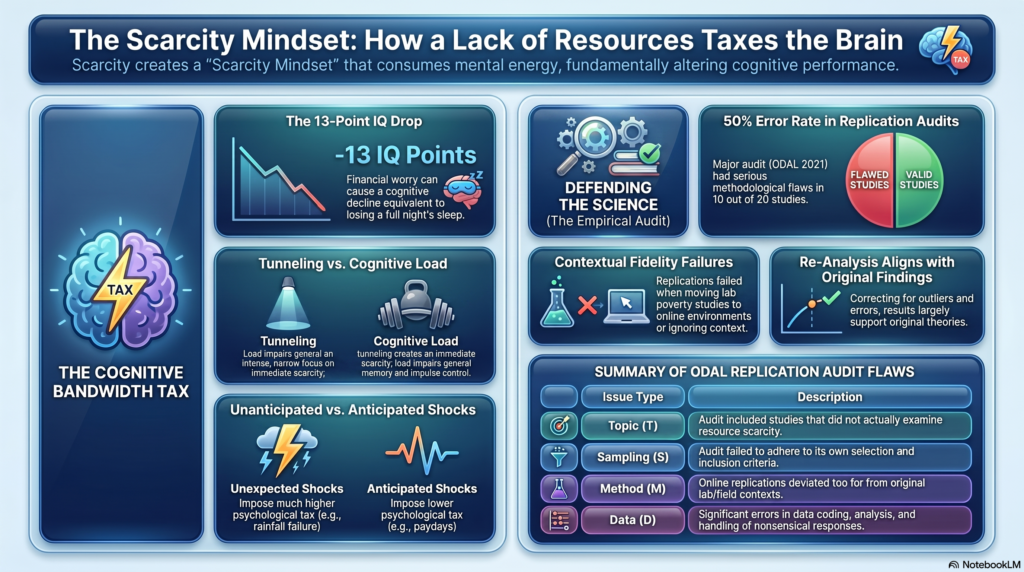
The data showed a performance drop equivalent to losing 13 points off your IQ – or like going a whole night without sleep. This is huge because it completely challenges that old idea that poverty is just about ‘bad choices.’ Nope, the research suggests poverty itself causes cognitive impairment, taxing the very mental resources you need to climb out of it. As the New South Wales (NSW) Government’s behavioral insights research puts it so simply:
- ‘Scarcity taxes our already limited cognitive bandwidth…’
- ‘A lack of resources reduces our cognitive bandwidth for long-term decisions, like planning for the future.’
Pretty impactful, right?
The ‘Tunnel Vision’ Trap: Why We Sometimes Act ‘Penny Wise and Pound Foolish’ Under Pressure.
This bandwidth tax often shows up as something called ‘Tunneling.’ Research by Lichand & Mani (2019) explains that scarcity creates a ‘substitution effect.’ Your brain gets laser-focused on the immediate crisis – what’s inside the tunnel – but then it totally overlooks everything outside of it.
This leads to that classic ‘penny wise and pound foolish’ situation, like what they observed with Brazilian farmers. When facing a potential drought, these farmers became super good at remembering less important things, like the exact number of rainy days. But guess what? They got significantly worse at tracking crucial stuff, like how much water was actually left in their tanks!
There’s a cool scientific detail here, Weber’s Law, which basically says that misjudging water volume actually increases as the volume grows, making the mental burden even heavier when the stakes are highest. Because immediate needs scream the loudest, scarcity forces us into an inefficient focus, often shutting the door on long-term opportunities. It’s like we’re locking ourselves in, even when we want to get out.
The Hidden Cost of Worry: Why Unexpected Shocks Hit Our Brains Hardest.
Here’s a fascinating insight from cognitive economics: not all scarcity feels the same. The ‘Cognitive Droughts’ research points out a big difference between expected and unexpected tough times.
- The Comfort of Knowing: For farmers receiving Brazil’s ‘Bolsa Família’ cash transfer, knowing when payday was coming didn’t create a huge mental burden. Because it was predictable, their brains could ‘smooth out’ the psychological experience. Less stress, you know?
- The Unseen Toll: But on the flip side, the threat of an unanticipated drought? That took a massive toll even before the rain stopped falling.
This reveals what scientists call the ‘ex-ante psychological toll.’ Simply worrying about what might happen acts like a hidden price tag on your mental bandwidth, making it harder to focus on anything else. It’s that constant, buzzing hum of risk that truly drains your brain. It tells us that not having a safety net is, in itself, a cognitive poison, messing with our performance long before any actual disaster strikes.
A Little Academic Drama: Why Some Critics Missed the Point on Scarcity Science.
Naturally, as the scarcity mindset concept became super important for policy, it also got a lot of academic scrutiny. A high-profile ’empirical audit’ by O’Donnell et al. (ODAL) tried to replicate 20 major scarcity studies, and their findings seemed to cast doubt on the whole field. However, the original researchers – Shah, Shafir, and Mullainathan (2023) – fired back with a strong rebuttal, pointing out critical flaws in 10 of those 20 audited studies.
What was all the fuss about? The debate really came down to four main types of errors in the audit that they felt misrepresented the original research:
- Wrong Topic! The audit included studies that had absolutely nothing to do with resource scarcity, like research on ‘luxury consumption’ or ‘marketing promotions.’ Talk about missing the mark!
- Sampling Slip-ups: The replicators didn’t even stick to their own rules for selecting studies, including some that just measured income instead of actually manipulating scarcity.
- Data Distortions: They apparently ignored unusual data points and mishandled missing values, which could make it look like there were no significant results when there actually were.
- ‘Methodological Infidelity’: And here’s the kicker – a major point of contention! The rebuttal highlighted the ‘MTurker issue.’ The auditors tried to use online participants (often with low attention spans) to mimic high-stakes lab or real-world experiments. Shah et al. called this a fundamental failure in ‘fidelity to the original work.’ It’s like trying to judge a five-star chef’s cooking by tasting a fast-food burger, you know?
Let’s Design Smarter: How to Stop Adding ‘Administrative Taxes’ to Already Stressed Minds.
If we agree that scarcity is a tax on our brains, then we have to admit that complex government services are an ‘Administrative Tax’ on people who are already struggling. Imagine a multi-page, jargon-filled form. For someone already under the immense cognitive load of poverty, that’s not just annoying; it’s often an impossible hurdle.
When your mental bandwidth is low, you naturally fall back on ‘intuitive, automatic, or biased thinking.’ To help, the NSW Government suggests three simple yet powerful strategies:
- Keep It Simple: Streamline steps to cut down on mental effort. Imagine forms that are pre-filled with information you’ve already provided – such a relief for a taxed brain!
- Good Timing: Reach out to people when they actually have the capacity to engage, not when they’re in the middle of a crisis.
- Make It Pop: Use bold fonts, bright colors, or personalized messages like ‘Pay Now’ stamps to make the most important information jump out and cut through that ‘cognitive fog.’
By making our safety nets less complicated, we stop asking people in poverty to pay a ‘bandwidth tax’ just to get the help they need to survive. It’s just common sense, really.
Thinking Differently: Unlocking Human Potential by Understanding Cognitive Limits.
The science of scarcity really makes us rethink how we view human potential. We need to shift our mindset from ‘helping the poor’ as just a nice thing to do, to seeing it as a critical mission: designing environments that actually respect our human cognitive limits.
High performance isn’t just about talent or ‘grit,’ is it? It’s also about having enough mental bandwidth. If scarcity is constantly draining the mental reserves of millions, then we have to ask ourselves: How much incredible human potential, how much raw intelligence, and how much productivity are we truly losing every single day by ignoring the cognitive architecture of poverty? Reducing this ‘bandwidth tax’ isn’t just about fairness; it’s the only way we can truly unlock the full, incredible capacity of the human mind. Let’s make it happen!