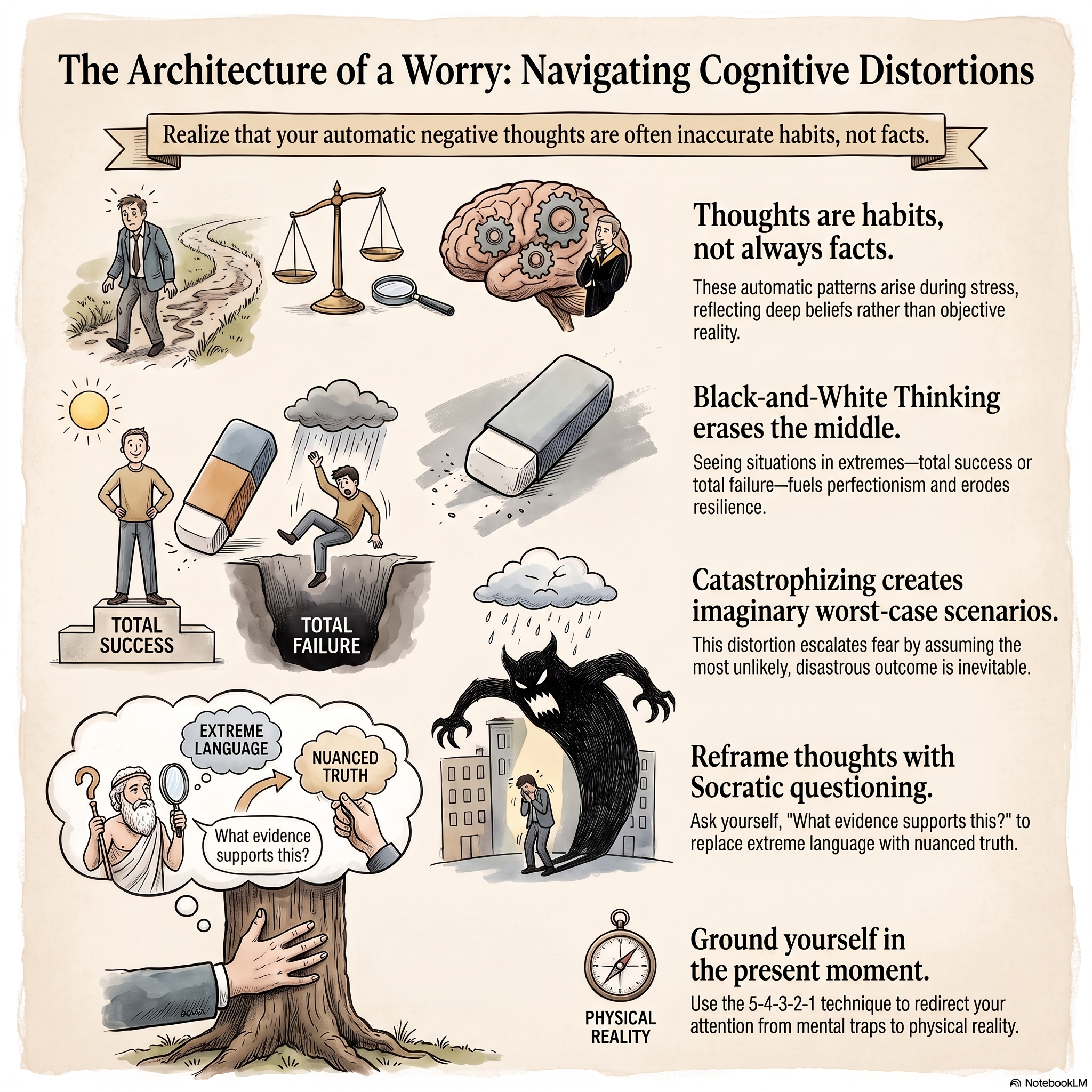
Ever feel like your mind has a mind of its own? We often think of ourselves as objective observers of life, but when stress, trauma, or tough times hit, our brains sometimes switch to “autopilot.” It’s like a “ghost in the machine” that starts generating quick interpretations of our lives, and let’s be honest, they’re often skewed, biased, and unnecessarily painful. When these thoughts become a habit, they can trap us, making our perception of the world seem more about our internal struggles than what’s actually happening around us.
In the world of Cognitive Behavioral Therapy (CBT), we call these patterns “cognitive distortions.” These aren’t new discoveries; psychiatrist Aaron Beck first identified them way back in the 1960s. Essentially, they’re habitual, inaccurate thought patterns that make us see situations more negatively than they really are. As a practitioner, I often think of them as old coping responses that have become rigid over time. They’re not objective truths; they’re more like old survival scripts that have simply outlived their usefulness.
The goal here isn’t to achieve “perfect” thinking (because, let’s face it, that’s not really a thing!). Instead, it’s about regaining your mental clarity and emotional control. By understanding how these thoughts sometimes betray us, you can start to use tools of psychological flexibility to rewrite your own internal stories. Ready to reclaim your reality? Here are six powerful takeaways to get you started.
Takeaway 1: Your Feelings Are Not Facts (Emotional Reasoning)
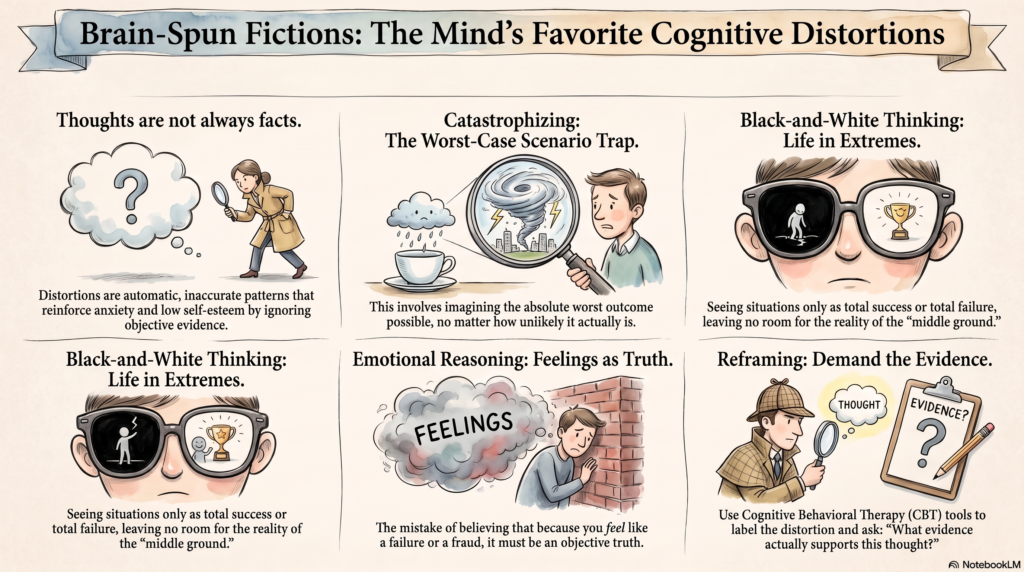
One of the most sneaky ways your mind can trick you is through emotional reasoning. This distortion convinces you that whatever you’re feeling right now is a reliable indicator of what’s true in the outside world. From a clinical perspective, it turns a temporary, shifting emotion into a fixed, heavy truth. For example, if you feel like a failure, emotional reasoning insists that you must be one, completely ignoring all those times you’ve succeeded or how genuinely difficult your current situation might be.
The real burden of this distortion is that it can create a self-fulfilling prophecy. When you treat a feeling as an undeniable fact, you stop looking for evidence that might prove otherwise. This can turn a tough moment into a deep-seated belief about yourself, making it incredibly hard to keep a balanced perspective, especially when you’re going through something difficult. Remember: “Emotional reasoning assumes feelings are facts. If you feel something is true, you believe it must be.”
Takeaway 2: The “Should” Trap and the Prison of Rigidity
Many of us live under the invisible weight of self-imposed rules we call “should” and “must” statements. In my practice, I see these as well-intentioned, but ultimately misguided, attempts at self-motivation. We think that if we’re tough on ourselves, we’ll perform better. But in reality, these statements build an internal prison of rigidity. When we inevitably fail to meet these impossible standards, we’re crushed by guilt. And when others don’t meet our standards? We’re often consumed by resentment.
This is crucial for understanding why our relationships can sometimes feel strained. When we project our “shoulds” onto others, we lose the ability to see them with nuance or empathy. We get fixated on their failure to meet our rigid script, rather than seeing the reality of the situation.
- “I should never make mistakes.”
- “They must know better.”
Takeaway 3: The Power of “Always” and “Never” (Overgeneralization)
Have you ever had a bad moment or a tough day and suddenly felt like your entire life was falling apart? That’s overgeneralization at work. It happens when we take a single negative event and blow it up, using it as a blueprint for our entire future. It’s essentially turning a bad day into a “bad life.” Phrases like “always” or “never” are huge red flags for this pattern. They reinforce a sense of helplessness, making it seem like your current struggles are inevitable and unchangeable. To fight back against this, you need to consciously replace these extreme terms with more nuanced and accurate descriptions.
- The Script: “I always mess up these presentations; I’ll never succeed here.”
- The Rewrite: “I struggled with this presentation, but I have performed well on others in the past, and I can learn from this experience.”
Takeaway 4: The 5-4-3-2-1 Anchor: Escaping the Trauma Time Machine
When you’re hit with stress or a traumatic memory, your brain can sometimes jump into what I call a “trauma time machine.” This activates your “fight, flight, or freeze” response, making your nervous system react as if a past danger is happening right now. That’s where the 5-4-3-2-1 Sensory Method comes in handy! It’s a fantastic grounding tool designed to pull you out of that overdrive by activating your parasympathetic nervous system – that’s the part of your body that calms you down and brings you back to a resting state.
By engaging all five of your senses with vivid specificity, you can literally anchor your brain in the “here and now.” Give it a try:
- 5 things you can see: Look for small, specific details around you, like a pattern on a wall, the way the light hits an object, or the color of someone’s shirt.
- 4 things you can feel: Notice the fabric of your clothing against your skin, the texture of your chair, the weight of your feet on the floor, or the temperature of the air.
- 3 things you can hear: Tune into background sounds, like distant traffic, a humming appliance, or birds chirping outside.
- 2 things you can smell: Focus on the scent of lotion on your hands, fresh air coming through a window, or the faint smell of coffee from another room.
- 1 thing you can taste: Take a sip of water, or notice any lingering taste from your last meal.
Takeaway 5: You Are Not Your Actions (The Labeling Fallacy)
Labeling is a pretty extreme form of all-or-nothing thinking where we slap a “global identity” on ourselves or others based on a single action. It totally oversimplifies the incredible complexity of being human. Instead of seeing a mistake as a behavior that can be corrected, labeling turns that mistake into a permanent character flaw. Switching to factual descriptions – like “I missed a deadline” instead of “I’m a failure” – encourages a growth mindset and lets you focus on problem-solving without attacking your fundamental self-worth. Remember this powerful mantra: “Label the Behavior, Not the Person.”
Takeaway 6: Catastrophizing: Why We Invent the Worst-Case Scenario
Ever found yourself jumping straight to the absolute worst, most unlikely outcome of a situation? That’s catastrophizing. For example, if a friend doesn’t text back right away, your mind might immediately assume they hate you. Or if you hear a strange noise at night, you might instantly picture an intruder in your house. This habit is deeply connected to an “intolerance of uncertainty.” Your brain uses catastrophizing as a misguided coping response, trying to “prepare” for the worst because it finds the unknown unbearable. But honestly, this escalation just keeps your body in a constant, exhausting state of high alert for threats that often don’t even exist.
Conclusion: Toward a More Balanced Reality
Recognizing these types of distortions, including the six we’ve talked about today and others like mind-reading or mental filtering, is the foundational step toward building what we call “psychological flexibility.” The next time you feel yourself spiraling, try using grounding tools like the 5-4-3-2-1 method, or even simple box breathing (where you inhale, hold, exhale, and hold again for a count of four each). By learning to reframe these automatic thoughts into more balanced, realistic descriptions, you can finally start to see the world as it truly is, rather than through the distorted lens of anxiety.
So, tell me, which “hidden script” of your mind will you choose to challenge today?