We often wear stress like a badge of honor, thinking it’s just a temporary hurdle. But what if I told you your body doesn’t see it that way? Every high-pressure moment – that looming deadline, a tough conversation, or a night of tossing and turning – it’s all logged on an invisible, internal ledger.
Your body is incredibly smart; it adapts to these challenges to keep you functioning. But here’s the kicker: that adaptation isn’t free. There’s a physiological ‘bill’ that eventually comes due, and the payment is often your physical and neurological health. This accumulating biological debt? We call it Allostatic Load.
1. The Invisible Ledger of Daily Life
Let’s be real, we all face stress. But think about it: your biology isn’t just reacting to stress; it’s actively adapting. While we’re wonderfully resilient, this constant adaptation comes with a cost. This ‘biological bill’ builds up over time, and it’s paid for with your own physical and neurological well-being. This is where Allostatic Load comes in.
2. Stress Isn’t Just a Feeling – It’s a Debt Called Allostatic Load
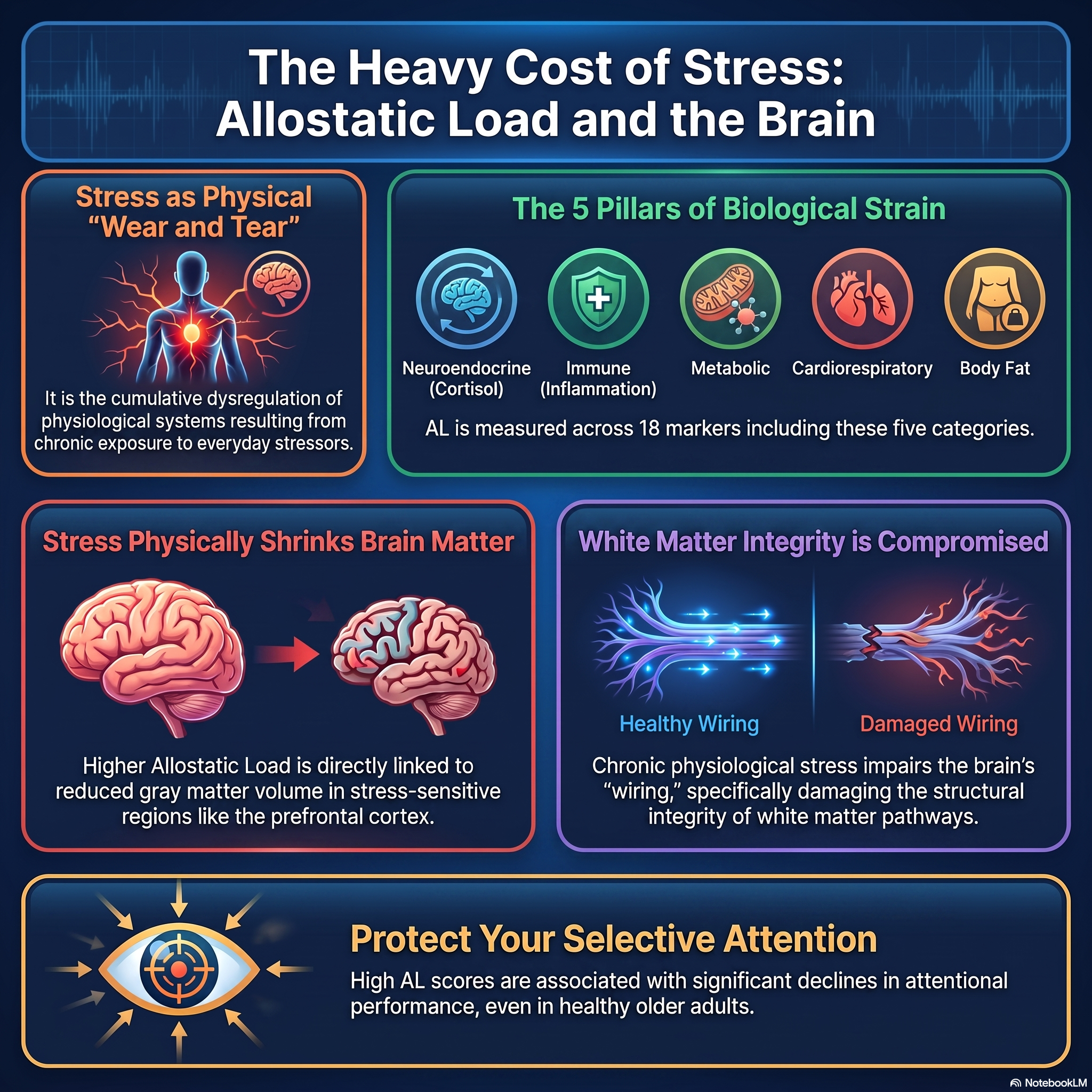
When experts talk about ‘stress’ in a clinic, they’re not just referring to a vague feeling. They’re talking about a measurable physical reality: Allostatic Load (AL). It’s essentially the cumulative ‘wear and tear’ on your body from continually being exposed to fluctuating physiological responses.
Modern neurobiology has really shifted our perspective. Stress isn’t just a fleeting psychological state; it’s a rigorous accounting system for your body’s strain. When your body is forced to constantly stay on ‘high alert’ to maintain stability – a process called allostasis – the very systems designed to protect you can start to degrade from overuse.
“Allostatic load is the price people pay for adapting to stress.” – Bruce McEwen, Neuroendocrinologist
3. Your Brain Is Reshaping Itself (Especially as You Age)
Now, let’s talk about your brain. Groundbreaking research, like a study published in Frontiers in Aging Neuroscience, reveals just how this biological debt physically impacts it. High Allostatic Load is directly linked to significant structural decay – we’re talking about lower gray matter volume and weaker white matter integrity.
And it’s not random damage! This impact targets key brain areas like your prefrontal cortex, hypothalamus, mammillary bodies, and parts of your basal ganglia (specifically the caudate and putamen nuclei).
The Alzheimer’s Paradox: A Stress-Induced Shortcut?
One fascinating discovery from the Frontiers study is this: while chronic stress can mimic ‘brain aging,’ it doesn’t seem to correlate with β-amyloid accumulation, which is the main protein marker for Alzheimer’s. However, high AL was associated with atrophy in the inferior temporal cortex and the parahippocampus – areas notoriously sensitive to Alzheimer’s.
What does this mean for you? It suggests that chronic stress might be creating a distinct biological pathway to cognitive decline, essentially ‘pre-staging’ your brain for dementia even before the disease officially arrives. It’s like stress is setting the stage for future problems.
How Do We Measure This Load?
To figure out your Allostatic Load, scientists track 18 different biomarkers across five key categories. Think of these as the metrics on your body’s internal credit report:
| Category | Examples of Biomarkers |
|---|---|
| Neuroendocrine | Cortisol, Epinephrine, DHEA-S (your adrenal function indicator) |
| Immune | Markers of systemic inflammation, like Interleukin-6 and hsCRP |
| Metabolic | Insulin, HDL/LDL cholesterol, creatinine (for kidney function) |
| Cardiorespiratory | Blood pressure, heart rate variability (SDNN/RMSSD) |
| Anthropometric | Physical measurements like BMI and waist-to-hip ratio |
4. The Nocebo Effect: Your Brain’s Pain “Volume Knob”
Have you ever heard of the placebo effect, where positive expectations can bring relief? Well, there’s a flip side called the Nocebo Effect. This is when negative expectations – driven by fear, anxiety, or even just watching someone else experience pain – can actively amplify your physical agony. It’s wild!
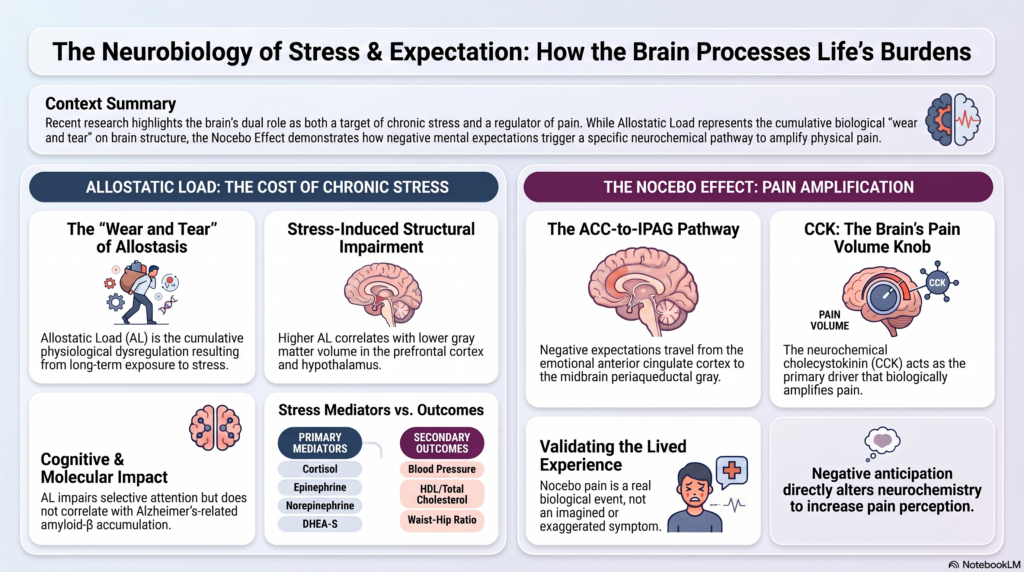
In a fascinating turn of events, two separate labs (at the University of Toronto Mississauga and McGill University) independently pinpointed the exact same neurochemical driver for this: cholecystokinin (CCK). They actually mapped out a precise biological pathway where CCK acts as a bridge, literally turning up your pain:
- Your Anterior Cingulate Cortex (ACC), which handles the emotional side of pain, releases CCK.
- This CCK then travels to the lateral periaqueductal gray (lPAG) in your midbrain.
- The lPAG then acts like a biological ‘volume knob,’ dialing up your body’s sensitivity to pain.
The coolest part? Researchers proved this isn’t ‘all in your head’ by using light-activated tools to switch this circuit on and off. They even discovered a drug, proglumide (a CCK antagonist), that could completely block the nocebo response. Pretty amazing, right?
“The brain is actively generating a real biological pain response through specific neural circuitry.” – Dr. Loren Martin
5. Your Recovery Rate Matters More Than the Stressor Itself
Here’s a crucial point: your ‘biological bill’ isn’t just about the stressor itself, but about how you handle the aftermath. Imagine two students taking the exact same high-stakes exam. Both might have the same spike in heart rate and cortisol (their Magnitude of Reactivity). But their long-term health outcomes can differ wildly based on their Rate of Recovery.
Stress is often unavoidable in life, I know. But lingering in that stressed state? That’s a choice your body pays for. If your physiological systems stay elevated long after a challenge has passed, your debt keeps growing. Being able to quickly return to your baseline is truly the ultimate biological competitive advantage.
The Four Factors That Add Up Your Physiological Strain:
- Amount of Exposure: How often and for how long you’re exposed to stressors.
- Magnitude of Reactivity: How intensely your system spikes (think how high your blood pressure climbs).
- Rate of Recovery: How quickly your body returns to normal after the stress is over.
- Resource Restoration: The specific activities you use to replenish your system.
6. Sleep: Your Ultimate Restoration Tool
If Allostatic Load is the debt, then restoration is your repayment plan. And guess what? Sleep is the most essential activity for replenishing all those resources you used during stressful times. Sleep deprivation is a real double-edged sword: it’s both a consequence of high stress and a direct contributor to your Allostatic Load, literally weakening your brain’s defenses.
The Progression of Physiological Strain:
This is how stress can escalate within your body:
| Stage | Description | Examples |
|---|---|---|
| Primary Mediators | The initial signaling chemicals released in response to stress. | Cortisol, Epinephrine, Norepinephrine, DHEA-S |
| Secondary Outcomes | The physical damage that accumulates from prolonged stress. | High Blood Pressure, Elevated Cholesterol, Increased Waist-to-Hip Ratio, Kidney Strain |
7. Balancing Your Biological Ledger
The beauty of allostasis – your body’s amazing ability to find stability through change – reminds us how flexible our systems are. But even that flexibility has its limits. When we ignore our Rate of Recovery, we’re essentially letting Allostatic Load reshape our brains and crank up the volume on our pain.
Looking ahead, the goal isn’t to get rid of all stress; that’s just not realistic. Instead, it’s about mastering the art of restoration. By understanding these specific pathways – from the CCK in our midbrain to the DHEA-S in our blood – we can start to treat recovery as a biological necessity, not just a luxury.
So, how will you choose to restore your resources tonight?
While adapting to life’s challenges comes at a price, the biological debt of chronic stress is a bill we absolutely can manage through intentional restoration. Let’s start paying ourselves back!