Ever feel like the world is spinning faster and faster? You’re not alone! Our workplaces are constantly changing, new demands pop up daily, and those super-specific skills you worked so hard to get? Well, their shelf life seems to get shorter every year. It’s tempting, once you’ve landed that job, to just settle in and think, “Okay, I’m good. I’ll just maintain.” But as someone who thinks a lot about strategy, I have to tell you: simply relying on what you already know isn’t playing it safe; it’s actually a quick slide into becoming irrelevant.
You see, true mastery isn’t something that just happens by accident over time. It’s a purposeful, rigorous journey – almost like a “practice discipline” that needs careful self-awareness. We often struggle to grow because we just don’t understand how we learn, and we can easily fall for our own biased ideas about what we’re good at (or what we’re really missing).
Getting truly excellent in your career often feels like you’re going against your instincts. To really kickstart your progress, you need to look beyond your gut feelings and align your development with what behavioral science tells us about building capability. So, let’s dive into five surprising truths that will totally change how you think about your own path to mastery!
1. Your Degrees Only Count for 10% of Your Success
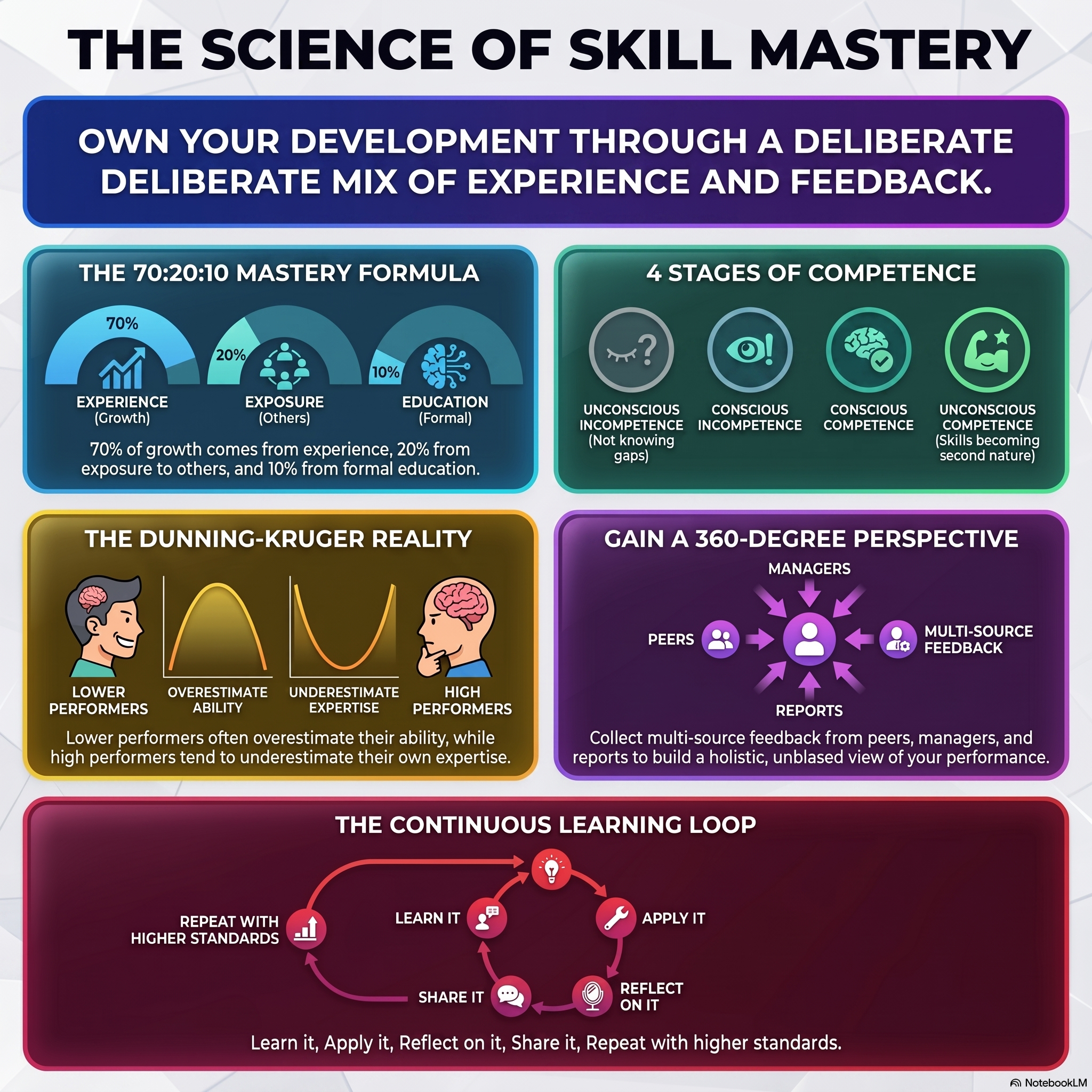
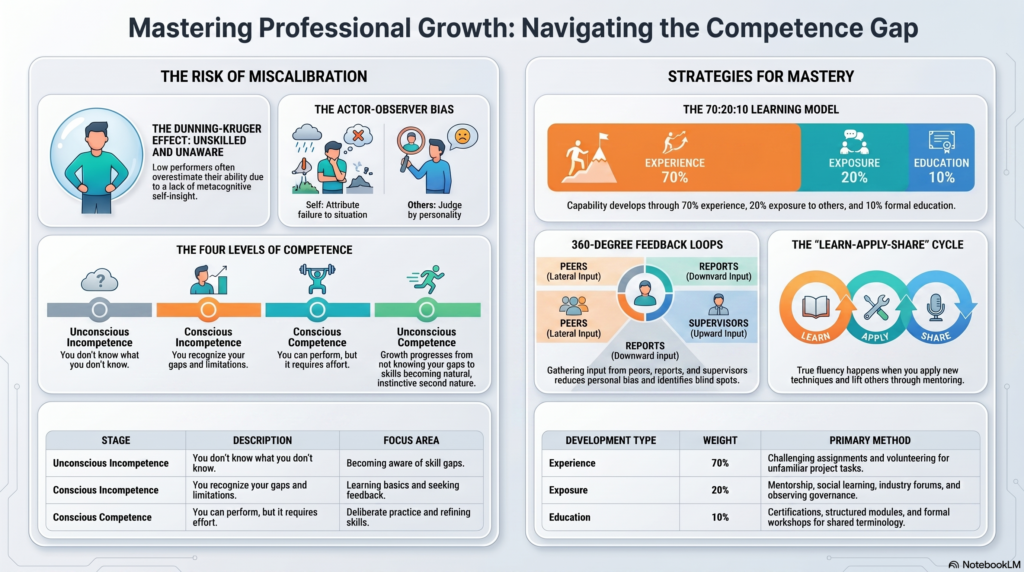
We all know formal education is important. It gives us the basic language and concepts for our careers, right? But here’s the kicker: it’s really just the starting line. If we want to understand how real capability grows, we need to look at something called the 70:20:10 Model. This handy framework breaks down how we truly develop:
- 10% Formal Education: Think traditional courses, certifications, and online learning. These are great for getting everyone on the same page with terminology, but they rarely make you truly fluent in a skill.
- 20% Exposure (Social Learning): This is what I like to call the “borrowed insight” phase. It’s about high-level observation – like really listening to how a mentor tackles a tough decision, or noticing the precise words and rhythm someone uses when leading a critical meeting. You’re learning by watching and listening!
- 70% Experience (Applied Learning): This is where the magic truly happens! Real growth is all about doing. It’s when you volunteer for tasks that push you out of your comfort zone, or when you try out new tools in messy, real-world situations. This is hands-on learning, and it’s powerful.
There’s a bit of an irony here, actually. Many organizations are hesitant to invest in developing their “mobile professionals,” fearing they’ll just take those shiny new skills to a competitor. Yet, research consistently shows that investing in your team’s development actually helps keep them around longer! Regardless of what your employer does, you absolutely must own this mix yourself. And remember, simply doing the same year of work ten times isn’t ten years of experience; it’s just reinforcing the same habits. True experience is intentional, always pushing you forward.
“Education’s purpose is to replace an empty mind with an open one.” – Malcolm Forbes
2. Frustration is the Most Critical Stage of Progress
Learning a new skill is definitely a journey, and psychologists often talk about the “Four Levels of Competence” – taking us from being completely unaware to mastering something instinctively. Most of us hit a really tough spot at Stage 2: Conscious Incompetence.
This is that moment when you finally realize, “Oh boy, I really don’t know this!” It’s when the sudden awareness of your limitations can seriously zap your motivation. But guess what? That frustration you’re feeling? It’s actually the biggest signal that real learning is finally beginning! Strategically, this is exactly when you need to break things down into tiny “micro-goals” and commit to structured practice.
The numbers don’t lie: moving from Stage 2 to Stage 3 (where you’re consciously competent) can take around seven months if you’re learning solo. But if you get some professional coaching? That timeline can shrink to just three months! Plus, a structured approach during this tricky transition can boost your consistency by a whopping 40%. So, seeing your own incompetence isn’t a failure at all; it’s actually the essential step to unlocking that fantastic 40% gain in consistency that defines a true professional.
3. The Dunning-Kruger Effect Might Just Be Math, Not Hubris
You’ve probably heard of the Dunning-Kruger (DK) effect, right? It’s that idea that people who aren’t very good at something tend to overestimate their abilities. We often brush it off as simple arrogance or a “metacognitive deficit.” But hold on, modern researchers are giving the DK effect a fresh look, suggesting it might be less about personality flaws and more about “stochastic noise” – basically, mathematical quirks!
First, let’s consider the Statistical Artifact explanation. Imagine a test scored from 0-100. If someone is brilliant and scores a 95, where can they go in their self-prediction? Only “down.” They’re almost mathematically forced to underestimate their future performance. On the flip side, someone scoring at the bottom has tons of room to predict higher and almost no room to predict lower. It’s just how the numbers work when you’re at the edges!
Second, there’s the Rational Bayesian model. This view suggests our brains are like “naive statisticians.” When you have limited evidence from just one task (like a single test), your brain tends to do an “internal regression to the prior mean.” What does that mean? It means your brain combines what just happened with what it generally believes about itself (which is often a little optimistic). So, if you bomb a really difficult test, your “rational” brain might assume that low score was an outlier and nudge your estimate back towards your usual, higher self-belief. So, in this light, the Dunning-Kruger effect isn’t necessarily a character flaw; it’s more about the mathematical reality of how we process information when things are uncertain.
4. You Are Your Own Worst Observer
Even if you’re super self-aware, every single one of us has a blind spot thanks to something called the Actor-Observer Bias. This little cognitive trick makes us judge others’ failures by their personality (“Oh, they messed up because they’re disorganized!”) while we blame external circumstances for our own slip-ups (“I messed up because the project brief was unclear!”).
This bias creates a huge gap between how we see ourselves and how our colleagues and organization truly perceive us. To bridge that gap, you absolutely need 360-degree feedback (or even 720-degree, if you include customers and vendors!). Getting input from multiple sources gives you a complete picture that you just can’t get by only looking inward.
“Realizing that others may not view them how they want to be seen can inspire employees to devote more effort to their development.” – AIHR
It can be tough to hear, but by confronting the reality that your “situational” excuse might be seen by your peers as a “dispositional” trait (meaning, a part of your personality), you gain the crystal-clear understanding you need to adjust your professional path.
5. You Must “Own” Your Development Project
Mastery really requires a shift in how you think: you are the CEO of your own talent! To make sure your skills never stagnate, you need to put the Cycle of Excellence into action. This isn’t just a simple loop; it’s a spiral that constantly moves upward as you raise your own internal standards:
- Learn it: Absorb new knowledge and skills.
- Apply it: Put what you’ve learned into practice.
- Reflect on it: Think about what worked, what didn’t, and why.
- Share it: Teach or explain it to someone else.
- Repeat, with higher standards: Go back to step one, but aim for a deeper understanding and better execution.
That “Share it” phase is incredibly powerful – it’s the ultimate reinforcement of that 70% experience-based learning we talked about earlier. When you teach someone, it forces you to translate those implicit “gut feelings” into clear, explicit instructions. It reveals any shakiness in your own understanding and pushes you from just “doing it without thinking” (Unconscious Competence) back into a state where you can analyze and truly improve the process. By guiding others, you solidify your own mastery and ensure you’re always repeating the cycle with progressively higher standards.
Conclusion: The Mastery Question
So, there you have it! Growth is an active, social, and ongoing process. It means leaning into the discomfort of conscious incompetence, actively seeking objective feedback to cut through your biases, and understanding that our brains are often just “naive statisticians” trying to make sense of limited information.
To check in with your own professional journey, ask yourself this important question: “In which of my most critical professional skills am I currently confusing ‘staying safe’ with ‘standing still’?”
Identifying where you truly stand isn’t a sign of weakness; it’s actually your first step toward a huge strategic advantage. In today’s economy, where being agile is rewarded and standing still is punished, pausing isn’t just a break – it’s the quiet act of falling behind. Let’s keep moving forward!