For generations, we’ve told ourselves a comforting tale: that deep within each of us lies an unwavering moral compass, a core of honesty and compassion forged in granite, capable of weathering any storm. We imagine our character as a fixed star, guiding our choices regardless of the chaos around us. But what if this cherished belief is merely a beautiful deception? What if modern psychology reveals a chilling reality: that the very essence of your ‘values’ is often just a fleeting shadow, cast by the room you happen to be standing in?
This is the audacious whisper of the “Situationist Critique,” a compelling body of research that gently, yet firmly, peels back the veneer of our self-assured character. It proposes that our actions are not so much a reflection of a deep-seated soul, but rather a profound echo of our immediate environment. If the situationists are right, your character isn’t a solid, unyielding rock; it’s more like a shimmering reflection, constantly changing with the context you inhabit.
The Orchestra of Virtue: A Skill, Not a Song We’re Born Knowing
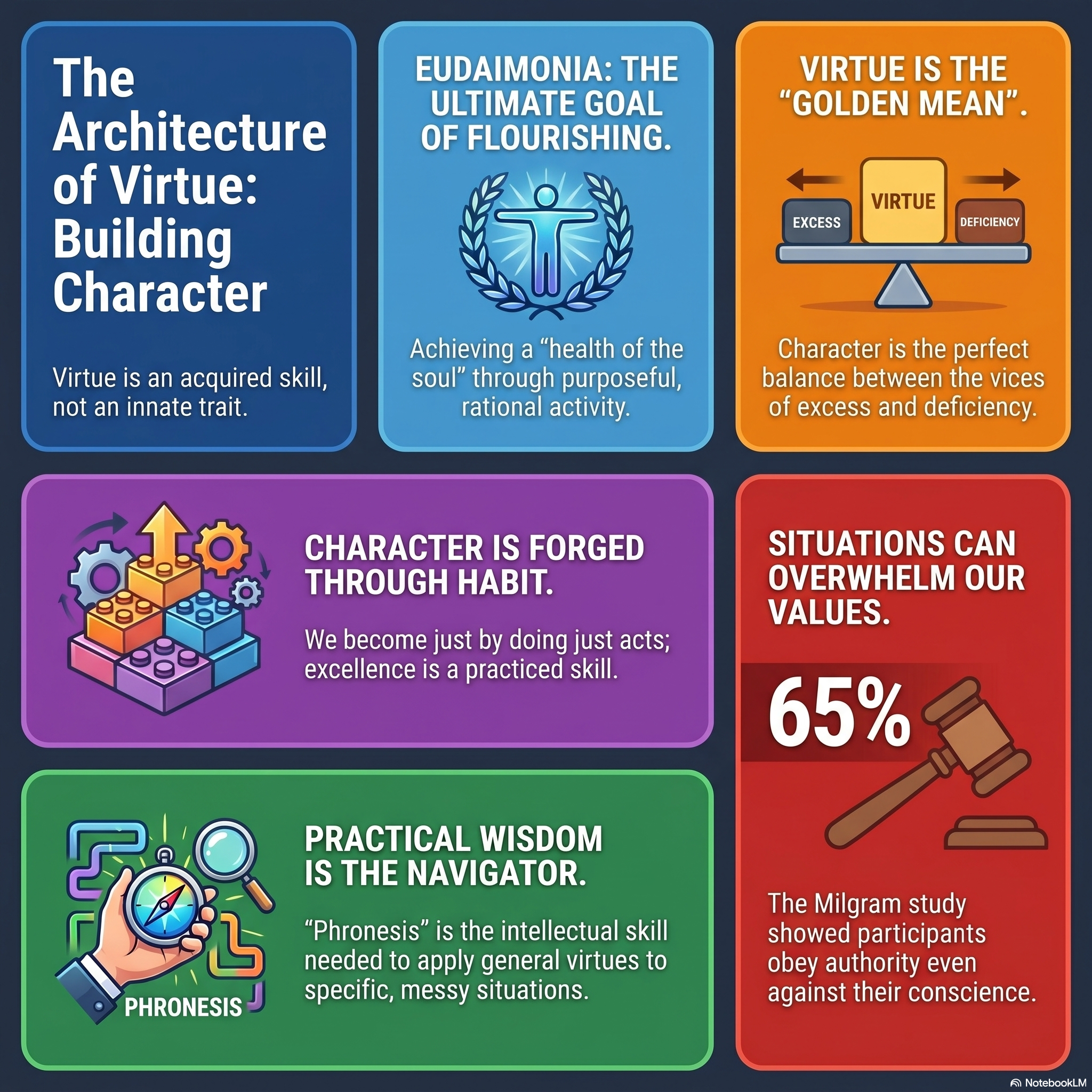
We often perceive “goodness” as an innate reflex, a button pressed effortlessly. Yet, ancient wisdom, particularly from the great Aristotle, paints a far more demanding picture. He saw ethical development not as a birthright, but as an elite skill, much like the virtuosity of a master musician or a brilliant painter. You don’t arrive in the world with a brush already in hand, or fingers dancing across ivory keys; you become a painter or a pianist through grueling, passionate repetition.
In this profound analogy, virtue becomes a muscle. It’s not a gift you either possess or lack, but a strength that must be painstakingly built, note by note, stroke by stroke. Just as a concert pianist dedicates years to practicing scales, perfecting technique to make a masterpiece seem effortless, the ethical agent must habituate themselves to noble deeds. It is this unwavering commitment to practice that, over time, sculpts and perfects the person.
“Neither by nature… nor contrary to nature do the virtues arise in us; rather we are adapted by nature to receive them, and are made perfect by habit.”
The Unsettling Symphony of Milgram: When Values Tremble Under Pressure
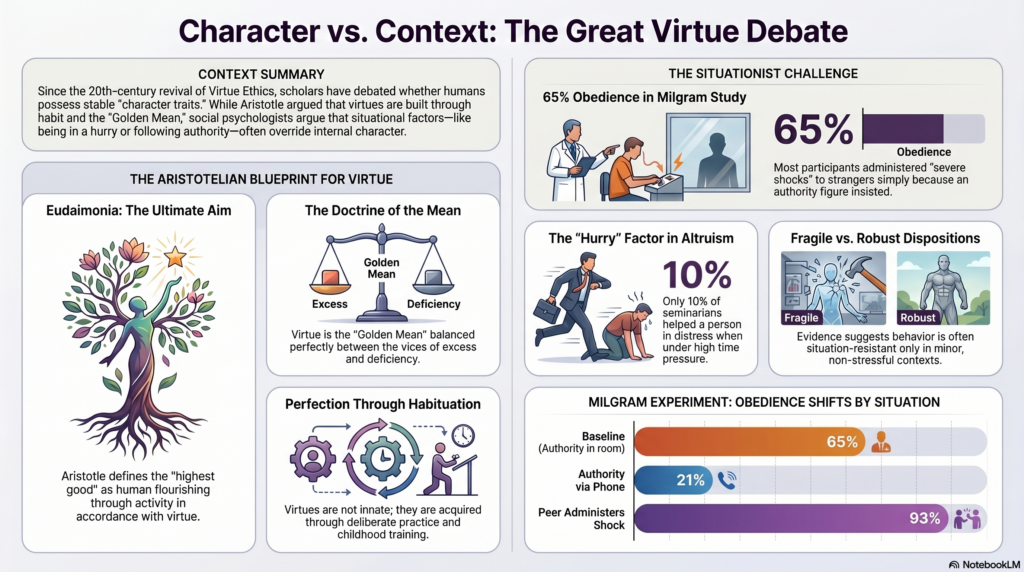
Perhaps no story illustrates the startling fragility of our perceived moral compass more dramatically than Stanley Milgram’s infamous experiments on “destructive obedience.” Picture this: a group of ordinary individuals, asked to participate in a learning study, found themselves in a chilling dilemma. While psychiatrists predicted only a tiny fraction of the population – perhaps 1-2% – would ever administer a lethal shock to a stranger, the actual data unveiled a haunting readiness to inflict harm, painting a terrifying gap between our declared values and our behavior under duress.
- The Baseline Betrayal: A staggering 65% of participants, despite hearing recorded screams of agony from a ‘victim,’ administered the maximum 450-volt shock. Their proclaimed compassion was drowned out by the authority’s command.
- The Proximity Effect: When the authoritative voice was no longer physically present but gave orders via telephone, the curtain of obedience began to tear, and participation plummeted. The unseen made it easier to resist.
- The Subsidiary Bypass: When subjects were allowed to distance themselves from the direct act, performing only minor clerical tasks while someone else ‘administered’ the shock, obedience soared to an astonishing 93%. Our ability to participate in cruelty seems to grow with every step of separation from the ‘dirty work.’
Milgram’s unsettling narrative suggests that even those who genuinely believe themselves compassionate can participate in severe cruelty if the situational frame allows for psychological distance or perceived diffusion of responsibility. Our values, it seems, are surprisingly delicate when placed under the formidable pressure of specific circumstances.
The Rare Maestros of Morality: A Da Vinci of Virtue
Aristotle, with his characteristic honesty, acknowledged the profound scarcity of true excellence. He understood that achieving full virtue was as rare and remarkable as discovering a musical genius. He envisioned the “Virtuoso” of ethics – an individual who attains a level of “consummate and seemingly effortless mastery” in navigating the complex melodies of morality. Most of us, he suggested, are merely students, diligently practicing our scales in an imperfect world, striving for a harmony we rarely fully achieve.
To strike the “Golden Mean” – that perfect, nuanced balance between two vices – is a target incredibly difficult to hit. It demands Phronesis, or practical wisdom, a deep, intuitive understanding of the moment, far beyond a simple mathematical average. To be truly virtuous, one must act towards the right person, to the right extent, at the right time, and with the right motive – a symphony of precision and discernment.
The Whisper of the Coin: When Tiny Factors Chart Our Course
Traditional ethics often rests on the concept of “Robust Dispositions” – the belief that an honest person remains honest, come rain or shine. But the situationists invite us to consider a different story: perhaps we are more like weather vanes than granite pillars, sensitive to the slightest external breeze. They argue that minor, seemingly trivial factors can sometimes trigger profound “virtuous” behavior more effectively than a lifetime of deeply held values.
Consider the captivating tale of the “phone booth study” (Isen and Levin, 1972). Imagine an ordinary person, going about their day. Then, a small, unexpected discovery: a stray coin, glinting in the coin return of a public phone booth. This minuscule act of finding ten cents drastically, almost magically, increased their likelihood of helping a stranger in need. If a mere ten-cent coin can dictate our “compassion,” the grand narrative of a firm, unshakeable character begins to sound suspiciously like a psychological myth.
“Since it is possible to explain our ordinary belief in character traits as deriving from certain illusions, we must conclude that there is no empirical basis for the existence of character traits.”
The True Aristotle’s Encore: A Cognitive-Affective Return
Yet, the story doesn’t end with a surrender to pure situational determinism. Modern defenders of virtue, returning to a richer, “cognitive-affective” reading of Aristotle, offer a powerful counter-narrative. This perspective rejects the notion of virtue as a robotic reflex or a pre-programmed trait. Instead, it posits that “True Virtue” is an active, ongoing commitment – a lifelong journey of bringing our swirling thoughts and deep-seated emotions into a disciplined harmony with our most cherished values.
This renewed understanding suggests that the Situationist Critique, rather than dismantling Aristotle, actually illuminates his original intent. Virtue isn’t a static destination, but a disciplined, reflective process of integration. It’s the daily, conscious project of ensuring that our internal feelings align with our rational choices, regardless of the ‘room’ we find ourselves in – a constant, internal orchestration.
The Architect’s Blueprint: Designing Our Moral Landscape
If we accept this compelling narrative – that we are not yet “Da Vincis of Virtue” – then our primary ethical duty transforms. It shifts from merely trusting an elusive inner strength to becoming wise architects of our own lives. Since we now understand how sensitive our character is to the pressures of circumstance, we must cultivate the wisdom to meticulously manage our surroundings.
We must recognize the profound, shaping power that “the room” holds over us and choose our social architecture with the utmost care and intention. The evidence compels a difficult, yet liberating, self-reflection for any ethical strategist. You must ask yourself: do you truly trust your character to hold firm in any storm, or have you, perhaps, simply been fortunate enough to avoid the wrong circumstances? The highest form of wisdom may not be merely “knowing yourself,” but intimately knowing which environments will allow your best self to truly flourish and survive.