
Unlocking Well-being: The Proven Physical and Psychological Benefits of Journaling
1. Introduction: The Convergence of Narrative and Biology
The human drive to externalize internal experience—to translate the amorphous realm of thought and emotion into the fixed, linear structure of language—is a behavior as ancient as literacy itself. For centuries, this practice, manifested as diary-keeping or journaling, was relegated to the domains of literature, history, or spiritual confession. It was viewed as a repository for memory or a tool for self-reflection, but rarely as a biological intervention. However, the last forty years of research in the fields of psychoneuroimmunology, cognitive psychology, and neuroscience have radically revised this perspective. We now understand that the act of journaling is not merely a psychological unburdening but a physiological regulatory mechanism that exerts measurable effects on the immune system, cardiovascular health, and neural architecture.
This report provides an exhaustive analysis of the scientific literature surrounding journaling. It moves beyond anecdotal endorsements to examine the rigorous empirical evidence—randomized controlled trials (RCTs), meta-analyses, and neuroimaging studies—that establish writing as a potent therapeutic tool. The scope of this inquiry encompasses the mechanisms of action, ranging from the down-regulation of amygdala activity through “affect labeling” to the acceleration of wound re-epithelialization via stress hormone modulation. Furthermore, it delineates the critical distinction between therapeutic processing and maladaptive rumination, offering a nuanced guide to the protocols that unlock well-being.
2. Historical Evolution: From Catharsis to Cognitive Processing
2.1 The Pre-Scientific Era and Early Psychoanalysis
The roots of therapeutic writing can be traced to ancient civilizations. In Rome, Greece, and Egypt, writing was utilized as a form of “catharsis”—a purgation of the soul.1 The simple act of inscribing one’s burdens onto parchment was believed to provide relief, a concept that persisted largely examined until the late 19th century.
The formal medicalization of this practice began with the emergence of psychology as a distinct scientific discipline. Sigmund Freud’s “talking cure” was predicated on the hydraulic model of emotion: suppressed affect was viewed as a pathogen, a pressure that needed to be released to restore health.1 While Freud emphasized verbal articulation, the World Wars catalyzed a shift toward the written word. Soldiers in the trenches and civilians amidst the rubble turned to diaries not just to record history, but to process the incomprehensible trauma of industrialized warfare. In the absence of formal psychological support, the journal became the therapist.1
2.2 The Cognitive Turn: Progoff and the Intensive Journal
By the 1960s, the practice began to gain structural rigor. Dr. Ira Progoff, a psychologist and student of Carl Jung, developed the “Intensive Journal Method.” Progoff moved beyond the diary as a mere log of daily events, proposing instead a structured system of non-judgmental, open-ended writing designed to facilitate holistic self-discovery.1 Progoff’s work laid the groundwork for viewing the journal as a “psychological laboratory,” a controlled space where the writer could interact with their own subconscious.
2.3 The Pennebaker Revolution: Inhibition Theory
The pivotal moment in the scientific study of journaling occurred in the 1980s with the work of social psychologist James Pennebaker at the University of Texas at Austin. Pennebaker challenged the prevailing notion of simple catharsis. He proposed Inhibition Theory, which posits that the active inhibition of thoughts and feelings regarding traumatic events is a form of chronic physiological work.3
According to this model, keeping a secret or suppressing a trauma places the body in a state of low-grade, chronic inhibition. This inhibition serves as a cumulative stressor, keeping the autonomic nervous system in a state of sympathetic arousal (fight-or-flight), which over time degrades immune function and cardiovascular health. Pennebaker hypothesized that the act of expressive writing releases this inhibition, thereby removing the stressor and allowing the body to return to homeostasis.5
This theory launched the “Expressive Writing Paradigm,” a standardized protocol used in hundreds of subsequent studies: writing for 15–20 minutes for 3–5 consecutive days about one’s deepest thoughts and feelings surrounding a trauma.7 The results of these early studies were startling, showing that this brief intervention could reduce physician visits for months after the writing ceased.8
3. Theoretical Frameworks: Why Writing Heals
While Inhibition Theory provided the initial spark, subsequent research has revealed that the mechanisms of journaling are far more complex than simple “venting.” In fact, venting—the unbridled expression of anger or sadness without cognitive processing—has been shown to be ineffective or even deleterious.4 Current understanding relies on a convergence of several psychological theories.
3.1 Cognitive Adaptation and Narrative Formation
The most robust alternative to inhibition theory is the Cognitive Adaptation Theory. This suggests that trauma shatters an individual’s fundamental assumptions about the world (e.g., “the world is safe,” “I am a competent person”). The ensuing distress comes from the fragmentation of the self-narrative.
Journaling facilitates the reconstruction of meaning. Linguistic analysis of journals from successful interventions reveals a specific pattern: participants who experience the greatest health benefits tend to increase their use of causal words (e.g., because, reason, realize) and insight words (e.g., understand, know) over the course of the writing sessions.9 This indicates that the writer is not merely re-living the event but is actively structuring it into a coherent story with a beginning, middle, and end. This “narrative formation” transforms the trauma from a chaotic, intrusive sensory experience into a structured memory that can be filed away, reducing the need for the brain to constantly ruminate on it.4
3.2 Exposure and Habituation
From a behavioral psychology perspective, journaling functions as a form of Imaginal Exposure. By repeatedly writing about a traumatic event in detail, the individual confronts the feared stimuli (the memory) in a safe environment. Over repeated sessions, the conditioned emotional response (anxiety/fear) diminishes—a process known as habituation or extinction.4 This explains why participants often report high distress on the first day of writing, which significantly abates by the third or fourth day. The trauma loses its emotional sting through repeated, voluntary engagement.
3.3 Self-Regulation and Affect Labeling
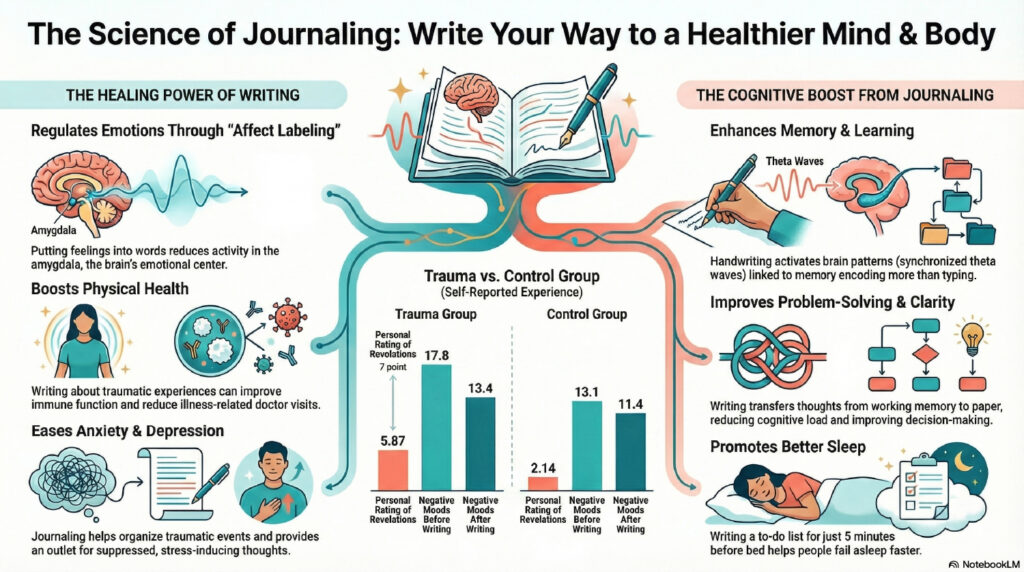
A more modern neuroscientific framework views journaling as a tool for Emotional Self-Regulation. This theory posits that the act of translating emotion into language (“Affect Labeling”) engages the prefrontal cortex, which exerts inhibitory control over the amygdala.12 This neural “seesaw” allows the individual to dampen emotional reactivity not by suppressing it, but by processing it through the brain’s linguistic centers. This mechanism is detailed further in the Neuroscience section of this report.
4. Psychoneuroimmunology: The Biological Impact
The most compelling evidence for the power of journaling comes from Psychoneuroimmunology (PNI), the study of the interaction between psychological processes and the nervous and immune systems. The data indicates that the cognitive changes induced by writing translate directly into measurable shifts in immune competence and physical healing.
4.1 Immune Competence: CD4+ Lymphocyte Counts
One of the most rigorous tests of the journaling hypothesis involved patients with HIV. In the late 1990s and early 2000s, researchers sought to determine if reducing the stress of HIV infection through expressive writing could influence the immune markers of the disease.
In a randomized controlled trial involving 37 HIV-infected patients, participants were assigned to write about emotional topics or neutral control topics (e.g., describing their shoes or the room) for four days, 30 minutes per session.13 The primary outcome measure was the count of CD4+ lymphocytes, the white blood cells that are the specific target of the HIV virus and a proxy for immune system strength.
The results were statistically significant: patients in the emotional writing condition showed a gradual increase in CD4+ lymphocyte counts relative to the control group.6 While viral loads decreased in both groups (likely due to medication adherence), the differential boost in CD4+ counts in the writing group suggested that the intervention buffered the immune system against the deleterious effects of stress-induced cortisol, which is known to be immunosuppressive.14 Although long-term follow-up suggested these effects might attenuate after three months 6, the finding that a cumulative two hours of writing could alter the cellular landscape of a chronic viral infection is a profound validation of the mind-body connection.
4.2 Antibody Response to Vaccination
The immune system’s ability to mount a defense against a new pathogen can be measured by antibody response to vaccination. Stress is known to impair this response. Studies have utilized the Hepatitis B vaccine as a challenge model to test the efficacy of expressive writing.
In these studies, participants who engaged in expressive writing regarding stressful life events prior to receiving a vaccination demonstrated significantly higher antibody titers (concentrations) in the weeks following the injection compared to controls.15 This suggests that journaling may act as an “adjuvant” to medical treatment, clearing the physiological noise of stress to allow the immune system to focus resources on the new threat. The timing is critical; the intervention appears most effective when it precedes the immune challenge, effectively “priming” the system.17
4.3 Accelerated Wound Healing: The Punch Biopsy Studies
Perhaps the most tangible evidence of journaling’s physiological power is found in wound healing research. The body’s ability to repair tissue is highly sensitive to cortisol; elevated stress hormones slow down the inflammatory and proliferative phases of healing.
Researchers at the University of Nottingham and University of Auckland developed a protocol using “punch biopsies”—standardized, medically induced wounds (typically 4mm deep) on the inner arm—to measure healing rates in a controlled manner.3
Key Study Findings:
- Methodology: Healthy volunteers wrote for 20 minutes a day for three consecutive days. Two weeks later, they received a punch biopsy.
- Results: By day 11 post-biopsy, 76% of the expressive writing group had fully healed wounds, compared to only 42% of the control group.8
- Implication: The writing group healed nearly twice as fast.
This paradigm was extended to surgical patients. In a randomized controlled trial with 76 patients undergoing elective laparoscopic bariatric surgery, those who engaged in pre-operative expressive writing showed improved wound healing metrics compared to those who wrote about daily activities.3
The Importance of Timing:
Further research has clarified that writing before the wound occurs (preventative/buffering) is consistently effective. Writing after the wound has occurred yields mixed results.18 Writing immediately after a physical trauma might induce acute stress that temporarily interferes with the initial inflammatory stage of healing. This underscores the role of journaling as a preventative maintenance tool that lowers baseline allostatic load.
4.4 Cardiovascular Health and Autonomic Regulation
Chronic stress is a known risk factor for hypertension and cardiovascular disease. By reducing the “inhibition work” of holding back emotion, journaling can lower the resting tone of the sympathetic nervous system.
Blood Pressure:
Longitudinal studies involving patients with essential hypertension have shown that expressive writing can lead to clinically significant reductions in both systolic and diastolic blood pressure over a period of months.20 While heart rate and blood pressure may transiently increase during the emotional writing session (as the participant relives the event), the long-term effect is a lowering of the baseline—a phenomenon known as the “inoculation effect.”
Heart Rate Variability (HRV):
HRV is a gold-standard measure of the balance between the sympathetic (fight-or-flight) and parasympathetic (rest-and-digest) nervous systems. Higher HRV indicates a healthier, more adaptable system. Research indicates that “Narrative Expressive Writing”—specifically writing that focuses on creating a coherent story—leads to increases in HRV.22 This suggests that the cognitive act of structuring trauma engages the vagus nerve, promoting a state of physiological safety and calm.
Table 1: Summary of Physiological Benefits
| System | Outcome Measure | Finding | Key Mechanism | Source |
| Immune | CD4+ Lymphocyte Count | Increased counts in HIV+ patients; slower decline. | Reduction of cortisol-mediated immune suppression. | 13 |
| Immune | Antibody Titers | Higher antibody response to Hepatitis B vaccine. | Priming of immune response via stress reduction. | 15 |
| Dermatological | Wound Re-epithelialization | 76% healed by day 11 vs 42% of controls. | Reduced allostatic load accelerates tissue repair. | 5 |
| Cardiovascular | Blood Pressure | Reduced Systolic and Diastolic BP over 4 months. | Decreased sympathetic nervous system baseline. | 20 |
| Autonomic | Heart Rate Variability (HRV) | Increased HRV and Vagal Tone. | Cognitive structuring activates parasympathetic braking. | 22 |
5. Neuroscience: Mapping the Written Word in the Brain
Advances in functional magnetic resonance imaging (fMRI) and electroencephalography (EEG) have allowed researchers to map the neural correlates of expressive writing, moving the field from psychological theory to neurobiological fact.
5.1 Affect Labeling and the Amygdala-PFC Axis
The core neural mechanism of therapeutic journaling appears to be “Affect Labeling”—the process of putting feelings into words.
Research led by Matthew Lieberman at UCLA has demonstrated a reciprocal relationship between the amygdala (the brain’s emotional alarm center) and the Right Ventrolateral Prefrontal Cortex (RVLPFC) (a region associated with impulse control and linguistic processing).12
The Mechanism:
When a person observes an emotionally charging image (e.g., an angry face), the amygdala activates. However, when the person is asked to label that emotion (e.g., selecting the word “angry”), fMRI scans show a significant reduction in amygdala activity and a simultaneous increase in RVLPFC activity.12
This suggests that the act of linguistic processing recruits prefrontal regions which then send inhibitory signals to the limbic system, dampening the emotional response. Effectively, you cannot be fully “in” the raw emotion and “describing” the emotion at the same time; the brain shifts resources to the cortex.24 This provides the neural basis for why writing about trauma feels calming after the initial distress—it literally forces the brain to down-regulate its alarm system.
5.2 Working Memory and Cognitive Offloading
Unresolved trauma and chronic stress consume cognitive resources. They act like background applications running on a computer, using up “Random Access Memory” (RAM) or Working Memory.
Researchers Klein and Boals investigated whether expressive writing could free up this capacity. They found that students who wrote about negative life events showed significant improvements in working memory performance compared to those who wrote about trivial topics.9
- Mechanism: By organizing a fragmented, intrusive memory into a coherent narrative, the brain can “close the file.” The memory moves from being an active, intrusive thought to a consolidated long-term memory.
- Result: This reduction in intrusive thinking frees up central executive resources, allowing for better focus, problem-solving, and cognitive efficiency.9
5.3 The Medium Matters: Handwriting vs. Typing
In the digital age, a critical question arises: does it matter if we type our journal entries or write them by hand? Emerging research suggests that the physical act of handwriting confers distinct neurocognitive benefits.
A high-density EEG study (using 256 sensors) compared brain activity during handwriting versus typing. The findings were stark:
- Handwriting: Activated a widespread network of connectivity between the sensory, motor, and visual cortices. The precise, fine-motor movements required to shape each letter create a “motor trace” that deepens memory encoding.28
- Typing: Showed significantly less connectivity. The movement (pressing a key) is repetitive and spatially uniform, failing to engage the same depth of neural processing.28
Implication: For therapeutic purposes, where the goal is deep processing and memory consolidation, handwriting is the superior modality. It forces the writer to slow down, potentially preventing the manic “dumping” of anxiety that can occur with rapid typing, and encourages a more deliberate engagement with the material.30
6. Cognitive Domains: Sleep, Memory, and Aging
The benefits of journaling extend beyond emotional regulation into core cognitive functions, including sleep architecture and protection against cognitive decline.
6.1 Sleep Latency: The “To-Do List” Effect
Sleep disturbance is often driven by “cognitive arousal”—the inability to shut off the brain’s planning and worrying functions. A common piece of advice is to “journal before bed,” but what you journal matters immensely.
A polysomnographic study by Scullin et al. (2018) recruited 57 young adults (ages 18-30) to test this. Participants were randomized into two groups:
- Completed List Group: Wrote about tasks they had already finished that day.
- To-Do List Group: Wrote about tasks they needed to do the next day.
The Finding: The To-Do List group fell asleep significantly faster (an average of 9 minutes faster) than the Completed List group.31 The more specific the list, the faster the sleep onset.31
The Mechanism: This is attributed to Cognitive Offloading. Unfinished tasks create a “rehearsal loop” in the brain (the Zeigarnik Effect). By writing them down, the brain “trusts” that the information is stored externally and releases the need to keep it active in working memory, thus lowering cognitive arousal and facilitating sleep.32 Conversely, writing about completed tasks (“reflection”) may activate memory retrieval networks that are stimulating rather than sedating.
6.2 Aging and Cognitive Reserve: The Dementia Connection
Longitudinal research suggests that journaling may act as a neuroprotective factor against dementia. The famous “Nun Study” (and subsequent replications) analyzed the autobiographical essays of young women entering convents and correlated the linguistic density of these writings with the onset of Alzheimer’s disease decades later.
More recent studies confirm that the habit of diary keeping is associated with a reduced risk of all-cause dementia.34
- Linguistic Density: The use of complex grammar and “high-density” ideas (e.g., using words with 6+ letters) correlates with higher cognitive reserve.
- External Memory: For those already experiencing cognitive decline, diaries serve as a prosthetic memory, helping to maintain orientation and self-identity (“Who am I?”) when internal memory systems begin to fail.35 This maintenance of the “self-narrative” is crucial for emotional stability in geriatric populations.
7. Clinical Methodologies: Protocols for Practice
The term “journaling” is imprecise. The scientific literature distinguishes between several specific protocols, each with different instructions and outcomes. To unlock the benefits described above, one must use the correct tool for the job.
7.1 The Pennebaker Expressive Writing Paradigm
This is the “gold standard” for processing past trauma and reducing allostatic load.
- Target: Old, unresolved traumas or current major stressors.
- Protocol: Write for 15–20 minutes per day for 3 to 4 consecutive days.
- Instruction: “Write your deepest thoughts and feelings about the most traumatic experience of your life. Let go and explore the event and how it has affected you. You might tie it to your childhood, your relationships, your career.”.7
- Caveats: Do not worry about grammar or spelling. Write continuously. Expect to feel sadder immediately after writing (like watching a sad movie), but this will dissipate within an hour.18
- Outcome: Long-term reduction in physician visits, improved immune function.
7.2 Gratitude Journaling (Emmons & McCullough)
This protocol targets “Positive Affect” and optimism.
- Target: Increasing life satisfaction, reducing somatic symptoms.
- Protocol: Once a week (or up to 3 times a week), write down 5 things you are grateful for.
- Instruction: Be specific. Instead of “my family,” write “I am grateful for the text my sister sent me this morning.”
- The “Frequency” Nuance: Studies show that doing this daily can sometimes lead to “gratitude fatigue,” where it becomes a rote chore. Weekly practice often yields higher sustained happiness boosts than daily practice.38
- Outcome: Increased exercise adherence, fewer physical symptoms, higher optimism.39
7.3 Positive Affect Journaling (PAJ)
Developed by Joshua Smyth and colleagues, this is designed for patients with anxiety or chronic medical conditions.
- Target: Anxiety reduction and quality of life in medical patients.
- Protocol: Write for 15 minutes about a positive experience or a “best possible self” scenario.
- Instruction: Use the same level of detail and emotional immersion as trauma writing, but focused on a positive event. Describe the sights, sounds, and feelings.
- Evidence: A randomized trial with medical patients showed that a 12-week web-based PAJ intervention significantly reduced mental distress, depression, and anxiety compared to usual care.40
- Mechanism: It strengthens “positive schemata,” retraining the brain to notice and savor positive inputs, counteracting the negativity bias of anxiety.42
7.4 Bullet Journaling (BuJo)
A modern methodology focused on mindfulness and organization.
- Target: ADHD, anxiety related to overwhelm, productivity.
- Protocol: “Rapid Logging” using bullets (tasks), dashes (notes), and circles (events).
- Instruction: Keep entries short and objective. Migrate tasks daily.
- Mechanism: It is a system of Externalized Executive Function. It reduces the cognitive load of “holding” tasks (similar to the to-do list effect) and provides a visual record of life, which can enhance the sense of agency.43 The “migration” process (rewriting undone tasks) forces a mindfulness pause: “Is this task actually worth my time?”.45
Table 2: Comparison of Journaling Protocols
| Protocol | Duration/Frequency | Primary Goal | Best For | Source |
| Expressive Writing | 20 min x 4 days | Emotional Processing | Past Trauma, PTSD, Immune boost | 7 |
| Gratitude Journaling | Weekly (5 items) | Positive Affect | Depression, Life Satisfaction | 38 |
| Positive Affect (PAJ) | 15 min, 12 weeks | Anxiety Reduction | Medical patients, Chronic Anxiety | 40 |
| To-Do List | 5 min pre-bed | Cognitive Offloading | Insomnia, Racing thoughts | 31 |
| Bullet Journaling | Daily, ongoing | Organization/Mindfulness | ADHD, Overwhelm, Productivity | 43 |
8. The Fine Line: Processing vs. Rumination
A critical distinction in the literature—and a potential pitfall for practitioners—is the difference between processing and rumination. Writing is not inherently healing; if done incorrectly, it can reinforce negative neural pathways.
8.1 The “Why” Trap vs. The “What” Solution
Rumination is the repetitive, passive focus on the symptoms of one’s distress (e.g., “Why do I feel this way? Why does this always happen to me?”). It is circular and static. Processing is active and linear; it seeks resolution or understanding.47
Research into “Self-Distancing” suggests that the type of questions asked matters.
- Rumination (Avoid): “Why” questions often lead to abstract, unanswerable self-criticism.
- Processing (Embrace): “What” and “How” questions (e.g., “What specifically triggered this feeling?” “How can I handle this differently next time?”) lead to concrete analysis and problem-solving.47
8.2 Signs of Maladaptive Writing
If a journal entry looks exactly the same today as it did a month ago—listing the same grievances in the same language—it is likely ruminative.48 Healthy processing is characterized by a narrative shift. The story evolves. The writer moves from “victim” (“This happened to me”) to “observer” or “agent” (“I felt this way when X happened, and I learned Y”).49
Table 3: Processing vs. Rumination Checklist
| Feature | Processing (Therapeutic) | Rumination (Maladaptive) |
| Direction | Linear (moves toward a conclusion) | Circular (repeats the same point) |
| Tone | Exploratory, curious | Judgmental, self-critical |
| Outcome | Insight, relief, clarity | Increased distress, feeling “stuck” |
| Question Type | “What,” “How,” “When” | “Why” (abstract) |
| Action | Leads to problem-solving | Leads to paralysis/inaction |
8.3 Contraindications and Safety Guidelines
Therapeutic journaling is powerful, and like any powerful intervention, it carries risks.
- Acute Trauma: Writing about a trauma immediately after it happens (e.g., in the days following an assault or accident) is often contraindicated. The brain is in acute shock, and forced processing can interfere with natural coping mechanisms and potentially retraumatize the individual.5 The general recommendation is to wait 1-2 months before engaging in deep expressive writing about a specific event.50
- Severe Psychopathology: For individuals with severe PTSD, dissociation, or psychosis, unstructured expressive writing can be destabilizing. The “floodgates” may open too wide. In these cases, journaling should only be done under the supervision of a therapist who can provide “containment” and grounding strategies.50
- The “Flip-Out” Rule: If writing leads to overwhelming distress that does not subside after 1-2 hours, the writer should stop and engage in “containment” activities (e.g., putting the journal away in a box, washing face with cold water).50
9. Future Outlook and Conclusion
The landscape of journaling research is evolving. Future studies are increasingly focused on digital therapeutics—can an AI-guided journal provide the same benefits as pen and paper? While preliminary data on digital interventions (like web-based PAJ) is promising 41, the neurocognitive benefits of handwriting remain a unique advantage of analog practice. Additionally, longitudinal research into the “dose-response” curve is needed: Is 4 days enough for a lifetime, or do we need “booster sessions” of writing every few months?
Conclusion:
The evidence is unequivocal: The practice of journaling is a biological intervention. It is a tool that allows the conscious mind to regulate the autonomic nervous system, down-regulate the amygdala, and organize the chaotic data of experience into a coherent narrative.
The data reviewed in this report confirms that the simple act of writing:
- Enhances Immune Function: Boosting CD4+ counts and antibody response.13
- Accelerates Healing: Speeding up wound repair by nearly 50%.3
- Improves Cognitive Function: Clearing working memory and speeding sleep onset.26
- Protects the Brain: Contributing to cognitive reserve in aging.34
However, the “Power” of journaling lies in the method. It requires the courage to confront the negative (Expressive Writing), the discipline to recognize the positive (Gratitude/PAJ), and the wisdom to know the difference between processing and ruminating. When applied with this nuance, the pen becomes a medical instrument, capable of unlocking profound physical and psychological well-being.
Reference Key for Citations
- 53: Foundational Pennebaker Studies & Expressive Writing Paradigm.
- 1: History of Journaling (Progoff, Freud, Ancient Roots).
- 9: Cognitive Mechanisms & Working Memory.
- 3: Wound Healing & Punch Biopsy Studies.
- 6: Immune System, HIV, & Vaccination Response.
- 12: Neuroscience, fMRI, & Affect Labeling.
- 10: Psychological Theories (Inhibition, Adaptation).
- 43: Bullet Journaling & Structured Logs.
- 39: Gratitude Journaling Studies.
- 31: Sleep Studies & To-Do Lists.
- 20: Cardiovascular & Autonomic Regulation.
- 59: Rumination, PTSD Risks, & Contraindications.
- 26: Working Memory & Cognitive Capacity.
- 28: Handwriting vs. Typing Neuroscience.
- 40: Positive Affect Journaling (PAJ).
- 48: Processing vs. Rumination & Prompts.
- 35: Aging, Dementia, & Longitudinal Outcomes.
Works cited
- The Evolution of Journaling in Trauma Recovery – Elizabeth Kipp, accessed January 6, 2026, https://elizabeth-kipp.com/evolution-of-journaling-in-trauma-recovery/
- A Brief History of Journal Writing – The Center for Journal Therapy, accessed January 6, 2026, https://journaltherapy.com/get-training/short-program-journal-to-the-self/journal-to-the-self/journal-writing-history/
- Abstract # 1758 The effects of expressive writing on wound healing in surgical patients | Request PDF – ResearchGate, accessed January 6, 2026, https://www.researchgate.net/publication/307630444_Abstract_1758_The_effects_of_expressive_writing_on_wound_healing_in_surgical_patients
- Emotional and physical health benefits of expressive writing | Advances in Psychiatric Treatment – Cambridge University Press & Assessment, accessed January 6, 2026, https://www.cambridge.org/core/journals/advances-in-psychiatric-treatment/article/emotional-and-physical-health-benefits-of-expressive-writing/ED2976A61F5DE56B46F07A1CE9EA9F9F
- Journaling: The Effects of Disclosure on Health |… – Clinician.com, accessed January 6, 2026, https://www.clinician.com/articles/379-journaling-the-effects-of-disclosure-on-health
- Writing to heal – American Psychological Association, accessed January 6, 2026, https://www.apa.org/monitor/jun02/writing
- Emotional and physical health benefits of expressive writing – Stanford SPARQ, accessed January 6, 2026, https://sparq.stanford.edu/sites/g/files/sbiybj19021/files/media/file/baikie_wilhelm_2005_-_emotional_and_physical_health_benefits_of_expressive_writing.pdf
- Could Writing About Your Emotions Help Your Body Heal Faster? – Thrive Global, accessed January 6, 2026, https://community.thriveglobal.com/could-writing-about-your-emotions-help-your-body-heal-faster/
- A new reason for keeping a diary – American Psychological Association, accessed January 6, 2026, https://www.apa.org/monitor/sep01/keepdiary
- Changes in language use mediate expressive writing’s benefits on health-related quality of life following myocardial infarction – NIH, accessed January 6, 2026, https://pmc.ncbi.nlm.nih.gov/articles/PMC4345899/
- Forming a story: the health benefits of narrative – PubMed – NIH, accessed January 6, 2026, https://pubmed.ncbi.nlm.nih.gov/11045774/
- Putting feelings into words: affect labeling disrupts amygdala activity in response to affective stimuli – PubMed, accessed January 6, 2026, https://pubmed.ncbi.nlm.nih.gov/17576282/
- Effect of written emotional expression on immune function in patients with human immunodeficiency virus infection: a randomized trial – PubMed, accessed January 6, 2026, https://pubmed.ncbi.nlm.nih.gov/15039514/
- Writing Heals The Immune System: New Research From James Pennebaker, accessed January 6, 2026, https://treehouserecoverypdx.com/addiction-blog/writing-heals-the-immune-system-new-research-from-james-pennebaker/
- Quantifying the Vaccine-Induced Humoral Immune Response to Spike-Receptor Binding Domain as a Surrogate for Neutralization Testing Following mRNA-1273 (Spikevax) Vaccination Against COVID-19 – PubMed Central, accessed January 6, 2026, https://pmc.ncbi.nlm.nih.gov/articles/PMC9663276/
- Factors Influencing Antibody Response to SARS-CoV-2 Vaccination – PMC – NIH, accessed January 6, 2026, https://pmc.ncbi.nlm.nih.gov/articles/PMC9967627/
- Opinion Polls and Antibody Response Dynamics of Vaccination with COVID-19 Booster Vaccines – MDPI, accessed January 6, 2026, https://www.mdpi.com/2076-393X/10/5/647
- The effects of expressive writing before or after punch biopsy on wound healing | Request PDF – ResearchGate, accessed January 6, 2026, https://www.researchgate.net/publication/310815882_The_effects_of_expressive_writing_before_or_after_punch_biopsy_on_wound_healing
- Thriving Together Series: The Mental Health Benefits of Journaling, accessed January 6, 2026, https://wellbeing.gmu.edu/thriving-together-series-the-mental-health-benefits-of-journaling/
- Autonomic effects of expressive writing in individuals with elevated blood pressure – PubMed, accessed January 6, 2026, https://pubmed.ncbi.nlm.nih.gov/15723890/
- (PDF) Autonomic Effects of Expressive Writing in Individuals with Elevated Blood Pressure, accessed January 6, 2026, https://www.researchgate.net/publication/8009517_Autonomic_Effects_of_Expressive_Writing_in_Individuals_with_Elevated_Blood_Pressure
- The Impact of Narrative Expressive Writing on Heart Rate, Heart Rate Variability, and Blood Pressure Following Marital Separation – PMC – NIH, accessed January 6, 2026, https://pmc.ncbi.nlm.nih.gov/articles/PMC5508977/
- Putting Feelings Into Words – UCLA Social and Affective Neuroscience Lab, accessed January 6, 2026, https://sanlab.psych.ucla.edu/wp-content/uploads/sites/31/2015/05/Lieberman_AL-2007.pdf
- Neural activity during affect labeling predicts expressive writing effects on well-being: GLM and SVM approaches – NIH, accessed January 6, 2026, https://pmc.ncbi.nlm.nih.gov/articles/PMC5629828/
- Affect labeling: a promising new neuroscience-based approach to treating combat-related PTSD in veterans – Frontiers, accessed January 6, 2026, https://www.frontiersin.org/journals/psychology/articles/10.3389/fpsyg.2024.1270424/full
- Expressive writing can increase working memory capacity – PubMed, accessed January 6, 2026, https://pubmed.ncbi.nlm.nih.gov/11561925/
- Effects of Expressive Writing on Neural Processing During Learning – PMC – NIH, accessed January 6, 2026, https://pmc.ncbi.nlm.nih.gov/articles/PMC6869814/
- Handwriting Shows Unexpected Benefits Over Typing – Psychiatrist.com, accessed January 6, 2026, https://www.psychiatrist.com/news/handwriting-shows-unexpected-benefits-over-typing/
- Handwriting but not typewriting leads to widespread brain connectivity: a high-density EEG study with implications for the classroom – Frontiers, accessed January 6, 2026, https://www.frontiersin.org/journals/psychology/articles/10.3389/fpsyg.2023.1219945/full
- The Neuroscience Behind Writing: Handwriting vs. Typing—Who Wins the Battle? – PMC, accessed January 6, 2026, https://pmc.ncbi.nlm.nih.gov/articles/PMC11943480/
- The Effects of Bedtime Writing on Difficulty Falling Asleep: A Polysomnographic Study Comparing To-Do Lists and Completed Activity Lists – NIH, accessed January 6, 2026, https://pmc.ncbi.nlm.nih.gov/articles/PMC5758411/
- Bedtime Journaling Benefits: Clear Your Mind and Sleep Better – Chilipad, accessed January 6, 2026, https://sleep.me/post/journaling-before-bed-benefits
- Working Memory and Writing: How Journaling Enhances Cognitive Processing Power | by Motoi | Medium, accessed January 6, 2026, https://medium.com/@motoi_45338/working-memory-and-writing-how-journaling-enhances-cognitive-processing-power-898d709e52c0
- Personal Journal Keeping and Linguistic Complexity Predict Late-Life Dementia Risk: The Cache County Journal Pilot Study – NIH, accessed January 6, 2026, https://pmc.ncbi.nlm.nih.gov/articles/PMC5926989/
- How Journaling Each Day Can Improve Cognition – Eden Senior Care, accessed January 6, 2026, https://www.edenseniorhc.com/how-journaling-each-day-can-improve-cognition/
- Daily life experiences of an older woman with Alzheimer’s disease residing alone as recorded in her diaries – NIH, accessed January 6, 2026, https://pmc.ncbi.nlm.nih.gov/articles/PMC12690047/
- Therapeutic Journaling, accessed January 6, 2026, https://www.fammed.wisc.edu/files/webfm-uploads/documents/outreach/im/tool-therapeutic-journaling.pdf
- Counting Blessings Versus Burdens: An Experimental Investigation of Gratitude and Subjective Well-Being in Daily Life, accessed January 6, 2026, https://greatergood.berkeley.edu/pdfs/GratitudePDFs/6Emmons-BlessingsBurdens.pdf
- Gratitude and Well-Being, accessed January 6, 2026, https://emmons.faculty.ucdavis.edu/gratitude-and-well-being/
- Online Positive Affect Journaling in the Improvement of Mental Distress and Well-Being in General Medical Patients With Elevated Anxiety Symptoms: A Preliminary Randomized Controlled Trial – PubMed, accessed January 6, 2026, https://pubmed.ncbi.nlm.nih.gov/30530460/
- Online Positive Affect Journaling in the Improvement of Mental Distress and Well-Being in General Medical Patients With Elevated Anxiety Symptoms: A Preliminary Randomized Controlled Trial, accessed January 6, 2026, https://mental.jmir.org/2018/4/e11290/
- Journaling for Mental Health: Research-Backed Benefits – Paraclete Counseling Center, accessed January 6, 2026, https://www.paracletecounseling.com/blog/journaling-for-mental-health-benefits-and-how-to-start
- Benefits of a Bullet Journal and How To Begin » LLIF.org, accessed January 6, 2026, https://llif.org/2022/09/15/benefits-of-a-bullet-journal-how-to-begin/
- System Review: The Bullet Journal Method | Pembroke college, accessed January 6, 2026, https://www.pmb.ox.ac.uk/news/system-review-bullet-journal-method
- Story – Bullet Journal, accessed January 6, 2026, https://bulletjournal.com/pages/story
- Will Journaling Help Me Sleep? What Actually Works – Give Yourself Kindness, accessed January 6, 2026, https://giveyourselfkindness.com/pages/will-journaling-help-me-sleep
- Managing Rumination: Techniques to Break the Cycle of Repetitive Thinking, accessed January 6, 2026, https://dayoneapp.com/blog/rumination/
- Rumination and Processing: A Guide to Emotional Clarity! – Solid Foundations Therapy, accessed January 6, 2026, https://www.solidfoundationstherapy.com/blogs/rumination-and-processing-a-guide-to-emotional-clarity
- Processing vs. Rumination: How to Navigate Your Emotional Landscape, accessed January 6, 2026, https://www.betweenheartbeats.net/blog/muayaugh377356vv960qf7d5xu67x8
- Trauma Journaling: Healing Through Written Expression – Reflection.app, accessed January 6, 2026, https://www.reflection.app/blog/trauma-journaling-healing-through-written-expression
- Therapeutic Journaling – VA.gov, accessed January 6, 2026, https://www.va.gov/WHOLEHEALTHLIBRARY/docs/Therapeutic-Journaling.pdf
- For those who struggle with rumination, does journaling help you cope with it? If so, how? I’m looking for advice – Reddit, accessed January 6, 2026, https://www.reddit.com/r/Journaling/comments/1lmqtym/for_those_who_struggle_with_rumination_does/
- Psychology Classics: James Pennebaker’s Expressive Writing Paradigm, accessed January 6, 2026, https://www.psychologyinaction.org/2013-01-11-classic-psychology-experiments-james-pennebakers-expressive-writing-paradigm/
- Expressive Writing in Psychological Science, accessed January 6, 2026, https://cssh.northeastern.edu/pandemic-teaching-initiative/wp-content/uploads/sites/43/2020/10/Pennebaker-Expressive-Writing-in-Psychological-Science.pdf
- Expressive writing as a therapeutic intervention for people with advanced disease: a systematic review – PubMed Central, accessed January 6, 2026, https://pmc.ncbi.nlm.nih.gov/articles/PMC6676535/
- Efficacy of journaling in the management of mental illness: a systematic review and meta-analysis – PMC – NIH, accessed January 6, 2026, https://pmc.ncbi.nlm.nih.gov/articles/PMC8935176/
- A systematic review of gratitude interventions: Effects on physical health and health behaviors – Providence Institute For Human Caring, accessed January 6, 2026, https://www.hearmenowstories.org/images/review-of-gratitude-effects-on-physical-health.pdf
- The Effects of Bedtime Writing | Keller Center for Research – Baylor University, accessed January 6, 2026, https://kellercenter.hankamer.baylor.edu/news/story/2018/effects-bedtime-writing
- Distinguishing between rumination and intrusive memories in PTSD using a wearable self-tracking instrument A proof-of, accessed January 6, 2026, https://backend.orbit.dtu.dk/ws/portalfiles/portal/246645113/distinguishing_between_rumination_and_intrusive_memories_in_ptsd_using_a_wearable_self_tracking_instrument_a_proof_of_concept_case_study.pdf
- Rumination in PTSD as well as in Traumatized and Non-Traumatized Depressed Patients: A Cross-Sectional Clinical Study | Behavioural and Cognitive Psychotherapy, accessed January 6, 2026, https://www.cambridge.org/core/journals/behavioural-and-cognitive-psychotherapy/article/rumination-in-ptsd-as-well-as-in-traumatized-and-nontraumatized-depressed-patients-a-crosssectional-clinical-study/3EE59E898EBAD152FB3564EE625891DF