
A Journey to Authentic Living
1. Introduction: The Architecture of Identity
The human quest for self-discovery is often romanticized as a mystical journey, a search for a hidden “true self” buried beneath layers of societal conditioning. However, contemporary psychological research suggests that this process is less about excavation and more about structural engineering. The “self” is not a static artifact waiting to be found but a dynamic construction built upon a foundation of core beliefs, neural schemas, and internalized relational patterns. When these foundational elements are misaligned with an individual’s lived reality—or when they are constructed from the faulty blueprints of early childhood trauma—the result is a pervasive sense of inauthenticity, psychological distress, and behavioral dysfunction.
This report provides an exhaustive analysis of the mechanisms underlying human identity, drawing upon Cognitive Behavioral Therapy (CBT), Schema Therapy, Attachment Theory, Jungian Depth Psychology, and Existential-Humanistic philosophy. It aims to dissect the anatomy of the “Core Belief”—the rigid, absolute truths we hold about ourselves—and explore how these unconscious convictions shape our perception of reality. Furthermore, it examines the “Shadow,” the repository of disowned self-aspects, and the “Persona,” the adaptive mask worn to navigate the social world.
The objective is to move beyond theoretical abstraction into the practical application of authentic living. Authenticity, in this context, is defined not merely as “being yourself” but as a state of physiological, emotional, and cognitive congruence.1 It is the alignment of one’s internal value system with external action, a state that research indicates is a robust predictor of mental health, resilience, and meaningful connection.2 To achieve this, one must engage in the rigorous work of dismantling maladaptive schemas, integrating the shadow, and consciously constructing a life guided by intrinsic values rather than extrinsic fears.
2. The Genesis of Belief: Formation, Function, and Entrenchment
To understand the adult psyche, one must first examine the soil in which it grew. Core beliefs are not innate; they are learned. They are the cognitive residues of our earliest interactions with the world, forming a lens through which all subsequent experience is filtered.
2.1 The Nature of Core Beliefs: The “I Am” Statements
Core beliefs function as the central processing unit of the personality. In the hierarchy of cognition, they sit at the very bottom, beneath “intermediate beliefs” (rules and assumptions) and “automatic thoughts” (the stream of consciousness reaction to specific events).4 While automatic thoughts are situational—”I messed up this presentation”—core beliefs are global, rigid, and overgeneralized—”I am incompetent”.5
These beliefs are characteristically absolute. A person does not believe “I am sometimes unlovable under specific conditions”; they believe “I am unlovable”.5 This absolutism makes them impervious to nuance. Because the brain functions as a prediction engine designed to minimize surprise, it actively seeks information that confirms its existing models. This phenomenon, known as confirmation bias, ensures that a negative core belief is self-sustaining.6 If an individual believes “I am defective,” they will unconsciously screen out praise and hyper-focus on criticism, interpreting ambiguous social cues as rejection. The belief generates the behavior (withdrawal, defensiveness) that elicits the negative feedback, which then serves as “proof” of the original belief.7
2.2 The Critical Period: Childhood and Neuroplasticity
The majority of these foundational beliefs are established within the first seven years of life.6 During this period, the child’s brain is in a state of high neuroplasticity and operates largely in theta and alpha brainwave states, which are associated with hypnosis and high suggestibility. The child lacks the critical faculty to evaluate the truthfulness of the messages they receive. If a parent is distant, the child does not think, “My father is stressed about work”; the child concludes, “I am not important”.5
Research into childhood personality traits suggests that these early formations have enduring effects. A complex interplay of biological temperament (e.g., sensitivity or conscientiousness) and environmental feedback shapes the trajectory of adult well-being.8 A child with a highly sensitive temperament may internalize a scolding as a catastrophic rejection, forming a core belief of “I am bad,” whereas a less sensitive child might interpret the same event as a temporary rule violation. Thus, the adult self is the result of a “complex web of biological, social, and psychological influences unfolding over the life course”.8
2.3 Attachment Theory: The Relational Blueprint
Attachment theory, developed by John Bowlby and Mary Ainsworth, provides the most robust framework for understanding how early relationships encode core beliefs.9 The “Internal Working Model” is essentially a set of core beliefs about the self and the “other.”
These models are encoded in the limbic system, the brain’s emotional center, often bypassing the logical prefrontal cortex.10 This explains why highly intelligent adults can intellectually understand they are safe but physiologically feel abandoned or terrified in relationships.
2.3.1 Secure Attachment
Secure attachment arises from consistent, responsive caregiving. The child internalizes a sense of safety and worthiness.
- Core Beliefs: “I am lovable,” “Others are trustworthy,” “I can depend on others without losing myself”.9
- Adult Outcome: High resilience, ability to set boundaries, comfort with intimacy.
2.3.2 Anxious-Preoccupied Attachment
This style develops from inconsistent caregiving—sometimes the parent is present and loving, other times intrusive or absent. The child learns that love is conditional and precarious.
- Core Beliefs: “I am not okay on my own,” “I must cling to others to survive,” “My needs are a burden”.11
- Adult Outcome: The “Abandonment” schema. High anxiety in relationships, jealousy, and a tendency to “over-function” to ensure they are not left behind. They often operate under the belief “My caregiver is usually not available”.12
2.3.3 Dismissive-Avoidant Attachment
Caused by emotionally unavailable or rejecting caregivers. The child learns that expressing needs leads to rejection, so they suppress them to maintain proximity to the caregiver.
- Core Beliefs: “I must not depend on anyone,” “Intimacy is dangerous,” “I am only valuable if I am self-sufficient”.9
- Adult Outcome: The “Emotional Deprivation” schema. Difficulty with vulnerability, emphasis on independence over connection, and a view of others as clingy or demanding.
2.3.4 Disorganized Attachment
The result of trauma, abuse, or a caregiver who is frightening. The child faces a biological paradox: the source of safety is also the source of terror.
- Core Beliefs: “The person I love is dangerous,” “I am inherently defective,” “I have no control”.9
- Adult Outcome: Severe emotional dysregulation, difficulty trusting anyone, and a fragmented sense of self (“I am in danger if my caregiver is not with me”).12
3. The Architecture of Limitation: Early Maladaptive Schemas
While general CBT identifies “Core Beliefs,” Schema Therapy offers a high-resolution map of the specific patterns—or “Early Maladaptive Schemas” (EMS)—that plague adult functioning. Defined by Dr. Jeffrey Young, a schema is a “broad, pervasive theme or pattern comprised of memories, emotions, cognitions, and bodily sensations… developed during childhood or adolescence and elaborated throughout one’s lifetime”.13
These schemas are grouped into five domains representing unmet core emotional needs.
3.1 Domain I: Disconnection and Rejection
This domain is the most severe, stemming from a childhood lacking in safety, stability, nurturance, and empathy. Adults with these schemas often feel that their need for connection will never be met.13
- Abandonment/Instability: The pervasive belief that significant others are unstable or unreliable. The individual expects that anyone they love will eventually die, leave, or find someone better. In relationships, this manifests as extreme clinginess or possessiveness.13
- Mistrust/Abuse: The expectation that others will hurt, cheat, lie, manipulate, or take advantage. The individual perceives the world as a binary of “victim” and “victimizer,” leading to chronic hypervigilance and difficulty relaxing.13
- Emotional Deprivation: The belief that one’s primary emotional needs—specifically nurturance, empathy, and protection—will never be met. This is often an “invisible” schema because it is defined by what didn’t happen. Adults with this schema may choose cold partners, replicating the deprivation of childhood.13
- Defectiveness/Shame: The feeling that one is inwardly flawed, invalid, or inferior. This is distinct from guilt (feeling bad about what you did); shame is feeling bad about who you are. It drives the “imposter syndrome” and extreme sensitivity to criticism.13
- Social Isolation/Alienation: The sense of being fundamentally different from others and not belonging to any group. This often stems from being marginalized in childhood (e.g., due to race, disability, or family reputation).13
3.2 Domain II: Impaired Autonomy and Performance
These schemas interfere with the ability to separate from parents and function independently. They arise from enmeshed or overprotective parenting.13
- Dependence/Incompetence: The belief that one cannot handle everyday responsibilities (managing money, making decisions) without help. This creates a “learned helplessness”.16
- Vulnerability to Harm or Illness: An exaggerated fear of impending catastrophe (medical, financial, criminal) and the belief that one cannot prevent it. This drives Generalized Anxiety Disorder (GAD) and phobias.16
- Enmeshment/Underdeveloped Self: Excessive emotional closeness with significant others (usually parents) at the expense of individuation. The person may feel they have no identity separate from the parent.16
- Failure: The belief that one has failed, will inevitably fail, or is fundamentally inadequate relative to peers. This is often linked to a history of criticism regarding academic or athletic performance.16
3.3 Domain III: Impaired Limits
This domain relates to a deficiency in internal limits, responsibility, or long-term goal orientation. It stems from permissiveness and a lack of discipline in childhood.16
- Entitlement/Grandiosity: The belief that one is superior to others and not bound by the rules of reciprocity. This is central to narcissistic pathology. The individual may feel entitled to do whatever they want, regardless of the cost to others.16
- Insufficient Self-Control/Self-Discipline: The inability to tolerate frustration or delay gratification to achieve personal goals. This manifests as procrastination, substance abuse, or impulsivity.16
3.4 Domain IV: Other-Directedness
An excessive focus on the desires and feelings of others at the expense of one’s own needs. This is a survival strategy to gain love or avoid retaliation.16
- Subjugation: Surrendering control to others to avoid anger or abandonment. The individual suppresses their own desires and emotions, often accumulating unconscious rage.16
- Self-Sacrifice: Voluntarily meeting the needs of others at the expense of one’s own, often out of guilt or empathy. This leads to burnout and resentment, common in “helper” professions.16
- Approval-Seeking/Recognition-Seeking: Tying one’s self-esteem entirely to the reactions of others. The individual has no stable sense of self-worth and is a “chameleon,” changing to fit the crowd.16
3.5 Domain V: Overvigilance and Inhibition
Excessive suppression of spontaneous feelings and rigid adherence to internalized rules. This domain destroys joy and spontaneity.13
- Negativity/Pessimism: A pervasive focus on the negative aspects of life (pain, death, loss) while minimizing the positive. This is a defense mechanism to prepare for the worst.13
- Emotional Inhibition: The suppression of anger, joy, or vulnerability to avoid disapproval or shame. The person appears “flat” or robotic.13
- Unrelenting Standards/Hypercriticalness: The belief that one must strive to meet impossibly high standards to avoid criticism. This is the root of maladaptive perfectionism and leads to significant impairment in pleasure and relaxation.13
- Punitiveness: The belief that people (including oneself) should be harshly punished for mistakes. It involves a lack of forgiveness and a “crime and punishment” view of the world.13
3.6 Schema Modes: The Chameleon of the Self
Schemas are not always active; they are triggered by specific events. When triggered, individuals enter a “Schema Mode.” Young identifies three main maladaptive coping styles that determine these modes 17:
- Surrender (Freeze): The individual accepts the schema as true. Example: A person with the Defectiveness schema chooses a critical partner who confirms they are flawed.
- Avoidance (Flight): The individual arranges their life to avoid triggering the schema. Example: A person with the Failure schema never applies for a promotion.
- Overcompensation (Fight): The individual fights the schema by acting in the opposite extreme. Example: A person with the Subjugation schema becomes a rebel or a tyrant.
4. The Shadow and the Subconscious: Depth Perspectives
While CBT and Schema Therapy map the cognitive and behavioral terrain, Depth Psychology—particularly the work of Carl Jung—descends into the unconscious. Here, we encounter the “Shadow,” the hidden counterpart to our conscious personality.
4.1 The Jungian Shadow: The Repository of the Unlived Life
The Shadow consists of those aspects of the personality that the conscious ego has rejected or repressed because they are deemed unacceptable, evil, or inferior.18 Jung argued that “the shadow is a living part of the personality and therefore wants to live with it in some form”.18
The shadow is formed in childhood. As we learn what is “good” and “bad” from our parents and culture, we split our psyche. The “good” traits (e.g., politeness, quietness) become our Persona (the mask we wear), while the “bad” traits (e.g., anger, sexuality, selfishness) are cast into the Shadow.20 However, the shadow is not merely a collection of negative traits. It often contains the “Golden Shadow”—positive qualities like creativity, power, and assertiveness that were repressed because they threatened the child’s attachment. For example, a child raised in a family that valued conformity might repress their artistic brilliance, relegating it to the shadow.21
4.2 Mechanisms of Projection
The shadow does not stay hidden; it projects itself onto others. This is the primary mechanism by which we interact with our disowned selves.
- Negative Projection: If we deny our own aggression, we will see others as uniquely aggressive or hostile. We may feel an irrational hatred toward someone who embodies the trait we are suppressing.
- Positive Projection: If we deny our own competence or divinity, we project it onto gurus, celebrities, or lovers. We engage in hero worship, putting others on a pedestal while feeling small and inferior. This is often the root of limerence and obsessive infatuation.21
4.3 Integrating the Shadow
Shadow work is the process of making the unconscious conscious. Jung stated that “One does not become enlightened by imagining figures of light, but by making the darkness conscious”.18
The consequences of ignoring the shadow are profound. A repressed shadow can “possess” the ego, leading to sudden outbursts of rage, addiction, or self-sabotage—phenomena often described as “acting out of character”.20 Conversely, integrating the shadow releases the energy that was used to repress it, resulting in increased vitality, creativity, and authenticity.18
5. Internal Family Systems (IFS): The Society Within
A modern parallel to Jungian shadow work is Internal Family Systems (IFS) therapy, developed by Richard Schwartz. IFS posits that the mind is not a unitary entity but is naturally multiple, composed of various “parts” or sub-personalities.22
5.1 The Ecosystem of Parts
IFS categorizes these internal parts into three roles, which map closely to schema modes:
- Exiles: These are the wounded parts, often young children, who carry the burdens of trauma and negative core beliefs (e.g., “I am unlovable”). Because their pain is overwhelming, other parts lock them away in the subconscious. These align with the “Vulnerable Child” mode in Schema Therapy.24
- Managers: These are proactive protective parts. They try to keep the Exiles from being triggered by controlling the environment. Common Managers include the Perfectionist, the People-Pleaser, and the Inner Critic. They align with “Overcompensation” or “Surrender” coping styles.
- Firefighters: These are reactive protective parts. When a Manager fails and an Exile is triggered (emotional pain breaks through), the Firefighter steps in to extinguish the pain immediately. They use extreme measures like binge eating, substance abuse, dissociation, or rage. They align with “Avoidance” or maladaptive coping.22
5.2 The Self vs. The Shadow
In IFS, the goal is not to eliminate these parts but to unburden them. The core of the individual is The Self, which is characterized by the “8 Cs”: Calm, Clarity, Compassion, Curiosity, Confidence, Courage, Creativity, and Connectedness.23
Unlike Jungian work, which can view the shadow as an “it” to be integrated, IFS views the shadow (Exiles and Protectors) as “yours” to be befriended. The “Inner Critic” is not an enemy but a protective part trying to prevent you from getting hurt, albeit in a maladaptive way. By accessing the Self and approaching these parts with curiosity (“Why are you doing this?”), the internal system can be harmonized.19
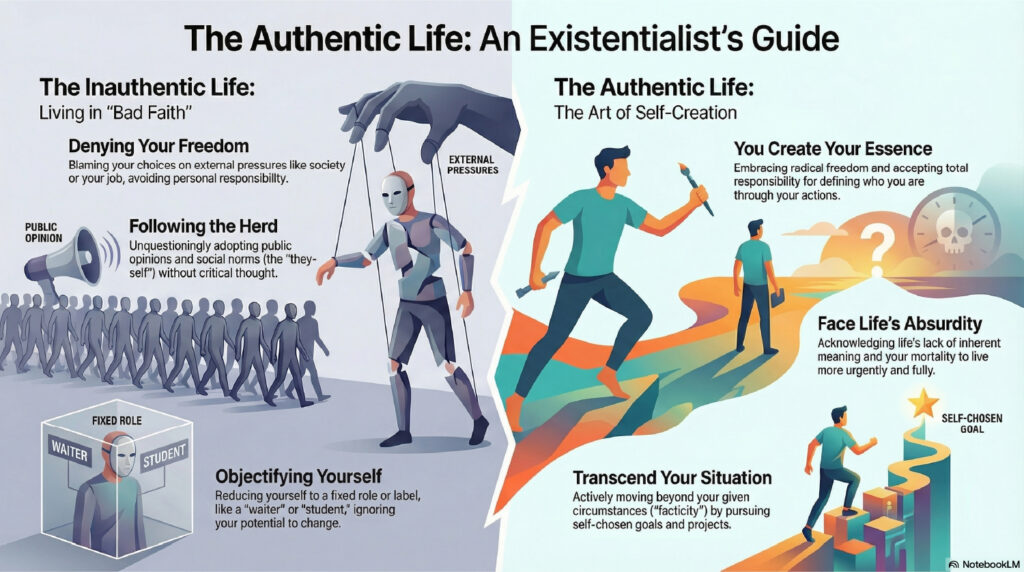
6. The Existential Framework: Authenticity vs. Bad Faith
The psychological machinery of beliefs and schemas operates within the broader context of existence. Existential psychology frames the struggle for self-discovery as a battle between authenticity and “Bad Faith.”
6.1 The Cost of Inauthenticity
Jean-Paul Sartre defined “Bad Faith” (mauvaise foi) as the act of lying to oneself to escape the anxiety of freedom. It is the denial of one’s agency—claiming “I have no choice,” “I am just this way,” or “I did it because everyone else was doing it”.25 In clinical terms, this manifests as Self-Alienation, a disconnect between one’s physiological/emotional reality and their conscious behavior.1
Research confirms the high cost of this alienation. Studies show that individuals who score low on authenticity measures exhibit higher rates of anxiety, depression, and physical symptoms. Conversely, “authentic living”—the congruence between one’s internal values and external actions—serves as a buffer against stress. A study by Bryan et al. (2017) found that authenticity protects people against the adverse health effects of loneliness; even when lonely, authentic individuals were less likely to engage in self-destructive behaviors like alcohol abuse.3
6.2 Dasein and Responsibility
Heidegger’s concept of Dasein (“Being-in-the-world”) emphasizes that we are thrown into a world not of our making, yet we are responsible for how we exist within it.26 Authentic living requires accepting this responsibility. It means acknowledging our mortality and our freedom.
A core belief like “I am a victim” is, in existential terms, a refusal of responsibility. While the trauma that caused the belief was not the individual’s fault, the maintenance of the belief in adulthood is a choice (often unconscious). Moving to authenticity requires the “courage to be,” to embrace one’s freedom to choose a new way of being despite the anxiety it provokes.27
7. Methodologies of Excavation: Uncovering the Core
To transform the self, we must first map it. Several evidence-based techniques exist to surface unconscious beliefs and integrate shadow parts.
7.1 The Downward Arrow Technique (CBT)
This is a primary tool for identifying the “bottom line” core belief.4 It involves peeling back the layers of a surface-level thought to reveal the fundamental fear beneath.
Step-by-Step Protocol:
- Identify the Trigger: Pinpoint a specific situation that caused a strong emotional reaction.
- Example: “My partner didn’t ask me how my day was.”
- Identify the Automatic Thought (AT): What is the immediate interpretation?
- AT: “He doesn’t care about me.”
- The Interrogative Descent: Ask, “If that thought were true, what would that mean about me?” or “Why is that so upsetting?”.29
- Answer: “It means I am not important to him.”
- Repeat the Probe: “And if you aren’t important to him, what does that mean?”
- Answer: “It means I’m not important to anyone. I’m forgettable.”
- Strike the Core: Continue until you hit an absolute statement about identity or the future.
- Probe: “And if you are forgettable…?”
- Core Belief: “I am unworthy of love.”.30
Clinical Nuance: As one descends the arrow, the emotional intensity usually increases. This affect shift is the signal that the core belief has been touched. It is crucial to frame the final statement as a hypothesis to be tested, not a fact to be accepted.4
7.2 The 3-2-1 Shadow Process
Developed by Ken Wilber, this exercise integrates Gestalt and Jungian techniques to reclaim projected shadow material.18
- Face It (3rd Person): Identify a person who triggers you (e.g., someone you hate or envy). Describe them in detail using “He/She/They.”
- Example: “He is so arrogant. He thinks he knows everything.”
- Talk to It (2nd Person): Visualize the person and speak to them.
- Example: “Why do you always have to be right? Who do you think you are?”
- Be It (1st Person): Become the person. Speak as them, using “I.”
- Example: “I am arrogant. I know everything. I need everyone to see how smart I am.”
- Integration: Acknowledge that this quality exists within you. Ask yourself: “How do I express arrogance? Where in my life do I need to be right?” This re-owns the projection, transforming it from an external threat to an internal dynamic that can be managed.18
7.3 Values Elicitation
To live authentically, one must know what they value. Values are distinct from goals; goals can be achieved (e.g., “get married”), but values are directions of travel (e.g., “be loving”) that can never be completed.32
Exercises:
- The Funeral Visualization: Imagine your own funeral. What would you want your friends, family, and colleagues to say about you? This strips away trivial concerns (money, status) and highlights deep values (kindness, integrity, courage).34
- Peak Experiences: Recall a moment where you felt most alive and “yourself.” What values were being honored in that moment? (e.g., Creativity, Freedom, Connection).35
8. Reconstruction: Strategies for Change and Congruence
The final phase is the active restructuring of the psyche. This involves challenging old beliefs and aligning behavior with newly discovered values.
8.1 Cognitive Restructuring and Behavioral Experiments
Neuroplasticity allows us to build new neural pathways. We cannot simply “delete” a schema, but we can weaken it by building a stronger, alternative pathway.
- Evidence Logs: Individuals with negative core beliefs reject positive evidence. To counter this, one must keep a daily log of evidence that contradicts the schema.
- Schema: “I am incompetent.”
- Log: “I fixed the printer,” “I cooked a good meal,” “My friend asked for my advice.” Over time, this cumulative data forces the brain to update its model.37
- Behavioral Experiments: This is the most powerful tool for change. It involves acting as if the new belief were true to test reality.
- Prediction: “If I ask for a raise, my boss will fire me.”
- Experiment: Ask for the raise (or a smaller request) and observe the outcome.
- Result: Even if the raise is denied, the person is rarely fired. Surviving the “threat” dismantles the catastrophic thinking of the schema.38
8.2 Leveraging Character Strengths (VIA)
Positive Psychology focuses on amplifying what is right with us. The VIA Survey of Character Strengths classifies 24 universal strengths (e.g., Bravery, Zest, Curiosity, Love).39 Research shows that using one’s “Signature Strengths” in new ways is strongly correlated with decreased depression and increased well-being.41
- Application: A person with a “Social Isolation” schema can use their strength of “Curiosity” to navigate social anxiety. Instead of focusing on “Will they like me?” (Self-focus), they focus on “What is their story?” (Curiosity-focus). This shifts the neural activation from the threat system to the reward system.41
8.3 Vulnerability and Boundaries
Authenticity requires vulnerability—the willingness to show up and be seen when we cannot control the outcome.43
- Shame Resilience: Shame is the silent killer of authenticity. It grows in secrecy. Speaking one’s shame to a trusted person destroys its power. This connects back to attachment; we heal the “Unlovable” core belief by experiencing acceptance in the face of our perceived flaws.44
- Setting Boundaries: Many with “Self-Sacrifice” schemas view boundaries as selfish. However, boundaries are the prerequisite for compassion. As Brené Brown notes, “Daring to set boundaries is about having the courage to love ourselves, even when we risk disappointing others”.45 Practical scripts (e.g., “I can’t take that on right now,” “I need to stop this conversation”) are essential tools for maintaining the integrity of the self.46
8.4 Mindfulness: The Metacognitive Gap
Finally, mindfulness is the practice that makes choice possible. It creates a gap between the trigger and the reaction.
- The Observer Self: Through meditation, one learns to observe thoughts (“I am having the thought that I am a failure”) rather than becoming them (“I am a failure”). This “defusion” breaks the automaticity of the core belief.36
- Savoring Values: Mindfulness can also be used to savor moments of congruence. When we act in alignment with our values, noticing the physical sensation of “rightness” strengthens the neural reward for authentic behavior.49
9. Conclusion: The Ongoing Journey
The journey to authentic living is not a linear path to a final destination but a cyclical process of expansion and integration. It involves the continuous excavation of the “False Self”—the defensive structures, schemas, and masks built for survival in childhood—and the courageous construction of a life based on intrinsic values.
This report has outlined the complex machinery of the self: from the neurobiological encoding of core beliefs in the limbic system to the projection of the shadow in adult relationships. It has provided a roadmap for navigating this terrain using the precise tools of CBT, the depth of Jungian analysis, and the framework of Existential responsibility.
Ultimately, the goal is Congruence: the alignment of the Ideal Self (who we want to be), the Self-Image (who we believe we are), and the Actual Self (how we behave).2 When these three align, the friction of “Bad Faith” dissolves, replaced by the vitality of being fully, unapologetically alive. As we integrate our shadows and update our schemas, we do not become perfect; we become whole.
10. Appendix: Data Tables and Reference Guides
Table 1: The 18 Early Maladaptive Schemas (Detailed Reference)
| Domain | Schema | Description | Typical Adult Behavior |
| Disconnection & Rejection | Abandonment | Belief that others are unreliable and will leave. | Clinginess, jealousy, choosing unstable partners. |
| Mistrust/Abuse | Expectation of being hurt or manipulated. | Hypervigilance, testing partners, avoiding intimacy. | |
| Emotional Deprivation | Belief that emotional needs will not be met. | Choosing cold partners, not expressing needs, somatic symptoms. | |
| Defectiveness/Shame | Feeling inwardly flawed and unlovable. | Perfectionism, defensiveness, hiding the “true self.” | |
| Social Isolation | Feeling different and alienated. | Avoiding groups, feeling like an outsider/imposter. | |
| Impaired Autonomy | Dependence | Inability to manage daily life without help. | Relying on parents/spouse for decisions, helplessness. |
| Vulnerability to Harm | Fear of imminent catastrophe. | excessive worrying, phobias, checking behaviors. | |
| Enmeshment | Lack of individual identity; fused with others. | Telling parents everything, lack of secrets/privacy. | |
| Failure | Belief in inevitable failure relative to peers. | Procrastination, underachieving, quitting easily. | |
| Impaired Limits | Entitlement | Belief in superiority and special rights. | Demandingness, lack of empathy, breaking rules. |
| Insufficient Self-Control | Inability to tolerate frustration. | Addiction, impulsivity, poor work history. | |
| Other-Directedness | Subjugation | Surrendering control to avoid anger/pain. | Passive-aggressiveness, suppressing anger, compliance. |
| Self-Sacrifice | Meeting others’ needs at own expense. | Burnout, resentment, psychosomatic illness. | |
| Approval-Seeking | Self-esteem dependent on external reaction. | Obsession with status, appearance, and popularity. | |
| Overvigilance | Negativity/Pessimism | Focus on negatives; minimizing positives. | Chronic worry, complaining, “glass half empty.” |
| Emotional Inhibition | Suppressing spontaneous emotion. | Stiff interactions, inability to cry or laugh freely. | |
| Unrelenting Standards | Striving for impossible perfection. | Workaholism, criticism of self and others. | |
| Punitiveness | Belief that mistakes must be punished. | Harsh self-talk, intolerance of others’ errors. |
Table 2: Attachment Styles and Core Beliefs
| Attachment Style | Underlying Core Beliefs | Impact on “Authenticity” |
| Secure | “I am worthy,” “Others are capable of love.” | High authenticity; comfortable expressing true self. |
| Anxious | “I am not okay alone,” “I must earn love.” | Low authenticity; shapeshifting to please others (False Self). |
| Avoidant | “I don’t need anyone,” “Feelings are weak.” | Low authenticity; suppressing the need for connection (Shadow). |
| Disorganized | “I am dangerous/bad,” “Safety is scary.” | Fragmented self; rapid shifting between masks. |
Table 3: Parts of the Self (IFS vs. Jung)
| Concept | Jungian Parallel | IFS Term | Function |
| The Wounded Child | The Complex | Exile | Holds the pain/trauma. Locked away. |
| The Mask | Persona | Manager | Proactive protection. Looks good to society. |
| The Acting Out | Shadow Possession | Firefighter | Reactive protection. Extinguishes pain (addiction/rage). |
| The True Center | The Self (God-Image) | The Self | Calm, Creative, Compassionate leader. |
Works cited
- Authenticity and brain health: a values-based perspective and cultural education approach, accessed January 6, 2026, https://pmc.ncbi.nlm.nih.gov/articles/PMC10432154/
- accessed January 6, 2026, https://www.centurypsychologygroup.com/blog/power-of-authenticity-in-mental-health/#:~:text=Research%20shows%20that%20authentic%20living,personal%20growth%20and%20builds%20trust.
- How Authenticity Enhances Health Outcomes – Psychology Today, accessed January 6, 2026, https://www.psychologytoday.com/us/blog/what-doesnt-kill-us/201803/how-authenticity-enhances-health-outcomes
- How to Use the Downward Arrow Technique in CBT – Manhattan Center for Cognitive Behavioral Therapy, accessed January 6, 2026, https://manhattancbt.com/downward-arrow-technique/
- Core Beliefs: 12 Worksheets to Challenge Negative Beliefs, accessed January 6, 2026, https://positivepsychology.com/core-beliefs-worksheets/
- Are Negative Core Beliefs Wrecking Your Life? – Psychology Today, accessed January 6, 2026, https://www.psychologytoday.com/us/blog/the-main-ingredient/202109/are-negative-core-beliefs-wrecking-your-life
- Core Beliefs in Healthy Youth and Youth at Ultra High-Risk for Psychosis: Dimensionality and Links to Depression, Anxiety, and Attenuated Psychotic Symptoms – NIH, accessed January 6, 2026, https://pmc.ncbi.nlm.nih.gov/articles/PMC6127011/
- Mechanisms by Which Childhood Personality Traits Influence Adult Well-being – PMC – NIH, accessed January 6, 2026, https://pmc.ncbi.nlm.nih.gov/articles/PMC2757085/
- Understanding the Role of Core Beliefs in Attachment and Trauma, accessed January 6, 2026, https://tilt.www.risk-and-resilience.co.uk/blog/understanding-the-role-of-core-beliefs-in-attachment-and-trauma
- Core beliefs and attachment – Evergreen Psychotherapy Center, accessed January 6, 2026, https://evergreenpsychotherapycenter.com/attachment-therapy/attachment-explained/core-beliefs/
- Attachment Stories: The Hidden Beliefs Shaping Your Relationships – Child and Family Institute, accessed January 6, 2026, https://childfamilyinstitute.com/2025/07/17/attachment-stories-the-hidden-beliefs-shaping-your-relationships/
- How Our Caregivers Shape Who We Are: The Seven Dimensions of Attachment at the Core of Personality – PubMed Central, accessed January 6, 2026, https://pmc.ncbi.nlm.nih.gov/articles/PMC8280313/
- The Ultimate Guide to Early Maladaptive Schemas [Full List] – Attachment Project, accessed January 6, 2026, https://www.attachmentproject.com/blog/early-maladaptive-schemas/
- The Ultimate Guide to Early Maladaptive Schemas: A Complete List, accessed January 6, 2026, https://www.restoringhopespokanepllc.com/post/the-ultimate-guide-to-early-maladaptive-schemas-a-complete-list
- 18 Early Schemas Defined, accessed January 6, 2026, https://www.schematherapy.com/id73.htm
- The association between early maladaptive schemas and romantic relationship satisfaction – PMC – PubMed Central, accessed January 6, 2026, https://pmc.ncbi.nlm.nih.gov/articles/PMC11694223/
- Schema Therapy Central Concepts – Schema Therapy Society e.V. (ISST), accessed January 6, 2026, https://schematherapysociety.org/Schema-Therapy
- Shadow Work: What It is and How to Do It > The Essential Guide!, accessed January 6, 2026, https://www.conni.me/blog/shadow-work
- The Shadow: What It Is + How to Use IFS to Work With It – Jackie J.Reid, accessed January 6, 2026, https://jackiejreid.com/the-shadow-what-it-is-how-to-use-ifs-to-work-with-it/
- The Jungian Shadow – The Society of Analytical Psychology, accessed January 6, 2026, https://www.thesap.org.uk/articles-on-jungian-psychology-2/about-analysis-and-therapy/the-shadow/
- The Definitive Shadow Work Guide (By a Jungian Therapist) : r/Jung – Reddit, accessed January 6, 2026, https://www.reddit.com/r/Jung/comments/1gxynv3/the_definitive_shadow_work_guide_by_a_jungian/
- What’s the difference between IFS and Shadow Work? : r/InternalFamilySystems – Reddit, accessed January 6, 2026, https://www.reddit.com/r/InternalFamilySystems/comments/oe9tmj/whats_the_difference_between_ifs_and_shadow_work/
- Isn’t Shadow Work the same as Parts Work? : r/InternalFamilySystems – Reddit, accessed January 6, 2026, https://www.reddit.com/r/InternalFamilySystems/comments/wvvzrc/isnt_shadow_work_the_same_as_parts_work/
- Comparing Parts to Archetypes: The Hero, Shadow, and Child in IFS – IFS Guide App, accessed January 6, 2026, https://ifsguide.com/comparing-parts-to-archetypes-the-hero-shadow-and-child-in-ifs/
- Authenticity (philosophy) – Wikipedia, accessed January 6, 2026, https://en.wikipedia.org/wiki/Authenticity_(philosophy)
- Humanistic and Existential Psychology – UTSA, accessed January 6, 2026, https://www.utsa.edu/lhri/December%205%20-%20%20Humanistic%20and%20Existential%20Psychology.pptx
- Chapter 6 –Brief Humanistic and Existential Therapies – NCBI – NIH, accessed January 6, 2026, https://www.ncbi.nlm.nih.gov/books/NBK64939/
- Cognitive-Skills-for-Depression.pdf, accessed January 6, 2026, https://psych.med.umich.edu/anxiety-program/pdf/Cognitive-Skills-for-Depression.pdf
- How to use the downward arrow technique. CBT Skills. – YouTube, accessed January 6, 2026, https://www.youtube.com/watch?v=7S3m0rgIVvQ
- Uncovering Unhelpful Core Beliefs Using the Downward Arrow Technique – Between Sessions, accessed January 6, 2026, https://www.betweensessions.com/wp-content/uploads/2021/09/Uncovering_Unhelpful_Core_Beliefs_Using_the_Downward_Arrow_Technique_083121_ad.pdf
- negative core beliefs. This worksheet – Choosing Therapy, accessed January 6, 2026, https://www.choosingtherapy.com/wp-content/uploads/2025/09/Negative-Core-Beliefs-Worksheet.pdf
- NLP Values Elicitation Guide | Effectively Elicit Values – Global NLP Training, accessed January 6, 2026, https://globalnlptraining.com/simply/nlp-values-elicitation-guide-effectively-elicit-values/
- Values elicitation exercise | Crowe Associates, accessed January 6, 2026, https://www.crowe-associates.co.uk/coaching-tools/values-elicitation-exercise/
- Living Into Our Values – Brené Brown, accessed January 6, 2026, https://brenebrown.com/resources/living-into-our-values/
- Module 04. Eliciting Your Values – Sarah Nilsson, accessed January 6, 2026, https://www.sarahnilsson.org/app/download/967979015/Starters-Kit_Module_04.pdf
- 5 Steps to Align Actions with Values Using Mindfulness, accessed January 6, 2026, https://www.themindfulnessapp.com/articles/align-actions-with-values-mindfulness
- Developing Balanced Core Beliefs – Centre for Clinical Interventions, accessed January 6, 2026, https://www.cci.health.wa.gov.au/~/media/CCI/Consumer-Modules/Improving-Self-Esteem/Improving-Self-Esteem—08—Developing-Balanced-Core-Beliefs.pdf
- Limiting Beliefs, accessed January 6, 2026, https://opportunity.ucdavis.edu/sites/g/files/dgvnsk8876/files/inline-files/limiting-beliefs.pdf
- VIA Institute – 24 Character Strengths List, accessed January 6, 2026, https://www.viacharacter.org/character-strengths
- Six Functions of Character Strengths for Thriving at Times of Adversity and Opportunity: a Theoretical Perspective, accessed January 6, 2026, https://www.viacharacter.org/pdf/CS_thriving_6_functions_-_theory_article_(Niemiec_2019).pdf
- What Are Character Strengths & Virtues? – Positive Psychology, accessed January 6, 2026, https://positivepsychology.com/classification-character-strengths-virtues/
- 340 Ways to Use VIA Character Strengths by Tayyab Rashid & Afroze Anjum – Action for Happiness, accessed January 6, 2026, http://legacy.actionforhappiness.org/media/52486/340_ways_to_use_character_strengths.pdf
- Brené Brown | The One Thing That Changes Everything [Best of] – Good Life Project, accessed January 6, 2026, https://www.goodlifeproject.com/podcast/brene-brown-on-vulnerability-courage-and-living-wholeheartedly/
- Brené Brown — The Courage to Be Vulnerable | The On Being Project – OnBeing, accessed January 6, 2026, https://onbeing.org/programs/brene-brown-the-courage-to-be-vulnerable-jan2015/
- Resources | Brené Brown, accessed January 6, 2026, https://brenebrown.com/resources/
- Building Boundaries Worksheet – Mental Health America, accessed January 6, 2026, https://mhanational.org/wp-content/uploads/2025/03/Building-Boundaries-Worksheet.pdf
- How to Set Boundaries — Examples and Scripts – Momentum Psychology, accessed January 6, 2026, https://momentumpsychology.com/how-to-set-boundaries-examples-and-scripts/
- 21 Mindfulness Exercises & Activities for Adults – Positive Psychology, accessed January 6, 2026, https://positivepsychology.com/mindfulness-exercises-techniques-activities/
- Savor Your Values: Finding Strength In Compassion – Mindful.org, accessed January 6, 2026, https://www.mindful.org/savor-your-values-finding-strength-in-compassion/