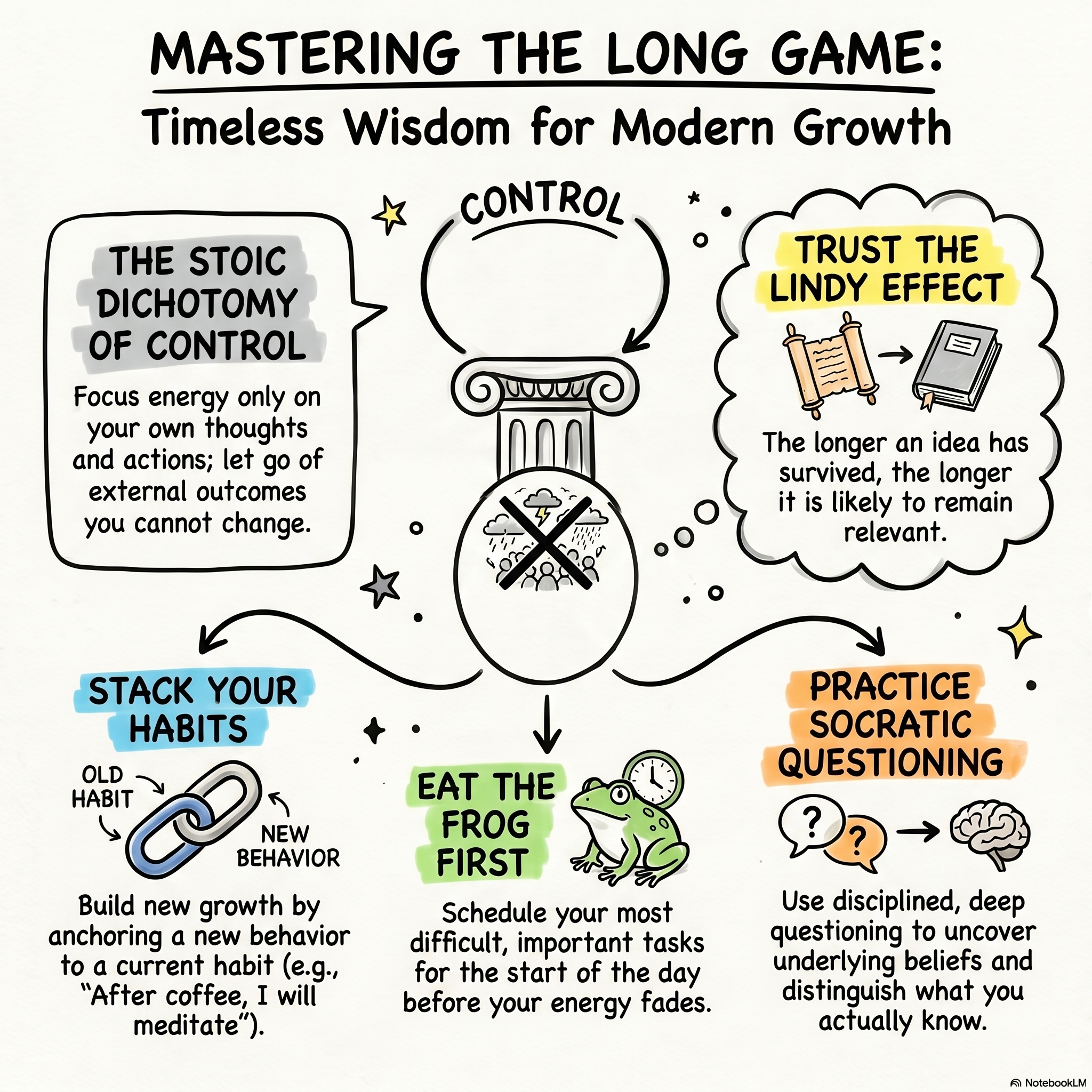
This guide offers a comprehensive approach to intellectual and personal growth, drawing insights from philosophy, education, and behavioral science. We’ll explore the Socratic method as a robust system for uncovering truths and fostering critical thinking. Alongside this, Stoic principles, such as the four virtues and the dichotomy of control, will be presented as vital tools for achieving lasting success. The article also provides practical strategies for forming positive habits, emphasizing how environment design and consistent tracking can eliminate negative behaviors and reinforce beneficial ones. Finally, we’ll touch upon the historical efforts of organizations like the Great Books Foundation in engaging communities with foundational cultural works. Together, these elements advocate for an examined life built on reasoned inquiry, resilient mindsets, and deliberate action.
1. The Starting Point: Why We Examine Our Lives
Imagine becoming the Architect of your own consciousness. For many, the mind is like a construction site left to chance – a chaotic mix of borrowed beliefs and automatic reactions. But when you choose the path of deep thinking, you are actively clearing the mental landscape to build something truly unshakable.
This profound transformation begins with a simple yet powerful realization: your life is a structure, built brick by brick from your consistent habits. To change the building, you must first examine the materials. As Socrates famously said, “The unexamined life is not worth living.”
Without self-examination, you risk being controlled by unseen patterns that limit your potential. We can categorize these patterns into two main types:
- Mindset Habits: These are the internal blueprints of your life. They encompass the beliefs and phrases you consistently repeat to yourself, such as “I’ll never change” or “I’m not good enough.” These act as an “internal critic” that can either propel your growth or halt it entirely.
- Action Habits: These are the physical components of your daily routine. They are the automatic behaviors you perform repeatedly, often without conscious thought – like biting your nails, starting your day with a sugary breakfast, or immediately checking your phone upon waking.
To move from being a passive passenger to the active Architect of your existence, you must first master the essential tools of discovery and demolition.
2. The Socratic Demolition and Construction Crew
Before a new, logical foundation can be laid, the “rubble” of self-deception, flawed opinions, and unacknowledged ignorance must be cleared away. Socrates used a method called “dialectic reasoning” as both a demolition tool and a construction crane. It involves a two-step process: you must first become aware of what you don’t know before you can uncover a truth that is genuinely justifiable.
The Socratic Two-Step
| Process Name | Primary Goal | Result for the Learner | The Architect’s Tool |
|---|---|---|---|
| Destructive Process | To eradicate faulty opinions and identify hidden ignorance. | The learner becomes “conscious of their ignorance” and more circumspect in action. | Dialectic Reasoning: Probing the contradictions in one’s own statements. |
| Constructive Process | To induce better, logical opinions through rigorous inquiry. | The learner establishes a foundation of “justifiable thinking” and deep conceptual understanding. | Intuitive Analogy: Using relatable examples to bridge the gap to complex truths. |
To perform this intellectual demolition, you need a specific set of instruments: a taxonomy of questions designed to uncover the hidden assumptions supporting your current mental structures.
3. The Thinker’s Toolkit: A Taxonomy of Socratic Questions
Socratic questioning is a systematic superpower. It goes beyond mere curiosity; it’s a disciplined exploration into the fundamental “parts of thinking.” By utilizing these categories, you can strip away the superficial layers of any argument and discern the underlying logic – or lack thereof.
Here are key types of Socratic questions to sharpen your mind:
- Questions of Purpose (The “Why”)
- Starter Question: “What is our central aim or task in this line of thought?”
- Questions of Information (The “Evidence”)
- Starter Question: “Do you have any evidence to support that?”
- Questions of Assumption (The “Taken-for-Granted”)
- Starter Question: “What are we taking for granted here?”
- Questions of Point of View (The “Perspective”)
- Starter Question: “How might someone object to that position?”
- Questions of Implication (The “What Follows”)
- Starter Question: “If we accept what you are saying, what are some implications?”
Once the Socratic method helps you discover truth, you need a way to protect that truth from the chaos of the world. For this, we turn to the Stoic Shield.
4. The Stoic Shield: Mastering the Dichotomy of Control
If Socrates is the Architect who builds the foundation of your intellect, Stoicism is the Shield that guards it. Living a “well-reasoned life” requires you to clearly distinguish between your internal world, where you possess complete agency, and the external world, which is indifferent to your desires. Mastering the Dichotomy of Control ensures your inner tranquility remains undisturbed by circumstances you cannot change.
The Dichotomy of Control
| Internal Factors (Within Your Control) | External Factors (Beyond Your Control) |
|---|---|
| Your own thoughts, beliefs, and judgments | The actions, opinions, and words of others |
| Your personal decisions and consistent efforts | External circumstances (weather, traffic, the economy) |
| How you choose to react to failure | The final outcome or “destination” of a project |
| Your integrity and moral character | Past events that cannot be rewritten |
By consciously directing your energy solely toward internal factors, you become antifragile. The external storms may rage, but your internal structure and peace of mind will remain sound.
5. The Blueprint of Virtue: Four Pillars of a Good Life
Stoic philosophy offers four “corrective” virtues that serve as the foundational pillars of character. These are not abstract ideals; they are active tools designed to eliminate the negative habits that sabotage your productivity and inner peace.
- Wisdom: The ability to perceive situations objectively and make rational choices.
- The Corrective: It actively destroys Rationalization. Wisdom cuts through the lies we tell ourselves to avoid difficult tasks or justify irrelevant distractions.
- Courage: The strength to confront adversity and choose the challenging, but right, path.
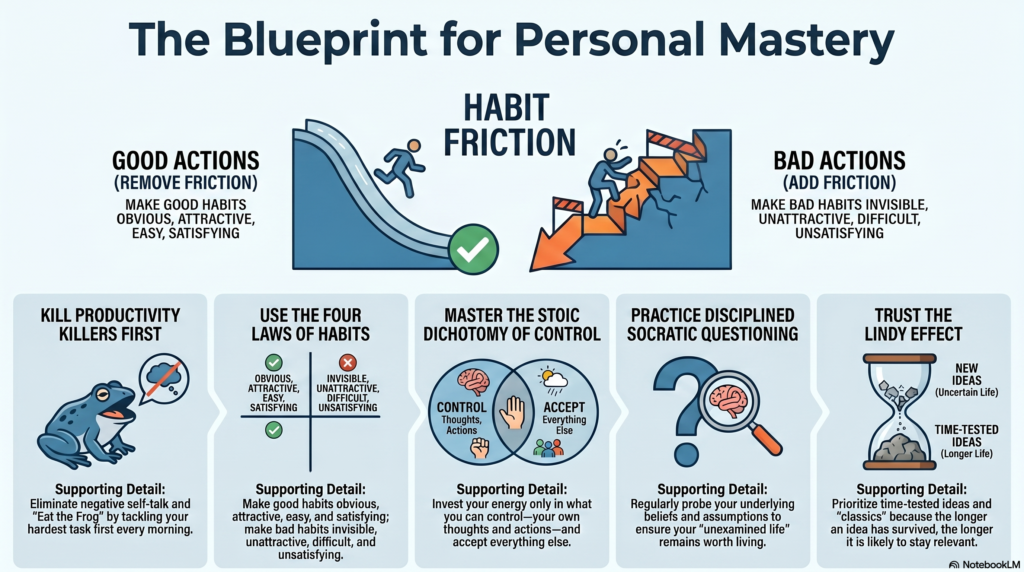
- The Corrective: It destroys Indecisiveness. Courage empowers you to “Eat the Frog First” – tackling the most intimidating task of the day before your resolve wanes.
- Justice: The unwavering commitment to fairness, equity, and objective respect for the truth.
- The Corrective: It destroys Negative Self-Talk. Justice demands you silence the “internal critic” and replace its bias with an objective, respectful assessment of your own potential.
- Self-Control: The power to regulate your emotions, desires, and time effectively.
- The Corrective: It destroys Distraction. Self-control allows you to set firm boundaries, such as cut-off times for phone use, and prevents you from prioritizing work over the essential sleep your mind needs to function optimally.
6. The Lindy Effect: Why Ancient Wisdom Outlasts Trends
The methods you are learning are not merely “vintage”; they are battle-tested and timeless. In an era saturated with fleeting self-help fads, we turn to the Lindy Effect to discern what truly warrants our attention.
The Lindy Effect: A principle stating that the future life expectancy of a nonperishable item (like an idea or technology) is proportional to its current age. Essentially, ideas “age in reverse” – the longer a philosophy has survived the stress-tests of time, the longer it is likely to remain relevant and valuable.
Socratic and Stoic principles have endured for over 2,000 years. They have been rigorously refined by some of history’s most successful and resilient minds, making them a far more reliable foundation for your life than any modern, transient trend.
7. Conclusion: Putting Method into Motion
Proficiency in deep thinking is a powerful skill, and like any superpower, it demands “practice, practice, and more practice.” Do not attempt to rebuild the entire structure of your life in a single day. Instead, leverage the proven laws of habit-building to make your new philosophical methods obvious, easy, and consistently applied.
Your ‘Examined Life’ Action Checklist
- Perform a 24-Hour Mindset Audit: Use a simple “Habit Scorecard” to jot down every thought and action you take for a full day. Identify the “rubble” (e.g., checking your phone at 7:00 AM) and the “bricks” (e.g., intentional reflection).
- Apply the Two-Minute Rule: Downscale your deep thinking practice. Spend just two minutes each morning asking one Socratic Question about a belief you hold. Make the habit so small it’s impossible to fail.
- Set Implementation Intentions: Give your virtues a concrete schedule. For example, say: “I will practice the Dichotomy of Control (Behavior) at 2:00 PM during my staff meeting (Time/Location).”
- Use Physical Triggers: Employ simple physical cues. Wear a “Breathe Band” or keep a specific pen on your desk as a reminder to replace the “internal critic” with the virtue of Justice and positive self-talk.
- Master the Decisive Moment: When a distraction or challenge arises, pause for three seconds. Ask yourself: “Is this internal or external?” Then, consciously choose the path of Self-Control.
Your mind is your most important project. Start building today.