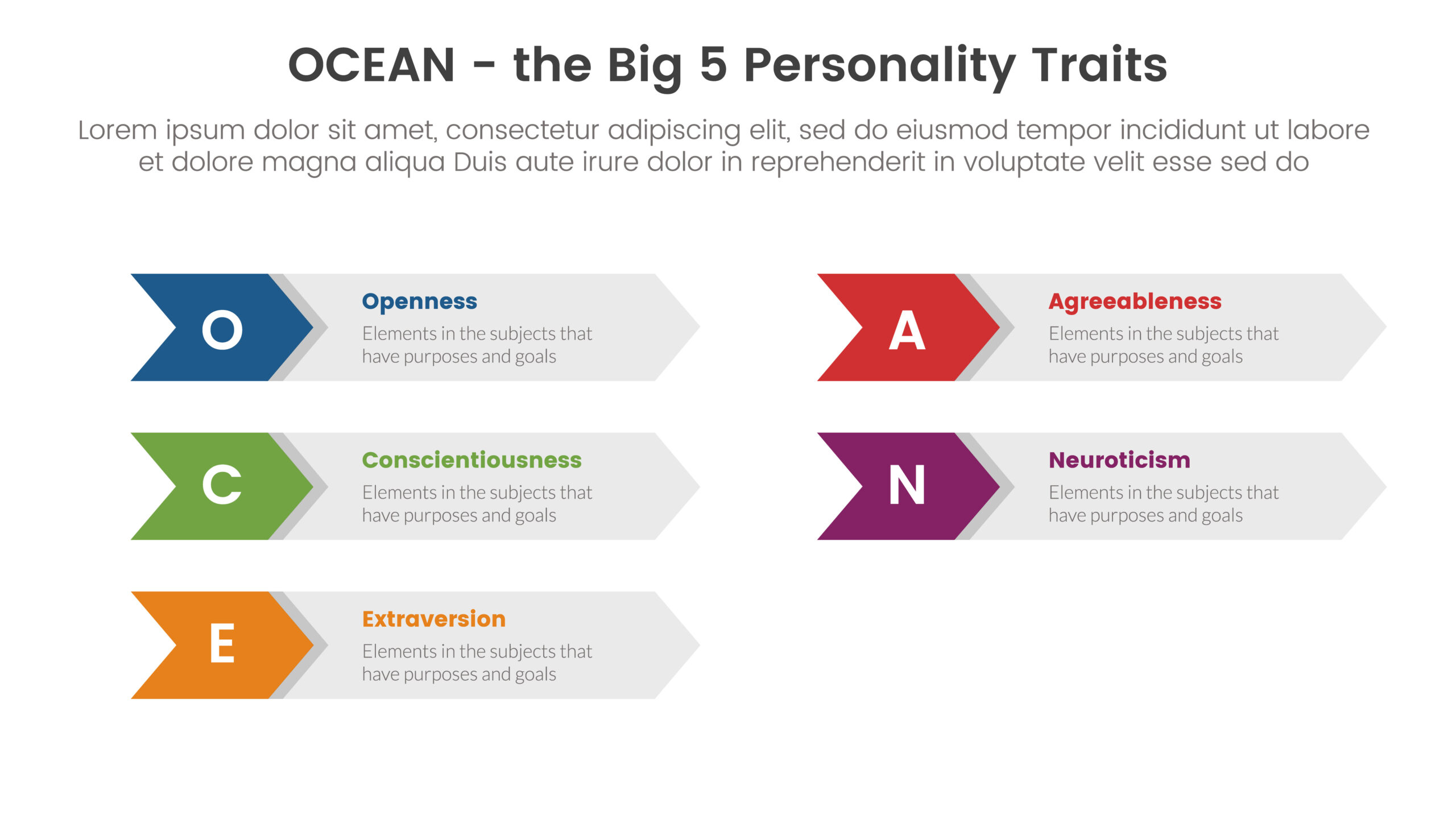
Understanding the Big Five Personality Traits: A Comprehensive Guide to the OCEAN Model
1. Introduction: The Cartography of Human Nature
The study of personality is, at its core, the scientific pursuit of understanding the fundamental ways in which individuals differ. For centuries, this pursuit was dominated by philosophy and theoretical conjecture, from the four humors of Hippocrates—blood, yellow bile, black bile, and phlegm—to the psychoanalytic archetypes of Freud and Jung. While these early frameworks provided rich vocabularies for describing human behavior, they lacked empirical rigor and cross-cultural replicability. They were inventions of the human mind, imposed upon the data of human experience, rather than discoveries derived from it.
In the modern era, the field of personality psychology has converged upon a single, empirically validated taxonomy that organizes the chaotic landscape of human behavioral traits into a coherent structure: The Five-Factor Model (FFM), widely known as the “Big Five.” This model asserts that the vast majority of variance in human personality can be described by five broad, bipolar dimensions: Openness to Experience, Conscientiousness, Extraversion, Agreeableness, and Neuroticism (often mnemonically arranged as OCEAN or CANOE).1
The Big Five is not merely a descriptive list; it is a hierarchical framework that bridges the gap between biological substrates and social outcomes. Unlike typological models that categorize individuals into discrete “types” (e.g., “introvert” vs. “extravert”), the FFM recognizes that personality traits are continuous dimensions, normally distributed across the population. This “periodic table” of personality traits has become the gold standard in psychological science, facilitating a unified language for researchers exploring genetics, neuroscience, industrial-organizational psychology, and clinical psychopathology.3
This report provides an exhaustive analysis of the Big Five. It traces the model’s historical evolution from the analysis of dictionaries to the mapping of genomes; it dissects the intricate hierarchy of domains and facets; it rigorously compares the FFM to popular alternatives like the Myers-Briggs Type Indicator (MBTI); and it explores the profound implications of these traits for mental health, career success, and the human lifespan.
2. Historical Evolution: The Lexical Hypothesis and the Empirical Turn
The discovery of the Big Five was not a “eureka” moment by a single theorist but the culmination of a half-century of statistical refinement driven by the Lexical Hypothesis. This hypothesis, famously articulated by Sir Francis Galton in the late 19th century and later refined by Goldberg, posits that the most socially and biologically significant personality characteristics have become encoded in natural language over the course of human evolution. If a distinction between two behaviors is important for survival or social interaction—for example, knowing whether a tribe member is reliable (Conscientious) or volatile (Neurotic)—people will invent a word for it.2
2.1 The Semantic Excavation: Allport and Odbert (1936)
The systematic operationalization of the lexical hypothesis began in 1936 with Gordon Allport and Henry Odbert. Understanding that the English language contained the fossilized wisdom of human observation, they undertook a monumental task: examining Webster’s New International Dictionary to extract every term descriptive of human behavior. They identified approximately 17,953 words. To make this list manageable for scientific analysis, they filtered the terms into four categories:
- Stable personality traits (e.g., “sociable,” “aggressive”).
- Temporary states and moods (e.g., “afraid,” “rejoicing”).
- Evaluative judgments (e.g., “excellent,” “worthy”).
- Physical characteristics (e.g., “tall,” “lean”).
Focusing on the first category, they distilled the list to roughly 4,500 stable trait descriptors. This list became the raw material for the next fifty years of personality research.7
2.2 The Factor Analytic Struggle: Cattell vs. Eysenck
In the 1940s, Raymond Cattell attempted to bring mathematical structure to Allport’s list using the then-new technique of factor analysis—a statistical method that groups correlated variables into underlying dimensions. Cattell reduced the list to 171 variables and eventually proposed a 16-factor model (the 16PF). However, Cattell’s manual calculations were prone to error, and other researchers found it impossible to replicate his 16-factor structure.1
Concurrently, British psychologist Hans Eysenck argued for a more parsimonious, biologically based model. He proposed three “superfactors” (the PEN model):
- Psychoticism: Aggression, impulsivity, and lack of empathy.
- Extraversion: Sociability and sensation-seeking.
- Neuroticism: Emotional instability.
While Eysenck captured crucial elements of personality, many researchers felt his three-factor model was too broad, failing to distinguish between distinct traits like “kindness” (Agreeableness) and “organization” (Conscientiousness), lumping them or ignoring them.1
2.3 The Emergence of the Big Five
The resolution to this debate came from the U.S. Air Force. In 1961, researchers Ernest Tupes and Raymond Christal re-analyzed data from eight large samples (including Cattell’s own data) using clearer, more advanced factor analytic criteria. In every sample, they found five recurrent factors: Surgency (Extraversion), Agreeableness, Dependability (Conscientiousness), Emotional Stability, and Culture (Openness). Due to the obscurity of their technical report, this finding remained largely unknown for two decades.7
In the 1980s, the model was rediscovered and cemented by two independent streams of research:
- The Lexical Stream: Lewis Goldberg, analyzing comprehensive word lists, repeatedly found the same five broad dimensions. He coined the term “Big Five” in 1981 to emphasize that these were not just five traits, but five broad domains encompassing the universe of personality adjectives.7
- The Questionnaire Stream: Paul Costa and Robert McCrae developed the NEO Personality Inventory (NEO-PI). Initially focusing on Neuroticism, Extraversion, and Openness, they soon realized the necessity of adding Agreeableness and Conscientiousness to fully describe their subjects. The convergence of Goldberg’s linguistic analysis and Costa and McCrae’s questionnaire data provided powerful evidence that these five factors were a reality of human psychology, not merely an artifact of language.1
3. The Anatomy of Personality: A Deep Dive into the Five Domains
The power of the Big Five lies in its hierarchical structure. At the top are the five broad Domains. Beneath each domain are specific Facets—granular traits that define the nuances of the broader construct. Understanding personality requires analyzing these facets, as they offer the “fidelity” needed to predict specific behaviors, distinct from the “bandwidth” of the broad domains.1
3.1 Neuroticism (vs. Emotional Stability)
Neuroticism is the dimension of emotional instability and negative affect. It represents the sensitivity of the brain’s threat-detection systems. High scorers are prone to psychological distress, identifying ordinary situations as threatening and minor frustrations as hopelessly difficult. It is the most robust predictor of psychopathology, including anxiety and depressive disorders.2
Facets of Neuroticism (NEO-PI-R):
- Anxiety: The tendency to be apprehensive, fearful, prone to worry, and nervous. High scorers often keep their “antennas up” for danger.
- Angry Hostility: The tendency to experience anger and related states such as frustration and bitterness. Unlike the calculated aggression of low Agreeableness, this is reactive emotional volatility.
- Depression: The tendency to experience feelings of guilt, sadness, despondency, and loneliness. It measures the frequency of depressive affect, not necessarily clinical depression.
- Self-Consciousness: Sensitivity to criticism, feelings of inferiority, and discomfort in social situations. This is the core of social anxiety.
- Impulsiveness: The inability to control cravings and urges. High scorers may smoke, drink excessively, or overeat when stressed. It reflects a deficit in emotional regulation rather than a desire for risk.
- Vulnerability: The inability to cope with stress, becoming dependent, hopeless, or panicked when facing emergency situations. It measures the fragility of the ego under pressure.14
3.2 Extraversion (vs. Introversion)
Extraversion is characterized by an energetic approach to the social and material world. It is driven by the brain’s dopamine reward system, leading high scorers to seek stimulation and social attention. Introverts are not necessarily anti-social; rather, they have a lower threshold for arousal and do not require the same level of external reward to function, often finding high-stimulation environments draining.1
Facets of Extraversion (NEO-PI-R):
- Warmth: Interest in and friendliness towards others; readily forming attachments. This facet overlaps with Agreeableness but focuses on the expression of affection.
- Gregariousness: The preference for other people’s company; enjoying crowds and social stimulation. This is the classic “party-goer” trait.
- Assertiveness: Social dominance, forcefulness, and leadership tendencies. High scorers speak out, take charge, and are often viewed as leaders.
- Activity: The tempo of life; high scorers are energetic, fast-paced, and vigorous. They keep busy and talk fast.
- Excitement Seeking: The need for environmental stimulation; liking bright colors, noise, and risk. This facet is strongly linked to dopamine sensitivity.
- Positive Emotions: The tendency to experience positive emotions like joy, happiness, love, and excitement. Extraverts are biologically predisposed to feel good.14
3.3 Openness to Experience (vs. Closedness)
Openness is the most complex and debated factor, sometimes labeled “Intellect” or “Culture.” It describes the breadth, depth, originality, and complexity of an individual’s mental and experiential life. It is the only Big Five trait consistently correlated with general cognitive ability (IQ), particularly crystallized intelligence and divergent thinking.2
Facets of Openness (NEO-PI-R):
- Fantasy: A vivid imagination and an active dream life. High scorers use fantasy to create an interesting inner world.
- Aesthetics: A deep appreciation for art and beauty; being moved by poetry, music, or nature.
- Feelings: Receptivity to one’s own inner feelings and emotions; evaluating emotion as an important part of life.
- Actions: Willingness to try different activities, go to new places, or eat unusual foods. It reflects a preference for novelty over routine.
- Ideas: Intellectual curiosity; an active pursuit of intellectual interests and a willingness to consider new, perhaps unconventional ideas. This is the facet most correlated with IQ.
- Values: Readiness to re-examine social, political, and religious values. High scorers tend to be liberal and non-dogmatic; low scorers tend to be conservative and traditional.14
3.4 Agreeableness (vs. Antagonism)
Agreeableness reflects individual differences in concern for social harmony. It measures the quality of one’s interpersonal orientation along a continuum from compassion to antagonism. Agreeable people value getting along with others and are willing to compromise their interests. Disagreeable (Antagonistic) people place self-interest above getting along and are often competitive or skeptical.2
Facets of Agreeableness (NEO-PI-R):
- Trust: The belief that others are honest and well-intentioned. Low scorers are cynical and suspicious.
- Straightforwardness: Frankness, sincerity, and ingenuousness. High scorers are honest; low scorers are willing to manipulate or deceive (Machiavellianism).
- Altruism: Active concern for others’ welfare; generosity and willingness to assist those in need.
- Compliance: Reactions to interpersonal conflict. High scorers inhibit aggression and forgive; low scorers are aggressive and competitive.
- Modesty: Humility and a tendency to play down one’s own achievements. Low scorers are arrogant or narcissistic.
- Tender-Mindedness: Attitudes of sympathy and concern for others; susceptibility to social appeals. Low scorers are “tough-minded” and realistic.14
3.5 Conscientiousness (vs. Disinhibition)
Conscientiousness concerns the way in which we control, regulate, and direct our impulses. It represents the drive for achievement and the ability to delay gratification. It is the single best predictor of occupational performance, academic success, and longevity.2
Facets of Conscientiousness (NEO-PI-R):
- Competence: The sense that one is capable, sensible, prudent, and effective. It correlates with self-efficacy.
- Order: Neatness, tidiness, and organization. High scorers keep things in their proper places.
- Dutifulness: Adherence to ethical principles and fulfillment of moral obligations. High scorers are reliable and ethical.
- Achievement Striving: High aspiration levels and working hard to achieve goals. This is the engine of career success.
- Self-Discipline: The ability to begin tasks and carry them through to completion despite boredom or distractions. This facet is critical for overcoming procrastination.
- Deliberation: The tendency to think carefully before acting; caution and impulse control. Low scorers are hasty and spontaneous.14
3.6 The Bandwidth-Fidelity Dilemma
The hierarchical nature of the Big Five gives rise to the “bandwidth-fidelity dilemma.” Broad traits (bandwidth) like Conscientiousness predict broad criteria (e.g., overall job performance) well. However, narrow facets (fidelity) often predict specific behaviors better. For example, while Conscientiousness predicts general health, the specific facet of Self-Discipline is a better predictor of adherence to an exercise regimen, while Deliberation is a better predictor of avoiding accidental injury. Researchers must choose the level of analysis appropriate for their predictive goals.12
4. Psychometric Superiority: The Big Five vs. MBTI
In corporate settings and popular culture, the Myers-Briggs Type Indicator (MBTI) remains ubiquitous. However, within the scientific community, the MBTI is widely regarded as psychometrically inferior to the Big Five. A rigorous comparison highlights the limitations of the typological approach versus the dimensional approach of the FFM.
4.1 Categorical vs. Dimensional Measurement
The fundamental flaw of the MBTI is its reliance on types. It classifies individuals into mutually exclusive categories (e.g., Introvert or Extravert) based on a median split. This assumes a bimodal distribution of personality traits (two distinct humps). However, decades of data confirm that personality traits follow a normal distribution (bell curve). Most people are “ambiverts” located near the mean. By forcing these individuals into one category or the other, the MBTI discards massive amounts of information and exaggerates minor differences between individuals near the cutoff.19
The Big Five utilizes a dimensional approach, scoring individuals on a continuous percentile scale (e.g., “85th percentile for Extraversion”). This captures the nuance of human variation that categorical systems miss.
4.2 Reliability: Stability Over Time
Reliability refers to the consistency of a measure.
- MBTI Reliability: Studies have shown that 50-75% of individuals receive a different MBTI type classification when retaking the test after just five weeks. This instability is a statistical artifact of the “cutoff” method; a small change in answers can flip a person’s type entirely.19
- Big Five Reliability: The FFM demonstrates high test-retest reliability. Correlations for trait scores over short intervals often exceed .80, and longitudinal stability over years is robust (r >.70). This indicates that the Big Five measures stable, enduring characteristics.21
4.3 Validity: Measuring What Matters
Validity refers to the accuracy of the measure in predicting real-world outcomes.
- The Missing Trait: The MBTI completely omits Neuroticism, the trait most predictive of emotional stability, stress tolerance, and psychopathology. By focusing only on “positive” descriptions, the MBTI fails to capture the dimension most critical for understanding mental health and workplace burnout.19
- Predictive Power: The Big Five consistently outperforms the MBTI in predicting job performance. For instance, Conscientiousness is a universal predictor of work performance (r ≈.25), whereas the MBTI’s predictive validity for job success is often near zero or statistically insignificant.19
4.4 Independence of Scales
Factor analysis shows that the MBTI scales are not statistically independent. The Judging-Perceiving scale correlates moderately with the Sensing-Intuition scale, suggesting they are not measuring distinct constructs. In contrast, the Big Five factors are relatively orthogonal (uncorrelated), ensuring that each trait provides unique, non-redundant information.26
Table 1: Psychometric Comparison of Big Five and MBTI
| Feature | Big Five (FFM) | Myers-Briggs (MBTI) |
| Measurement Model | Dimensional (Continuous scales) | Categorical (Discrete types) |
| Statistical Distribution | Normal (Bell Curve) | Bimodal (Assumed, incorrect) |
| Test-Retest Reliability | High (r >.80); Types stable over decades | Low (50-75% change type in 5 weeks) |
| Content Coverage | Comprehensive (Includes Neuroticism) | Incomplete (Omits Neuroticism/Stability) |
| Predictive Validity | Strong (Predicts job performance, health, divorce) | Weak/None (Not valid for selection) |
| Scientific Consensus | The Academic Gold Standard | Widely considered Pseudoscience |
19
5. Biological Foundations: Genetics and Neuroscience
The universality of the Big Five across cultures suggests a biological substrate. Modern personality neuroscience has moved beyond description to identify the genetic and neural mechanisms underlying these traits.
5.1 The Genetics of Personality
Behavioral genetics, utilizing twin studies (comparing monozygotic vs. dizygotic twins), has firmly established the heritability of personality.
- Heritability Estimates: Across all five traits, heritability is estimated at 40-50%. This means roughly half of the variation in personality within a population is attributable to genetic differences.3
- Environmental Influence: Surprisingly, the “shared environment” (parenting style, childhood home, socio-economic status of the family) has a negligible effect on adult personality (often <5%). The remaining variance is driven by the “non-shared environment”—unique life experiences, peer groups, and stochastic biological events.29
- GWAS Results: Genome-Wide Association Studies (GWAS) reveal that personality is polygenic. There is no single “gene for Extraversion.” Instead, thousands of genetic variants (SNPs), each with a tiny effect size, aggregate to influence trait levels.31
5.2 Neural Correlates and Neurotransmitters
Recent neuroimaging (fMRI, structural MRI) has mapped the Big Five to specific brain networks:
- Extraversion & Dopamine: Extraversion is strongly linked to the dopaminergic reward system. Structurally, it correlates with volume in the medial orbitofrontal cortex (coding reward value). Functionally, extraverts show greater activation in the ventral striatum and amygdala when viewing positive stimuli. This explains their drive for social attention and excitement.3
- Neuroticism & The Threat System: Neuroticism is associated with the brain’s circuitry for processing negative emotion. It correlates with activity in the amygdala, hippocampus, and mid-cingulate cortex. High scorers often show reduced connectivity between the amygdala (emotion generation) and the prefrontal cortex (emotion regulation), leading to difficulty in down-regulating anxiety.3
- Conscientiousness & Executive Control: This trait is linked to the lateral prefrontal cortex (PFC), a region governing planning, working memory, and impulse control. This provides the biological hardware for the self-discipline and goal-directed behavior characteristic of high C.3
- Agreeableness & Empathy: Agreeableness correlates with volume in regions associated with social information processing and theory of mind, such as the superior temporal sulcus and posterior cingulate cortex.31
- Openness & Connectivity: Openness is associated with the default mode network and increased connectivity between distant brain regions. This hyper-connectivity may facilitate the novel associations and abstract thinking that define the trait. It is also linked to the neurotransmitter serotonin, which may modulate the breadth of information processing.31
Table 2: Neurobiological Correlates of the Big Five
| Trait | Primary Brain Networks/Regions | Neurotransmitter System | Functional Implication |
| Extraversion | Ventral Striatum, Medial Orbitofrontal Cortex, Amygdala | Dopamine | Sensitivity to reward and social stimulation. |
| Neuroticism | Amygdala, Hippocampus, Mid-Cingulate Cortex | Serotonin/Norepinephrine | Sensitivity to threat and punishment; emotional regulation. |
| Conscientiousness | Lateral Prefrontal Cortex (PFC) | Dopamine (Frontal) | Executive function, planning, impulse control. |
| Agreeableness | Superior Temporal Sulcus, Fusiform Gyrus | Oxytocin/Testosterone | Empathy, face processing, social bonding. |
| Openness | Default Mode Network, Dorsolateral PFC | Serotonin/Dopamine | Abstract reasoning, pattern recognition, imagination. |
3
6. Lifespan Development: The Maturity Principle
While early psychologists believed personality was fixed by age 30, longitudinal research demonstrates that the Big Five traits undergo systematic changes throughout the entire lifespan. These changes typically follow the Maturity Principle: as individuals age, they tend to become more socially adapted and functional.
6.1 Patterns of Mean-Level Change
- Conscientiousness: Shows the most consistent increase. From young adulthood (20s) through middle age (50s), individuals become significantly more organized, disciplined, and reliable. This trajectory is driven by the demands of adult roles (career, parenting).34
- Agreeableness: Tends to increase, particularly in the 30s and 40s, and continues to rise into old age. This “softening” reflects a shift toward pro-sociality and away from competitive antagonism.35
- Neuroticism: Generally declines with age, especially in women. Young adulthood is often the peak of emotional instability, with people gaining better emotional regulation skills as they mature.34
- Openness: Increases during adolescence and early adulthood (the college years), stabilizes in midlife, and tends to decline in older age (70s+), correlating with cognitive decline.35
- Extraversion: The pattern is nuanced. The facet of Social Dominance (Assertiveness) increases through age 30. However, Social Vitality (Gregariousness) remains stable or declines slightly. Older adults are often as assertive as they were in youth but less likely to seek out high-energy social gatherings.3
6.2 Rank-Order Stability
Despite these mean-level changes, the relative ordering of individuals remains highly stable. A person who is the most extraverted in their college class will likely still be more extraverted than their peers at age 60, even if the entire cohort has become slightly less gregarious. Rank-order stability coefficients increase with age, peaking between ages 50 and 70 (r >.70), suggesting personality “sets” like soft concrete—never fully hard, but increasingly resistant to change.3
6.3 Environmental Drivers of Change
Personality change is not purely biological; it is driven by Social Investment Theory. Investing in normative social institutions—getting a job, getting married, having children—forces individuals to act in Conscientious, Agreeable, and stable ways. Over time, these repeated behaviors become internalized as traits. Conversely, non-normative events (trauma, unemployment) can derail these positive trajectories.34
7. Cross-Cultural Universality and The Tsimane Anomaly
For the Big Five to be a true model of human nature, it must be universal. Translation studies in over 50 nations (including China, Germany, Israel, and Japan) have generally replicated the five-factor structure, suggesting a species-wide universality.4 However, recent anthropological research has challenged this universality in small-scale societies.
7.1 The WEIRD Bias
Most personality research is conducted on WEIRD (Western, Educated, Industrialized, Rich, Democratic) populations. These societies are highly complex, with diverse specialized social roles (e.g., software engineer vs. artist vs. CEO) that may encourage the differentiation of personality into five distinct dimensions.
7.2 The Tsimane Study: A Failure to Replicate
A landmark study of the Tsimane people, a forager-horticulturalist society in the Bolivian Amazon, failed to find the Big Five. Analyzing personality data from 632 Tsimane adults, researchers found that the five traits did not emerge. Instead, the data best fit a “Big Two” model:
- Industriousness: A mix of energetic, persistent, and reliable traits.
- Pro-sociality: A mix of social and cooperative traits.
The Tsimane live in small, interdependent kinship groups where survival depends on general social effectiveness and hard work. The distinct separation of “Openness” (creativity) from “Intellect” or “Neuroticism” from “Introversion” may not be ecologically relevant in their environment.40
This Niche Diversity Hypothesis suggests that personality structure itself evolves. In simple societies, broad dimensions of “good cooperator” vs. “bad cooperator” suffice. In complex economies with thousands of distinct niches, personality differentiates into the finer-grained Big Five to facilitate specialization.
8. Applications I: Industrial-Organizational Psychology
The Big Five is the backbone of modern personnel selection and organizational behavior research. It predicts workplace outcomes better than any other personality framework.
8.1 Predicting Job Performance
Conscientiousness is the “g-factor” of personality at work. It predicts job performance across all occupations, from janitors to surgeons (r ≈.20-.30). High Conscientiousness employees are more productive, require less supervision, and engage in fewer Counterproductive Work Behaviors (CWB) like theft or absenteeism.11
- Extraversion is a strong predictor for jobs involving social interaction, such as sales and management. However, it can be a liability in jobs requiring solitary focus or vigilance.17
- Agreeableness predicts teamwork and service orientation. It is crucial for customer service roles. However, high Agreeableness is negatively correlated with salary earning, likely because agreeable people are less aggressive in salary negotiations.43
- Neuroticism is generally a negative predictor of performance, particularly in high-stress jobs, due to its association with anxiety and burnout.17
- Openness does not predict performance in routine jobs but is the strongest predictor of training proficiency (learning new skills) and adaptability in changing work environments.17
8.2 Leadership and Entrepreneurship
Meta-analyses show that Extraversion (specifically the Assertiveness facet) is the strongest predictor of Leadership Emergence (who gets promoted or chosen). However, Conscientiousness and Openness are stronger predictors of Leadership Effectiveness (who actually runs the team well).
Entrepreneurs typically score high in Openness (innovation), high in Conscientiousness (execution), and high in Extraversion (networking), but lower in Agreeableness and Neuroticism compared to managers.16
9. Applications II: Clinical Psychology and The DSM-5
Historically, personality disorders (PDs) like Borderline or Narcissistic were diagnosed as categorical diseases. This system was flawed: patients often met criteria for 3 or 4 different PDs (comorbidity), and many patients with severe dysfunction didn’t fit any specific category (PD-NOS).
9.1 The DSM-5 Alternative Model (AMPD)
The DSM-5 introduced the Alternative Model for Personality Disorders (AMPD) in Section III, which explicitly maps personality pathology to maladaptive variants of the Big Five traits (The PID-5 model). This dimensional approach views mental illness as an extreme on a continuum rather than a distinct “disease”.46
9.2 The Pathological Big Five
The AMPD identifies five pathological trait domains:
- Negative Affectivity (Pathological Neuroticism): Frequent and intense experiences of high levels of a wide range of negative emotions.
- Facets: Emotional lability, Anxiousness, Separation insecurity.
- Detachment (Pathological Introversion): Avoidance of socioemotional experience; withdrawal from interpersonal interactions.
- Facets: Withdrawal, Intimacy avoidance, Anhedonia.
- Antagonism (Pathological Low Agreeableness): Behaviors that put the individual at odds with other people.
- Facets: Manipulativeness, Deceitfulness, Grandiosity, Hostility.
- Disinhibition (Pathological Low Conscientiousness): Orientation toward immediate gratification; lack of regard for past learning or future consequences.
- Facets: Irresponsibility, Impulsivity, Distractibility, Risk taking.
- Psychoticism (Pathological High Openness): Exhibiting a wide range of culturally incongruent odd, eccentric, or unusual behaviors and cognitions.
- Facets: Unusual beliefs, Eccentricity, Perceptual dysregulation.2
9.3 Diagnosing Disorders via Traits
Clinicians can now diagnose traditional disorders by looking at the trait profile:
- Borderline PD: High Negative Affectivity (Emotional Lability), High Antagonism (Hostility), High Disinhibition (Impulsivity).51
- Narcissistic PD: High Antagonism (Grandiosity, Attention Seeking).51
- Antisocial PD: High Antagonism (Callousness, Deceitfulness) + High Disinhibition (Risk Taking, Irresponsibility).48
- Avoidant PD: High Detachment (Withdrawal) + High Negative Affectivity (Anxiousness).53
This mapping provides a more precise description of the patient. For example, two patients with “Borderline PD” might look very different; one might be primarily anxious/withdrawn (High N, High Detachment), while another is hostile/impulsive (High Antagonism, High Disinhibition). The trait model captures these differences.54
10. Applications III: Relationships, Health, and Society
10.1 Assortative Mating and Relationship Satisfaction
Do opposites attract? Research suggests no. Correlations between partners’ Big Five traits are generally low but positive, indicating a weak “birds of a feather” effect.
However, Actor Effects are massive:
- Neuroticism: High Neuroticism in one or both partners is the strongest predictor of relationship dissatisfaction, conflict, and divorce. The inability to regulate negative emotion acts as a constant corrosive agent on the relationship bond.
- Agreeableness & Conscientiousness: High levels in both partners predict higher satisfaction.
- Openness: Similarity in Openness is uniquely important. Couples mismatched on Openness (e.g., one traditional/pragmatic, one artistic/unconventional) often struggle with conflicting values and leisure preferences.56
10.2 Health and Longevity
Conscientiousness is a health asset. Longitudinal studies show that high C individuals live significantly longer. They are less likely to smoke, drink to excess, or drive recklessly. They are more likely to exercise, eat well, and adhere to medication regimens.
Neuroticism is a health risk. It predicts cardiovascular issues and somatic complaints, largely through the mechanism of chronic stress and cortisol dysregulation.4
10.3 Political Orientation
The Big Five correlates strongly with political views:
- High Openness / Low Conscientiousness predicts Liberalism/Progressivism. These individuals value novelty, change, and equality.
- Low Openness / High Conscientiousness predicts Conservatism. These individuals value tradition, order, and hierarchy.
These associations suggest that political polarization is, in part, a conflict between different personality types processing the world differently.16
11. Alternative Models: The HEXACO Challenge
While the Big Five is dominant, the HEXACO model is a significant rival. Developed by Ashton and Lee, it emerged from cross-cultural lexical studies that suggested six, not five, factors.
11.1 The Sixth Factor: Honesty-Humility (H)
The Big Five subsumes traits like sincerity and fairness under Agreeableness. HEXACO argues this is a mistake. It separates “Agreeableness” (tolerance, forgiveness) from Honesty-Humility (sincerity, fairness, lack of greed).
- High H: Sincere, modest, fair.
- Low H: Manipulative, deceitful, greedy, entitled. (The “Dark Triad” of Narcissism, Psychopathy, and Machiavellianism).
The HEXACO model demonstrates superior predictive validity for unethical behavior. Low H predicts cheating, workplace theft, and sexual harassment better than low Agreeableness in the Big Five.62 Despite this, the Big Five remains the standard due to historical inertia and the argument that H can be captured as a facet (Straightforwardness/Modesty) within Big Five Agreeableness.65
12. Conclusion
The Five-Factor Model of personality stands as one of the great triumphs of modern psychology. It has transformed the study of human nature from a collection of theoretical speculations into a rigorous empirical science. By identifying the five fundamental dimensions of Openness, Conscientiousness, Extraversion, Agreeableness, and Neuroticism, the model provides a universal coordinate system for mapping individual differences.
The Big Five’s power lies in its ubiquity and utility. It is written in our genome, wired into our neural circuitry, and encoded in our language. It predicts who will succeed in a job, who will struggle with mental illness, who will sustain a happy marriage, and even how long we will live. While challenges like the Tsimane study and the HEXACO model remind us that scientific models are always provisional, the Big Five currently offers the most comprehensive and accurate map of the human personality available. As we move into an era of personalized medicine and precision psychiatry, the FFM will remain the essential tool for understanding the complex architecture of human individuality.
Works cited
- Big 5 Personality Traits: The 5-Factor Model of Personality – Verywell Mind, accessed December 29, 2025, https://www.verywellmind.com/the-big-five-personality-dimensions-2795422
- Big Five personality traits – Wikipedia, accessed December 29, 2025, https://en.wikipedia.org/wiki/Big_Five_personality_traits
- Big Five Personality Traits: The 5-Factor Model of Personality – Simply Psychology, accessed December 29, 2025, https://www.simplypsychology.org/big-five-personality.html
- The Five Factor Model of personality structure: an update – PMC, accessed December 29, 2025, https://pmc.ncbi.nlm.nih.gov/articles/PMC6732674/
- Lexical hypothesis – Wikipedia, accessed December 29, 2025, https://en.wikipedia.org/wiki/Lexical_hypothesis
- 1.2 DEVELOPMENTAL BIG FIVE RESEARCH The lexical approach to personality is the most prominent approach in today’s personality – Refubium, accessed December 29, 2025, https://refubium.fu-berlin.de/bitstream/handle/fub188/10413/03_Chapter1b.pdf?sequence=4&isAllowed=y
- In a Nutshell: Big 5 Personality Traits (OCEAN Model), accessed December 29, 2025, https://blog.hptbydts.com/in-a-nutshell-big-5-personality-traits-ocean-model
- Personality Psychology: Lexical Approaches, Assessment Methods, and Trait Concepts Reveal Only Half of the Story—Why it is Time for a Paradigm Shift – PMC – PubMed Central, accessed December 29, 2025, https://pmc.ncbi.nlm.nih.gov/articles/PMC3581768/
- The lexical approach to personality: A historical review of trait taxonomic research – CORE, accessed December 29, 2025, https://files.core.ac.uk/download/pdf/15988014.pdf
- Big 5 Personality Traits | Psychology Today, accessed December 29, 2025, https://www.psychologytoday.com/us/basics/big-5-personality-traits
- What Are The Big 5 Personality Traits? | Thomas.co, accessed December 29, 2025, https://www.thomas.co/resources/type/hr-guides/what-are-big-5-personality-traits
- Bandwidth-fidelity dilemma in personality measurement for personnel selection, accessed December 29, 2025, https://experts.umn.edu/en/publications/bandwidth-fidelity-dilemma-in-personality-measurement-for-personn/
- Using the Big Five Personality Traits (OCEAN) in Practice – Positive Psychology, accessed December 29, 2025, https://positivepsychology.com/big-five-personality-theory/
- NEO Personality Inventory-Revised (NEO PI-R) Paul Detrick The NEO PI-R is one of a group of closely-related objective assessment – POST, accessed December 29, 2025, https://post.ca.gov/portals/0/post_docs/publications/psychological-screening-manual/NEO_PI-R.pdf
- Revised NEO Personality Inventory – Wikipedia, accessed December 29, 2025, https://en.wikipedia.org/wiki/Revised_NEO_Personality_Inventory
- How the Big Five Personality Traits Influence Work Behavior – Florida Tech, accessed December 29, 2025, https://online.fit.edu/degrees/graduate/master-organizational-leadership/how-the-big-five-personality-traits-influence-work-behavior/
- Personality and Job Performance | Predictive Factors | Scontrino-Powell, accessed December 29, 2025, https://scontrino-powell.com/blog/personality-and-job-performance
- (PDF) Bandwidth-Fidelity Dilemma – ResearchGate, accessed December 29, 2025, https://www.researchgate.net/publication/315833294_Bandwidth-Fidelity_Dilemma
- MBTI vs Big Five: Which Personality Test Should You Trust? – Early Years TV, accessed December 29, 2025, https://www.earlyyears.tv/mbti-vs-big-five-personality-test/
- A Comparison of MBTI and Big Five Personality, accessed December 29, 2025, https://lseee.net/index.php/hc/article/download/310/HC005822.pdf/1263
- MBTI-Reliability-and-validity-Infographic.pdf – The Myers-Briggs Company, accessed December 29, 2025, https://ap.themyersbriggs.com/content/MBTI-Reliability-and-validity-Infographic.pdf
- Reliability and Validity – 16Personalities, accessed December 29, 2025, https://www.16personalities.com/articles/reliability-and-validity
- Which is more reliable, the MBTI or the Big 5 personality test to recruit an employee? Why?, accessed December 29, 2025, https://www.quora.com/Which-is-more-reliable-the-MBTI-or-the-Big-5-personality-test-to-recruit-an-employee-Why
- Big Five vs MBTI: No Contest – PCI, accessed December 29, 2025, https://pciassess.com/big-five-better-than-mbti/
- How good is the Myers-Briggs Type Indicator for predicting leadership-related behaviors?, accessed December 29, 2025, https://pmc.ncbi.nlm.nih.gov/articles/PMC10017728/
- Thoughts on the scientific validity of Myers-Briggs Type Indicators? : r/intj – Reddit, accessed December 29, 2025, https://www.reddit.com/r/intj/comments/15udovz/thoughts_on_the_scientific_validity_of/
- Reliability and validity of the MBTI® instrument, accessed December 29, 2025, https://eu.themyersbriggs.com/~/media/Files/PDFs/Technical-information/MBTI_reliability_and_validity_info.pdf
- Myers-Briggs vs. OCEAN: An Industrial Psychologist Breaks Down the Differences, accessed December 29, 2025, https://www.interviewaceapp.com/blog/myers-briggs-vs-ocean-an-industrial-psychologist-breaks-down-the-differences
- Genetic and Environmental Pathways Underlying Personality Traits and Perceived Stress: Concurrent and Longitudinal Twin Studies – PubMed, accessed December 29, 2025, https://pubmed.ncbi.nlm.nih.gov/33132499/
- Genetic and Environmental Pathways Underlying Personality Traits and Perceived Stress: Concurrent and Longitudinal Twin Studies – PMC – NIH, accessed December 29, 2025, https://pmc.ncbi.nlm.nih.gov/articles/PMC7596875/
- Personality Neuroscience: An Emerging Field with Bright Prospects – PMC – PubMed Central, accessed December 29, 2025, https://pmc.ncbi.nlm.nih.gov/articles/PMC9561792/
- Testing Predictions From Personality Neuroscience: Brain Structure and the Big Five – PMC, accessed December 29, 2025, https://pmc.ncbi.nlm.nih.gov/articles/PMC3049165/
- The Big Five Personality Traits and Brain Arousal in the Resting State – MDPI, accessed December 29, 2025, https://www.mdpi.com/2076-3425/11/10/1272
- Stability and Change in the Big Five Personality Traits: Findings from a Longitudinal Study of Mexican-Origin Adults – NIH, accessed December 29, 2025, https://pmc.ncbi.nlm.nih.gov/articles/PMC8821110/
- Age Differences in the Big Five Across the Life Span: Evidence from Two National Samples, accessed December 29, 2025, https://pmc.ncbi.nlm.nih.gov/articles/PMC2562318/
- accessed December 29, 2025, https://pmc.ncbi.nlm.nih.gov/articles/PMC2562318/#:~:text=Agreeableness%20demonstrated%20a%20fairly%20linear,slightly%20starting%20around%20age%2080.
- Personality Trait Change in Adulthood – PMC – NIH, accessed December 29, 2025, https://pmc.ncbi.nlm.nih.gov/articles/PMC2743415/
- Personality change across the life span: Insights from a cross‐cultural, longitudinal study, accessed December 29, 2025, https://midus.wisc.edu/findings/pdfs/1696.pdf
- Cross-Cultural Research on the Five-Factor Model of Personality – ScholarWorks@GVSU, accessed December 29, 2025, https://scholarworks.gvsu.edu/cgi/viewcontent.cgi?referer=&httpsredir=1&article=1038&context=orpc
- New study throws into doubt the universality of the ‘Big Five’, accessed December 29, 2025, https://www.apa.org/monitor/2013/03/big-five
- ‘Universal’ personality traits don’t necessarily apply to isolated indigenous people, accessed December 29, 2025, https://www.apa.org/news/press/releases/2013/01/personality-traits
- How Universal Is the Big Five? Testing the Five-Factor Model of Personality Variation Among Forager–Farmers in the Bolivian Amazon – PubMed Central, accessed December 29, 2025, https://pmc.ncbi.nlm.nih.gov/articles/PMC4104167/
- Big Five personality traits in the workplace: Investigating personality …, accessed December 29, 2025, https://pmc.ncbi.nlm.nih.gov/articles/PMC10089283/
- (PDF) The validity of the Big Five personality traits for job performance: Meta-analyses of South African studies: Van Aarde et al . – ResearchGate, accessed December 29, 2025, https://www.researchgate.net/publication/318907342_The_validity_of_the_Big_Five_personality_traits_for_job_performance_Meta-analyses_of_South_African_studies_Van_Aarde_et_al
- Big Five personality traits in the workplace: Investigating personality differences between employees, supervisors, managers, and entrepreneurs – Frontiers, accessed December 29, 2025, https://www.frontiersin.org/journals/psychology/articles/10.3389/fpsyg.2023.976022/full
- Structured Clinical Interview for the DSM-5® Alternative Model for Personality Disorders (SCID-5-AMPD) Module I – American Psychiatric Association Publishing, accessed December 29, 2025, https://www.appi.org/Products/Interviewing/Structured-Clinical-Interview-for-the-DSM-5-Altern
- Alternative DSM-5 model for personality disorders – Wikipedia, accessed December 29, 2025, https://en.wikipedia.org/wiki/Alternative_DSM-5_model_for_personality_disorders
- Personality Inventory for DSM-5 – Short Form (PID-5-SF) – NovoPsych, accessed December 29, 2025, https://novopsych.com/assessments/diagnosis/personality-inventory-for-dsm-5-short-form-pid-5-sf/
- DSM-5 Personality Traits and DSM-IV Personality Disorders – PMC – NIH, accessed December 29, 2025, https://pmc.ncbi.nlm.nih.gov/articles/PMC3909514/
- Can Personality Disorders Be Redefined in Personality Trait Terms? – Psychiatry Online, accessed December 29, 2025, https://psychiatryonline.org/doi/10.1176/appi.ajp.2018.18040481
- THE PATHOLOGICAL BIG FIVE: AN ATTEMPT TO BUILD A BRIDGE BETWEEN THE PSYCHIATRIC CLASSIFICATION OF PERSONALITY DISORDERS AND TH, accessed December 29, 2025, https://www.kul.pl/files/118/Roczniki/2017-2/rp_2017_2_6ve.pdf
- The Five-Factor Model of Personality Disorders (Chapter 7), accessed December 29, 2025, https://www.cambridge.org/core/books/cambridge-handbook-of-personality-disorders/fivefactor-model-of-personality-disorders/0263D84150AE1FFD5DC55264BB1F943C
- Dimensional models of personality: the five-factor model and the DSM-5 – PMC – NIH, accessed December 29, 2025, https://pmc.ncbi.nlm.nih.gov/articles/PMC3811085/
- Trading Patients: Applying the Alternative Model for Personality Disorders to Two Cases of DSM-5 Borderline Personality Disorder Over Time and Across Therapists – Frontiers, accessed December 29, 2025, https://www.frontiersin.org/journals/psychology/articles/10.3389/fpsyg.2022.794624/full
- Five-Factor Model and DSM-5 Alternative Model of Personality Disorder Profile Construction: Associations with Cognitive Ability and Clinical Symptoms – MDPI, accessed December 29, 2025, https://www.mdpi.com/2079-3200/11/4/71
- Big Five personality domains and relationship satisfaction: Direct effects and correlated change over time – PubMed Central, accessed December 29, 2025, https://pmc.ncbi.nlm.nih.gov/articles/PMC11239117/
- Birds of a Feather Don’t Always Fly Farthest: Similarity in Big Five Personality Predicts More Negative Marital Satisfaction Trajectories in Long-Term Marriages – University of California, Berkeley, accessed December 29, 2025, https://bpl.studentorg.berkeley.edu/docs/07-%20Birds%20of%20a%20feather%20don’t%20always%20fly%20farthest-%20Similarity%20in%20Big%20Five%20personality%20predicts%20more%20negative%20marital%20satisfaction%20trajectories%20in%20long-term%20marriages.pdf
- Assortative Mating and Marital Quality in Newlyweds: A Couple-Centered Approach – American Psychological Association, accessed December 29, 2025, https://www.apa.org/pubs/journals/releases/psp-882304.pdf
- Assortative Mating Patterns Based on Longitudinal Trajectories of Personality Traits and Relationship-Specific Characteristics | Collabra: Psychology | University of California Press, accessed December 29, 2025, https://online.ucpress.edu/collabra/article/10/1/125635/203943/Assortative-Mating-Patterns-Based-on-Longitudinal
- How personality traits are associated with environmental engagement | Yale Environment Review, accessed December 29, 2025, https://environment-review.yale.edu/how-personality-traits-are-associated-environmental-engagement-0
- Big Five and HEXACO Personality Traits, Proenvironmental Attitudes, and Behaviors: A Meta-Analysis – PMC – NIH, accessed December 29, 2025, https://pmc.ncbi.nlm.nih.gov/articles/PMC7333518/
- Full article: Measurement and research using the Big Five, HEXACO, and narrow traits: A primer for researchers and practitioners, accessed December 29, 2025, https://www.tandfonline.com/doi/full/10.1111/ajpy.12202
- Exploring the Relationship Between Honesty-Humility, the Big Five, and Liberal Values in Swedish Students – Europe’s Journal of Psychology, accessed December 29, 2025, https://ejop.psychopen.eu/index.php/ejop/article/view/672/672.html
- HEXACO model of personality structure – Wikipedia, accessed December 29, 2025, https://en.wikipedia.org/wiki/HEXACO_model_of_personality_structure
What are some criticisms of HEXACO from the Big Five camp? – Psychology Stack Exchange, accessed December 29, 2025, https://psychology.stackexchange.com/questions/22078/what-are-some-criticisms-of-hexaco-from-the-big-five-camp