The ability to connect effectively with others is a cornerstone of success in both professional and personal life. This comprehensive guide explores the nuances of personality types, communication styles, and the critical skill of assertiveness. We’ll delve into the unique strengths of the ambivert personality, differentiate various communication approaches, and provide actionable techniques to enhance your interpersonal skills. By understanding yourself and others better, you can foster workplace harmony, improve mentoring outcomes, and significantly boost your personal well-being.
1. Understanding the Energy Behind the Voice: Introversion, Extroversion, and the Ambivert Advantage
As you embark on your journey into behavioral modification, it’s vital to recognize that communication is far more than just words; it’s a reflection of your internal energy and biological rhythm. In educational psychology, personality isn’t seen as a simple binary choice, but rather a rich spectrum defining how our brains process stimulation and reward.
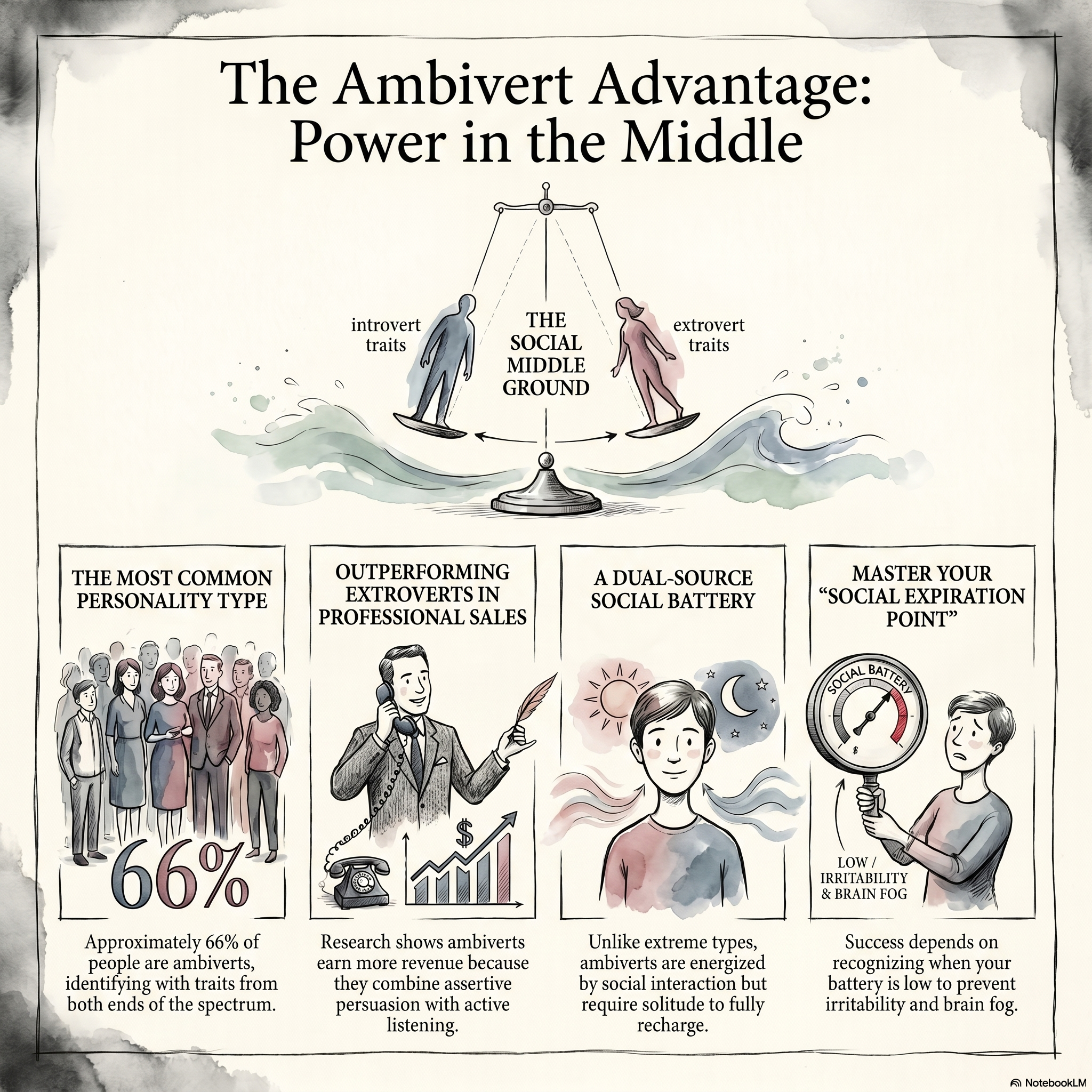
From a neuroscientific perspective, extroverts often exhibit a higher dopamine response to social rewards. In contrast, introverts typically have naturally higher ‘neocortical arousal’ levels, making them more susceptible to overstimulation. Ambiverts, however, operate near the optimal middle point of this arousal scale, granting them a unique psychological equilibrium that allows for incredible flexibility.
Personality Energy Types: A Comparison
| Primary Energy Source | Key Social Traits | The Primary Strength |
|---|---|---|
| Introverts | Recharge through solitude; prefer depth over breadth in conversation; may feel drained by prolonged social ‘noise.’ | Deep Focus: Exceptional listening skills and the ability to process information thoroughly before speaking. |
| Extroverts | Energized by external stimuli and group interaction; often ‘think out loud’ and seek social attention for dopamine rewards. | Active Engagement: Natural networking abilities and a high degree of comfort in leadership presence and outgoing roles. |
| Ambiverts | Balance traits of both extremes; operate at an optimal arousal level that allows for both sociality and solitude. | Adaptability: The ‘Happy Medium’ ability to flex between social engagement and quiet introspection depending on context. |
The ‘So What?’ of the Ambivert Advantage
For anyone aspiring to master interpersonal dynamics, the ‘Ambivert’ profile – whether it’s an innate trait or a practiced skill – stands as the gold standard for communication. Here’s why:
- Flexibility: You gain the ability to ‘turn it on’ for high-stakes social demands while remaining perfectly comfortable in the silence of deep, focused work.
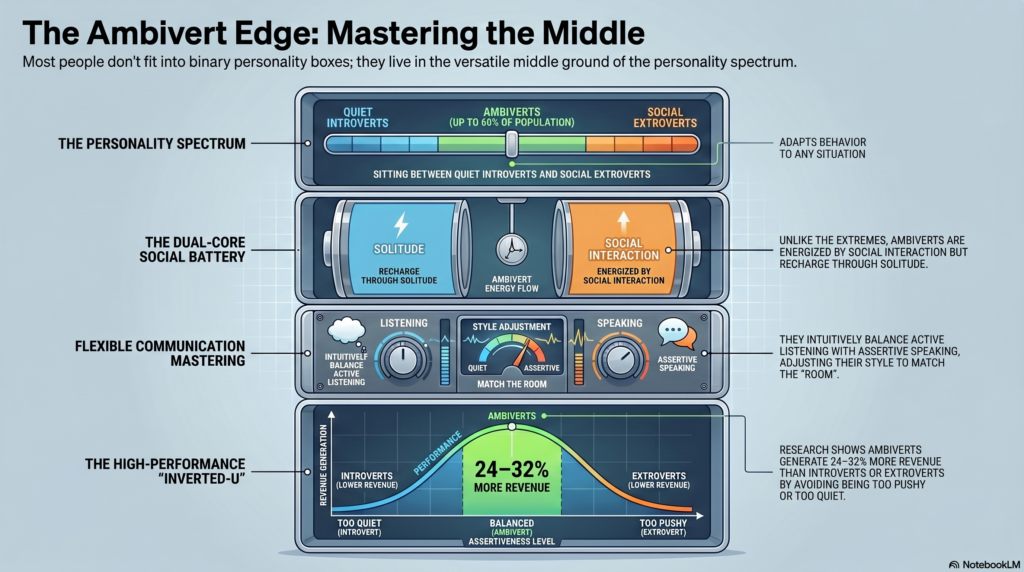
- Balanced Communication: By finding equilibrium between talking and listening, you can navigate group settings without dominating them or disappearing into the background.
- Contextual Awareness: This personality type excels at ‘reading the room,’ allowing you to intuitively adjust your behavior to match the specific emotional temperature of any environment.
While these categories help us understand our default settings, you might also encounter terms like ‘Omnivert,’ who swings between extreme introverted and extroverted states based on mood, or ‘Otrovert,’ a term emerging from social media that emphasizes a relational focus. As your mentor, I must clarify that ‘Otrovert’ is not yet a formally recognized term in clinical psychology but rather a social shorthand for connection-seeking behavior.
Ultimately, our natural energy type serves as the foundational ‘battery’ that powers the specific communication styles we adopt when interacting with the world.
2. The Four Pillars of Communication Style
In clinical practice, we observe that individuals often default to communication habits rooted in past experiences and perceived safety. Understanding these distinct styles is the crucial first step toward intentional behavioral change and more effective interaction.
Style Impact Profiles
Passive Communication
- The Behavioral Cue: A soft or hesitant voice, avoidance of eye contact, and the frequent use of apologetic ‘buffer’ phrases.
- The Hidden Cost: Beyond mere burnout, this style breeds deep-seated resentment, simmering anger, and a subconscious desire for retribution because the individual feels victimized and ignored.
- The Learner’s Takeaway: While passive communication might avoid immediate conflict, it ultimately fails to achieve genuine connection and causes the communicator to doubt their own judgment.
Aggressive Communication
- The Behavioral Cue: A loud, dominating tone, frequent interruptions, and the use of accusatory ‘You’ statements.
- The Hidden Cost: This style creates a culture of victimization and intimidation, severely weakening trust and mutual respect. Others will actively avoid or oppose you.
- The Learner’s Takeaway: Aggression may secure short-term compliance, but it systematically destroys the long-term collaboration and psychological safety essential for healthy environments.
Passive-Aggressive Communication
- The Behavioral Cue: Sarcasm, subtle criticism, or ‘agreeing’ to tasks while intentionally procrastinating or withholding information.
- The Hidden Cost: This style is a destructive hybrid of avoidance and frustration. It erodes trust because others must constantly ‘decipher’ your true intent.
- The Psychological Root: This behavior typically emerges when an individual is uncomfortable being direct about their needs and feelings, choosing indirect sabotage over honest confrontation.
Assertive Communication
- The Behavioral Cue: A calm, steady tone, open body language, and a focus on ‘I’ statements that take ownership of feelings.
- The Hidden Cost: It requires high levels of self-regulation and constant self-awareness, which can be mentally taxing, especially during the initial learning phase.
- The Learner’s Takeaway: This is the ‘gold standard’ because it masterfully balances your own needs with a profound respect for the rights of others, fostering win-win outcomes and genuine connection.
While these communication styles may feel like a permanent part of your identity, as a curriculum designer, I assure you they are simply skills that can be unlearned and replaced with the powerful habit of assertiveness.
3. The Gold Standard: Navigating Life with Assertiveness
Assertiveness, as defined by leading institutions like the Mayo Clinic, represents the ‘ideal middle ground’ in communication. It is a diplomatic style that profoundly demonstrates self-respect and acute situational awareness.
Top 5 Benefits of Assertive Communication
- Boosted Self-Esteem: You gain invaluable internal validation by confidently standing up for your personal point of view.
- Earned Respect: You project a reliable, honest image that naturally invites others to treat you with professional dignity.
- Stress Management: By setting clear and firm boundaries, you proactively prevent the physiological ‘overload’ of taking on too many responsibilities.
- Win-Win Situations: You facilitate resolutions where both parties genuinely feel their interests have been heard, understood, and addressed.
- Sense of Empowerment: You regain a tangible sense of agency and control over your personal decisions and the overall direction of your life.
The Ambivert Advantage: A Curvilinear Relationship
Groundbreaking research by Adam Grant illustrates a fascinating curvilinear relationship (an inverted-U shape) between extroversion and productivity. His studies reveal that in sales and management, individuals at the extreme ends of the spectrum—the very introverted or the very extroverted—often underperform compared to those who fall squarely in the middle: the ambiverts.
Grant’s data specifically shows that ambiverts achieved an impressive 32% more revenue than extreme extroverts. This isn’t surprising when we consider the hidden cost of high extroversion: appearing ‘too excited or overconfident.’ When a communicator is overly forceful, the recipient often detects a ‘persuasive intent,’ leading them to scrutinize the message more harshly and resist influence. Ambiverts, however, excel by expertly balancing the assertiveness needed to close a deal with the active, empathetic listening required to truly understand a customer’s underlying interests and needs.
To achieve this level of professional mastery, you must move beyond theoretical understanding and actively begin utilizing the practical tools found within the assertiveness toolbox.
4. The Assertiveness Toolbox: Practical Techniques for Daily Use
Your primary objective as a learner is to consistently practice these powerful techniques in low-stakes environments until they become instinctive and reflexive.
The ‘I Statement’ Technique
This fundamental technique is specifically designed to eliminate the ‘blame’ trigger in the listener, allowing your message to be heard clearly without immediately raising their defenses.
- Blame-Based (Aggressive): “You are always late with these reports and you’re making the whole team look bad.”
- Feeling-Based (Assertive): “I feel frustrated when deadlines are missed because I value our team’s reputation for reliability.”
Confident Body Language
Assertiveness is as much a physical state as it is a verbal one. Use these physical ‘anchors’ to consciously project authority, openness, and confidence:
- Posture: Maintain an upright, relaxed posture; lean forward slightly to signal active engagement and interest.
- Eye Contact: Maintain regular, steady eye contact to demonstrate honesty, presence, and genuine engagement.
- Facial Expressions: Keep your expressions neutral or positive; actively avoid scowling, frowning, or ‘shrinking’ your features.
- Positioning: Face the person directly and keep your limbs uncrossed to signal openness and approachability, rather than defensiveness.
The Power of ‘No’
As the Mayo Clinic emphatically states, “No” is a complete sentence. You are not obligated to provide a lengthy list of excuses or justifications to establish your boundaries.
- Be Direct: “No, I cannot take on that project right now.”
- Be Respectful: “I understand this is a priority for you, but I am not available this afternoon.”
- Stay Brief: Avoid over-explaining, as this often gives the impression that you are inviting further negotiation.
Small Start Strategy
Before diving into high-stakes negotiations or challenging confrontations, practice your assertiveness in these three low-risk scenarios:
- The Social Choice: With friends or family, practice choosing an activity or restaurant instead of passively defaulting to “whatever you want.”
- The Personal Space: Set a minor boundary at home regarding your time, quiet hours, or personal belongings.
- The Scripted Role-Play: Write out a script for a difficult conversation you anticipate. Practice it out loud to hear your own tone, pacing, and word choice.
Mastering these personal tools provides the inner strength and confidence needed to gracefully navigate the complexities of diverse social and cultural environments.
5. Adaptive Communication: Context and Culture
Effective communication demands a nuanced understanding that concepts like ‘politeness’ and ‘directness’ are profoundly shaped by culture. Leverage your Emotional Intelligence (EQ) as your compass in these varied settings.
Navigating Intercultural Settings
| Cultural Orientation | Typical Style | Tip for Navigation |
|---|---|---|
| Individualist | Direct and explicit; value personal honesty and transparency. | Be clear, state your opinions openly, and focus on assertive ‘I’ statements. |
| Collectivist | Indirect and polite; prioritize group harmony and consensus. | Avoid direct confrontation; focus on maintaining relationships and ‘saving face’ for all parties. |
| High-Context | Implicit; meaning is heavily embedded in tone, setting, and non-verbal cues. | Pay close attention to non-verbal signals and respect silence as a sign of reflection or consideration. |
| Low-Context | Explicit; messages are clear, straightforward, and rely on literal meaning. | Focus on the literal meaning of words; avoid idioms or slang that may not translate well. |
The Role of Emotional Intelligence (EQ)
Your Emotional Intelligence acts as an internal ‘check’ to ensure your communication remains assertively balanced, preventing it from inadvertently sliding into passive or aggressive territory:
- Self-Awareness: Noticing the physical signs of frustration or irritation within yourself before you speak.
- Self-Regulation: Actively preventing impulsive or defensive reactions during moments of conflict or disagreement.
- Empathy: Tuning into others’ verbal and non-verbal cues to deeply understand their underlying needs and perspectives.
- Social Skills: Utilizing your awareness and empathy to skillfully build trust and resolve disputes effectively.
Self-Care and Recovery Checklist
Even the most skilled and adaptable communicator can suffer from ‘vibrational exhaustion’ or social burnout. Use this essential checklist to consistently monitor and manage your energy levels:
- Identify Early Warning Signs: Are you experiencing ‘brain fog,’ heightened irritability, or a sudden, strong urge to withdraw from social interaction?
- Schedule Recovery Time: Treat your alone time as a mandatory professional appointment to consciously recharge your social battery.
- Recognize Social Expiration: Understand your personal ‘time limit for outside’ and give yourself explicit permission to step away before you become completely depleted.
- Honor Your Rhythm: Balance your schedule intentionally, ensuring that high-social events are consistently followed by periods of quiet reflection and personal solitude.