Beyond simple chemical imbalances, modern science reveals a complex interplay between our genes, environment, and brain’s adaptive capacity. This article explores the biological underpinnings of mental health, focusing on how the brain responds to stress and rest. We’ll delve into the Default Mode Network (DMN), a key system for self-reflection, and examine how epigenetics and neural plasticity, powered by molecules like BDNF, shape our psychological resilience. Together, these insights paint a picture of the brain as a ‘Biological Diary,’ continuously written and refined by our life experiences.
The Resilient Self: More Than Just ‘Bouncing Back’
For decades, resilience was often perceived as an innate trait—something you either possessed or lacked. However, cutting-edge neurobiology shows us that resilience is far more intricate: it’s a dynamic, ongoing dialogue between your unique history and your biology. It’s not a static shield, but a ‘Biological Diary’ actively being inscribed.
To truly grasp this concept, we can examine resilience through three distinct perspectives:
- A Dynamic Process: The continuous, interactive dance between an individual and their surroundings throughout their life.
- A Stable Trait: The inherent biological and psychological characteristics that provide a foundational level of strength.
- An Outcome: The measurable state of maintaining psychological well-being, even after navigating significant adversity.
Why This Matters: Shifting our view of resilience from a fixed character trait to a biological process is profoundly empowering. It means mental health isn’t an unchangeable destiny; it’s malleable. Your brain isn’t a static machine; it’s a living script, constantly being edited by your experiences. Understanding this empowers you to recognize that while you can’t always control external events, you can biologically ‘re-tune’ your internal systems. This ‘re-tuning’ occurs through the molecular ‘volume knobs’ of our genes, dictating how loudly or softly our biological instructions are expressed.
Epigenetics: The Molecular Volume Knobs
While your DNA (the genome) represents the stable blueprint you inherited, the epigenome acts as a crucial control layer. It determines which parts of that blueprint are actually utilized. Imagine it as a sophisticated set of switches and dimmers that regulate gene expression without altering the underlying DNA sequence itself.
| Epigenetic Mechanism | Simple Analogy | Biological Effect |
|---|---|---|
| DNA Methylation | Adding a ‘Padlock’ | Methyl groups attach to DNA, often at gene promoters, effectively locking the gene and preventing it from being ‘read’ or expressed. |
| Histone Modification | Adjusting the ‘Spool’ | Chemical groups alter how tightly DNA is wrapped around histone proteins. Tightly wrapped DNA hides genes, making them inaccessible, while loose wrapping makes them available for expression. |
| Non-coding RNAs | The ‘Interceptors’ | Molecules like microRNAs bind to genetic messages (mRNA), preventing them from being translated into functional proteins. |
Crucially, these molecular ‘knobs’ aren’t fixed from birth; they are continuously turned and adjusted by our interactions with the world around us.
Scarring vs. Steeling: How Life Experiences are Biologically Recorded
The brain functions as the body’s most advanced recording device. Every significant stressor or protective experience leaves a molecular signature on your epigenome. However, the specific nature of this record depends heavily on the intensity and predictability of the experience.
Biological Scarring
High-level, chronic, or unpredictable adversity can ‘scar’ the epigenome. This involves lasting alterations to genes such as FKBP5 (a key regulator of the stress response) and NR3C1 (the receptor for stress hormones). This scarring can sensitize the system, effectively leaving the ‘volume’ on the stress response permanently elevated, leading to heightened vulnerability.
Biological Steeling
Not all stress is detrimental. Moderate, predictable stress can actually ‘train’ the epigenome to become more robust. A powerful illustration comes from the Brazilian cohort study (Serpeloni et al., 2019), which found that prenatal exposure to violence could, paradoxically, prepare a child’s biological systems to be more resilient to later postnatal stressors. This ‘steeling’ effect is akin to an epigenetic workout, building a more robust and efficient stress-recovery system.
While these experiences profoundly shape our biological narrative, our inherent ‘Sensitivity Spectrum’ dictates how deeply these records are etched into our biology.
The Sensitivity Spectrum: Why We Respond Differently
Why do some individuals thrive in challenging environments while others struggle? The answer lies in our unique biological sensitivity to the world. Environmental Sensitivity is a heritable, polygenic trait that determines the degree to which an individual’s biology is ‘porous’ to both negative and positive environmental influences.
Orchids, Dandelions, and Vantage Sensitivity
- Dandelions: These individuals are biologically resilient across nearly any environment. They are sturdy, adaptable, and less reactive to their surroundings.
- Orchids: Highly sensitive individuals, often more susceptible to ‘scarring’ when exposed to harsh conditions. However, Orchids possess a remarkable advantage: Vantage Sensitivity. This unique ‘biological premium’ allows them to benefit significantly more from positive, nurturing environments compared to their less-sensitive peers.
The ‘So What?’: High sensitivity should not be seen as a flaw or fragility; rather, it is a heightened capacity for growth. Recognizing yourself as an ‘Orchid’ means your biological diary is simply more responsive to the ‘ink’ of a supportive and enriching environment.
This understanding of sensitivity naturally leads us to explore the brain’s physical capacity to change its own architecture.
Neural Plasticity and the ‘Miracle-Gro’ of the Brain
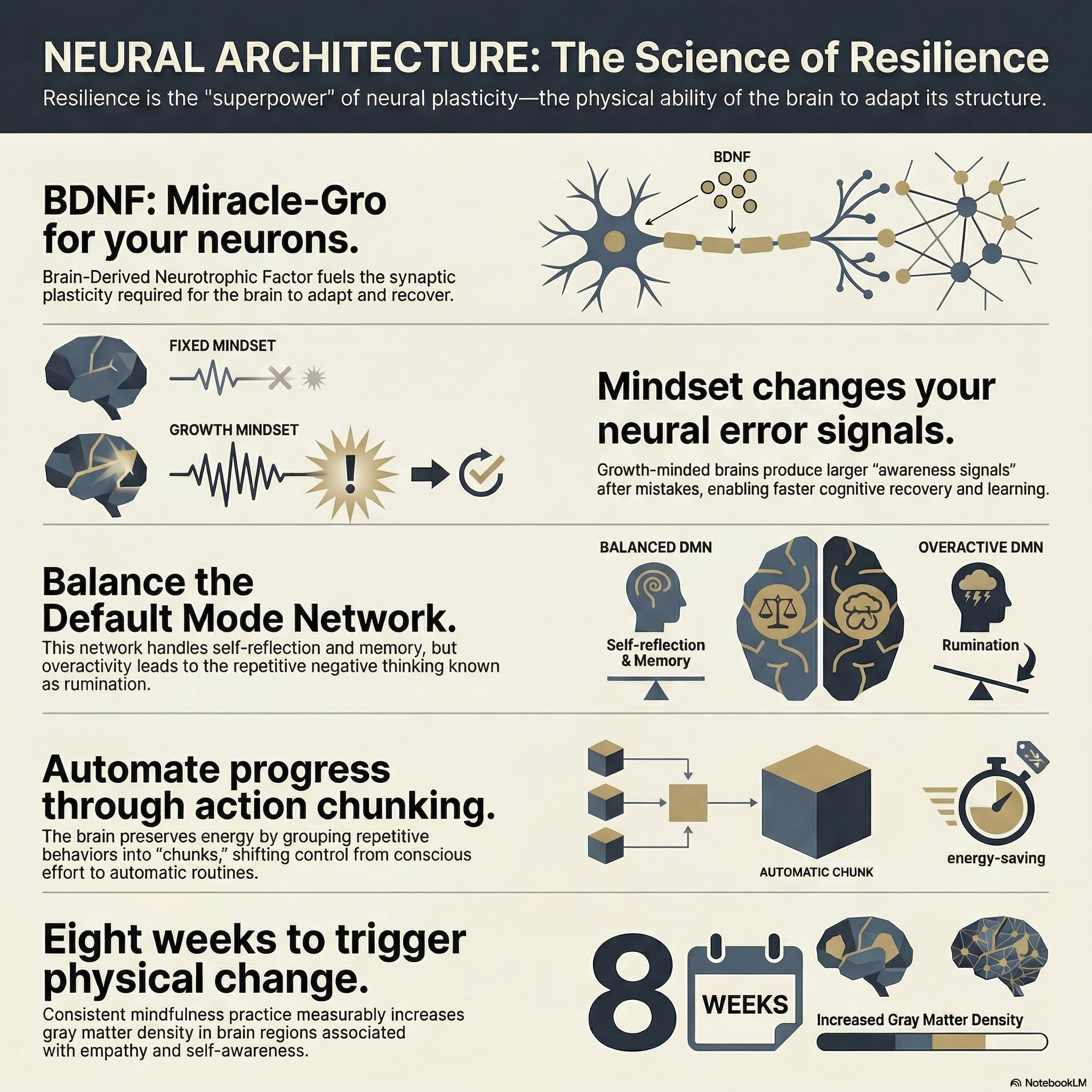
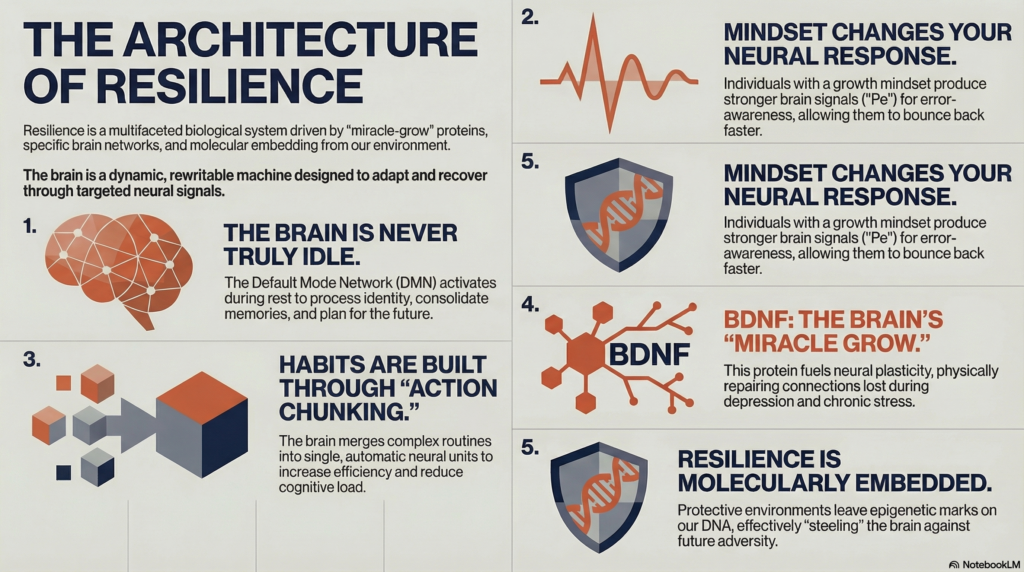
The physical engine driving the ‘Biological Diary’ is Neural Plasticity—the brain’s incredible ability to reorganize itself by forming new neural connections throughout life. The ‘star’ player in this engine is a protein known as BDNF (Brain-Derived Neurotrophic Factor). Scientists often refer to it as ‘Miracle-Gro for the brain’ because it acts as a powerhouse fuel for neuronal growth, survival, and connection.
BDNF functions much like a key entering a specific lock: the TrkB receptor. When BDNF ‘turns the key’ in this receptor, it initiates a complex molecular cascade that signals neurons to survive, grow, and expand. A significant drop in BDNF levels is a primary indicator of vulnerability to depression, reflecting the brain’s diminished capacity to adapt and repair itself.
The Three Superpowers of BDNF:
- Survival: It acts as a neuroprotective shield, actively preserving the health and function of existing neurons.
- Growth: It stimulates neurons to sprout new ‘branches’ (dendrites) and extend connections to neighboring cells.
- Connection: It fuels synaptic plasticity, strengthening the vital communication lines and enhancing efficiency between brain cells.
These essential biological growth factors provide the ‘hardware’ for a resilient brain, while our ‘software’—our internal narrative—is managed by a distinct neural network.
The Default Mode Network (DMN): The Internal Narrative
When you’re not actively focused on an external task, your brain shifts into its ‘rest state,’ governed by the Default Mode Network (DMN). More rigorously known as the Medial Frontoparietal Network (M-FPN), this network typically operates in opposition to the Task-Positive Network; when one is highly active, the other is usually less so.
The M-FPN is crucial for self-reflection, retrieving autobiographical memories, and constructing your sense of identity. It’s where you ‘write the story’ of who you are, but it can also be a double-edged sword, leading to both productive insights and maladaptive rumination.
| DMN: Productive Reflection | DMN: Maladaptive Rumination |
|---|---|
| Consolidating Identity: Integrating past lessons to build a coherent and strong sense of self. | Persistent Negative Replay: A ‘stuck’ DMN obsessively replaying failures or traumas (often linked to hyperconnectivity). |
| Future Planning: Simulating goals, imagining scenarios, and preparing for social interactions to navigate the world effectively. | Self-Criticism: The internal narrative becomes a repetitive loop of self-judgment, strongly associated with depression and anxiety. |
Fortunately, we can learn to ‘guide’ this powerful network through intentional biological and behavioral interventions, transforming it from a potential source of rumination into a powerful tool for resilience.
Rewiring the System: Proactive Resilience Building
One of the most empowering insights from understanding the ‘Biological Diary’ is that you are a co-author of your own biology. We possess the remarkable ability to actively ‘hotwire’ our neuroplasticity and favorably modify our epigenome through specific, consistent habits.
- 🧘 Meditation: Mindfulness meditation serves as a master-tuner of the DMN. Research indicates that consistent practice can trigger significant structural changes in as little as eight weeks. This includes increasing gray matter density in the hippocampus (the brain’s center for learning and memory) while simultaneously decreasing it in the amygdala (the brain’s alarm center for stress and anxiety).
- 🏃 Physical Exercise: Aerobic activity is arguably the most potent natural trigger for BDNF production. It literally ‘fertilizes’ your neurons, fostering the growth and survival of new connections that underpin improved mood, enhanced cognitive flexibility, and stress resilience.
- 🗣️ Psychotherapy: Effective therapeutic interventions do more than just reshape thoughts; they can physically normalize the connectivity of the M-FPN/DMN. Therapy helps the brain efficiently shift between internal reflection and external engagement, effectively ‘de-sticking’ the loops of rumination and promoting healthier cognitive patterns.
These specific habits and our understanding of underlying neural networks provide the powerful tools we can use to activate our internal growth factors and proactively rewrite our biological potential.
Conclusion: The Living Blueprint
It is time to move beyond the deterministic idea that our genetic code is a life sentence. Instead, it is a Living Blueprint—a ‘Biological Diary’ that we actively participate in writing every single day. Resilience is not a rare gift bestowed upon a select few; it is a profound skill facilitated by robust biological pathways like BDNF, the dynamic flexibility of the epigenome, and the intentional guidance of the Default Mode Network.
By truly understanding these ‘molecular volume knobs’ and the ‘Miracle-Gro’ capabilities of the mind, we realize that we are not merely passive recipients of our past experiences. We are, in fact, the proactive architects of our future.
Key Takeaway for the Aspiring Learner:
You are not a finished product. Through intentional interventions such as meditation, physical exercise, and structured reflection, you possess the inherent power to influence your brain’s ‘volume knobs,’ actively fuel your own neural growth, and transform a history of epigenetic ‘scarring’ into a future of profound ‘steeling’ and enhanced resilience.