
In an era of constant digital connection, the philosophy of Digital Minimalism offers a powerful strategic framework for organizations. Championed by author Cal Newport, this movement advocates for intentional technology use to significantly improve mental well-being and, consequently, organizational performance. The core premise is simple: the human brain, evolved over millennia, is ill-equipped for the perpetual stream of social validation and digital noise from modern smartphones. This mismatch leads to cognitive fragmentation, increased anxiety, and diminished focus.
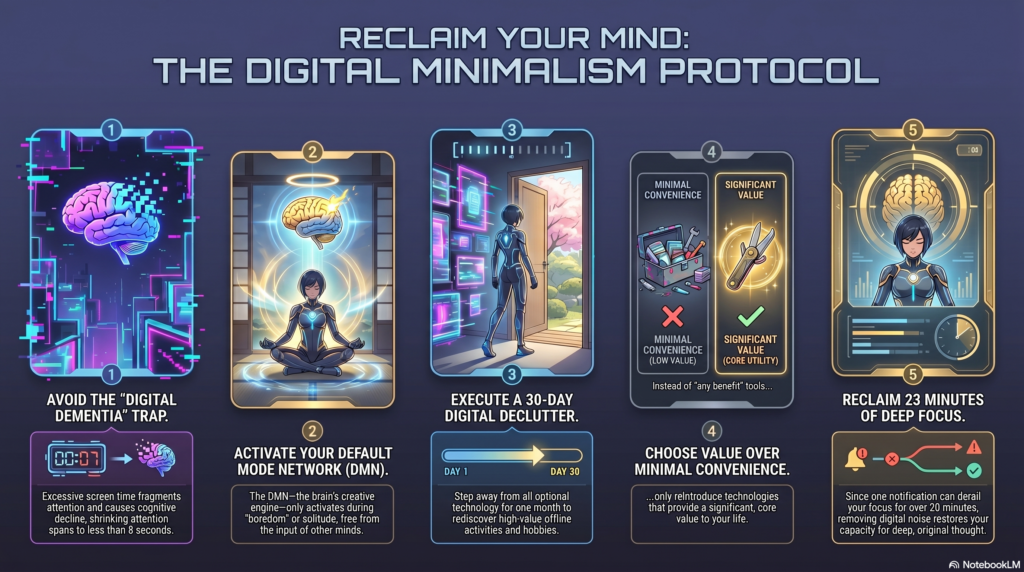
Newport proposes a 30-day ‘digital declutter’ to disrupt addictive dopamine loops and foster healthy boredom and solitude, allowing the brain’s Default Mode Network (DMN) to engage. Scientific insights underscore how reducing screen time can mitigate ‘digital dementia’ and cultivate deeper offline connections. Ultimately, this framework redefines devices as specialized tools rather than constant companions, prioritizing activities that align with an organization’s deepest values and strategic goals.
1. The Modern Cognitive Crisis: Diagnosing the Digital Mismatch
The contemporary professional landscape is marked by a profound ‘evolutionary mismatch.’ While the human brain is an incredibly sophisticated social computer, adept at processing nuanced, in-person cues, it is now barraged by fragmented digital stimuli and artificial social approval metrics. This shift from ‘bounded social interaction’ to incessant ‘portable connectivity’ erodes the cognitive boundaries essential for high-level processing and sustained focus.
For modern organizations, safeguarding ‘cognitive capital’ is no longer a peripheral wellness initiative; it’s a primary strategic asset. In a world where information access is virtually unlimited, an organization’s ability to protect its employees’ finite attention resources is the critical differentiator between stagnation and elite performance.
The Architecture of Overload
The transition to digital-first workplaces has inadvertently institutionalized ‘solitude deprivation.’ Many individuals now spend virtually no time alone with their thoughts. This constant connectivity interferes with the brain’s ancestral social calibration, contributing to heightened social anxiety and compulsive digital use. When every spare moment is filled with digital input, the brain is denied the crucial maintenance time required for cognitive consolidation and emotional regulation.
- Declining Attention Spans: Microsoft research indicates the average human attention span dropped from 12 seconds in 2000 to less than 8 seconds by 2013 — shorter than that of a goldfish.
- The 47-Second Reality: Current data reveals the average time spent on a single screen has fallen to just 47 seconds, with a median of 40 seconds.
- The Refocus Duration: A single digital interruption, such as checking a notification, derails deep focus for an average of 23 minutes. This represents a massive ‘hidden cost’ to organizational innovation, productivity, and error rates.
Strategic Impact
This relentless fragmentation leads to ‘Zoom fatigue’ and the rapid depletion of vital mental resources. The continuous need to ‘erase the internal whiteboard’ and rewrite it with every task or screen change diminishes executive function. Organizations that overlook these metrics risk operating with a cognitively compromised workforce, increasing the likelihood of errors in critical decision-making processes.
2. The Pathology of the Digital Workplace: From Attention Residue to Digital Dementia
Understanding the physiological impact of technology is paramount for long-term employee retention and neurological health. The persistent use of high-tech tools without a structured behavioral framework creates a specific pathology that actively degrades the human cognitive ‘hardware’ necessary for complex problem-solving.
The ‘Attention Residue’ Mechanism
As established by researcher Sophie Leroy, the human brain naturally seeks ‘closure’ — preferring to complete a task before switching focus. When workers switch tasks prematurely, performance suffers due to ‘Attention Residue’:
- Tethered Cognition: A portion of the brain’s resources remains mentally ‘tethered’ to the previous unfinished task, even after the physical transition to a new one.
- Notification Interference: Checking even a single notification (‘ping’) leaves a residue that compromises the brain’s ‘whiteboard,’ preventing 100% cognitive capacity from being applied to the new task.
- The 23-Minute Drain: Due to this persistent residue, it takes nearly half an hour to achieve full cognitive ‘ramp-up’ back to peak flow after an interruption.
Diagnosing ‘Digital Dementia’
Excessive reliance on digital devices for information retrieval can contribute to ‘Digital Dementia,’ a phenomenon characterized by:
- Persistent Forgetfulness: The ‘outsourcing’ of memory functions to devices reduces engagement of the hippocampus, a brain region crucial for memory formation.
- Impaired Executive Functioning: A decreased ability to sustain attention on linear, complex tasks.
- Information Fatigue: Processing speeds decline as the prefrontal cortex (PFC) becomes overwhelmed by non-linear, hyperlinked information.
The ‘Slot Machine’ Neurobiology of Digital Platforms
Digital platforms are meticulously engineered to utilize variable reward schedules, triggering powerful dopaminergic loops in the midbrain. This design often functions like a ‘digital slot machine,’ making checking behaviors highly addictive:
| Brain Region | Role in Digital Connectivity | Impact of Chronic Stimulation |
|---|---|---|
| Ventral Tegmental Area (VTA) | Origin of dopamine; processes rewards and social approval. | Hypersensitization to social cues; triggers obsessive checking behaviors. |
| Nucleus Accumbens (NAc) | Hub for reward anticipation and addiction-related behaviors. | ΔFosB Accumulation: This molecular marker builds up, creating a ‘vicious cycle’ of craving and addiction. |
| Prefrontal Cortex (PFC) | Responsible for executive function, focus, and inhibitory control. | Weakened inhibitory control; heavy digital users may experience a significant drop in impulse regulation. |
3. Philosophical Reorientation: Redefining Technology as a Utility Asset
Organizations must adopt a ‘first principles’ approach to technology. This necessitates a critical shift from a ‘maximalist’ mindset — uncritically adopting any tool that offers a modicum of value — to a minimalist framework that treats technology as a curated utility.
The Minimalist Tenets
Digital Minimalism is built upon three core strategic pillars:
- Missing Out is Not Negative: The profound value gained from deep focus on carefully selected activities far outweighs the infinite tally of avoided low-value diversions.
- Less Can Be More: An 80/20 analysis often reveals that concentrating energy on a small number of high-quality digital tools returns significantly more total value than spreading attention across dozens.
- Activity Trumps Passivity: Truly fulfilling online engagement involves active creation, meaningful contribution, or robust support for offline activities, rather than passive, algorithmic consumption.
The Value Taxonomy
- Core Value: Activities that directly support deep bonding, physical and mental health, or fundamental professional goals (e.g., high-resolution communication for critical projects).
- Minor Value: Fleeting distractions or minor conveniences (e.g., general social media feed scrolling, endless news consumption).
- Invented Value: Tools specifically designed to solve problems created by the tool itself (e.g., maintaining ‘streaks’ or status indicators on certain platforms).
The Utility Shift
Strategic implementation requires ‘working backwards.’ Instead of asking what value a tool *might* offer, employees must first identify their core values and strategic objectives. Only then should they identify the specific digital tools that are the absolute best and most efficient way to support those values. Technology must transform from a ‘source of value’ to a carefully selected ‘tool that supports value.’
4. Operational Implementation: The 30-Day Organizational Digital Declutter
A ‘radical reset’ is often required to break entrenched behavioral addictions and recalibrate the brain’s reward system. The 30-day organizational digital declutter serves as a robust behavioral systems design intervention.
The ‘Optionality’ Audit
The first step involves a comprehensive audit to identify ‘optional technology’ — tools that can be temporarily removed for 30 days without critical negative consequences:
- Optional: Social media platforms, news aggregation apps, non-essential notifications, certain entertainment streaming services.
- Non-Optional: Essential logistics tools (e.g., core project management software, calendaring systems).
- Rules for the Essential: For non-optional tools, implement strict ‘sender filters’ and establish specific rules for when and how they are used (e.g., checking email only at designated times like 10 AM and 4 PM).
The Discovery Phase
The 30-day declutter is an active phase of ‘Action and Experimentation.’ Its success hinges on intentionally filling the newly freed time with high-quality, offline activities. This could include physical making, aerobic exercise, engaging in new hobbies, or fostering in-person social affiliation. Without this crucial discovery of alternative, fulfilling activities, the brain is prone to reverting to addictive digital loops once the declutter period ends.
The Reintroduction Protocol
Following the 30-day period, digital tools are only re-incorporated if they successfully pass two rigorous tests:
- The First Principles Test: Does this tool genuinely support something significantly important to my life or work? Is it aligned with my core values or professional objectives?
- The Best Way Test: Is this specific tool truly the absolute best way to support that value, or is there a higher-quality, less distracting, or more efficient alternative available?
5. The Restorative Advantage: Leveraging the Default Mode Network (DMN)
Corporate creativity, problem-solving, and professional identity formation are powerful engines often fueled by healthy boredom and intentional solitude. Innovation frequently emerges as a byproduct of ‘white space’ that allows the brain’s Default Mode Network (DMN) to engage in crucial divergent thinking.
Solitude vs. Loneliness
- Intentional Solitude: This is time spent deliberately free from inputs from other minds. It actively facilitates Parasympathetic Dominance and increases Heart Rate Variability (HRV), signaling a high-performance recovery state essential for cognitive regeneration.
- Trait Loneliness: This is subjective social isolation that activates the HPA axis, leading to elevated cortisol levels and chronic metabolic stress, which is detrimental to cognitive function.
The Neurobiology of Creativity
Studies, such as the Lariboisière research, confirm the DMN’s causal role in tasks requiring divergent thinking, like the ‘Alternative Uses Task’:
- Theta Oscillations (4-7 Hz): These brainwave patterns are associated with inter-network communication and are essential for the initial phase of idea generation and creative exploration.
- Gamma Oscillations (30-70 Hz): Significantly increased during the response phase, these reflect intense local network processing and the emergence of creative insights.
- Connectivity: High levels of creativity demand synchronized communication between the DMN, the Saliency Network (SN), and the Fronto-Parietal Control Network (FPT-CN). Constant digital input suppresses these crucial oscillations, thereby reducing the originality and quality of creative responses.
The Four Pillars of DMN Engagement
Activating and leveraging the DMN for innovation and well-being involves:
- External Safety: Proactively removing digital interruptions and minimizing environmental triggers that demand attention.
- Psychological Safety: Engaging in calming practices to quiet threat-inducing thoughts and reduce HPA axis activity.
- Parasympathetic Dominance: Activating the body’s ‘rest-and-digest’ response, often through rhythmic breathing or mindfulness.
- Cellular Optimization: Shifting bodily resources toward mitochondrial repair and synaptic maintenance, crucial for long-term brain health.
6. Tactical Framework: Environment Design and Cognitive Micro-Habits
Sustaining a minimalist digital environment significantly reduces the reliance on willpower. Instead, it automates cognitive protection through intelligently designed environmental triggers and habitual routines.
The ‘Micro-Habit’ Toolkit
Integrating small, actionable micro-habits can profoundly impact cognitive well-being:
| Strategy | Neurological Mechanism | Practical Application |
|---|---|---|
| Bilateral Walking | Engages both hemispheres of the brain; signals safety via optic flow and movement, reducing stress. | Take a 10-minute outdoor walk without your phone to clear your mind. |
| Slow Gaze Pattern | Leverages visual pathways to help exit ‘fight-or-flight’ (sympathetic) mode and promote calm. | Slowly move your eyes across a room, observing details, to signal a lack of immediate threat. |
| Habit Stacking | Anchors a new, desired behavior to an already established and strong neural pathway. | Read a physical book for 20 minutes immediately after your first cup of coffee each morning. |
Structural Boundaries
- The Mere Presence Effect: Research conclusively shows that the mere presence of a smartphone on a desk — even if turned off — reduces available cognitive capacity. For high-demand tasks, phones should be kept in a separate room.
- No-Phone Zones: Establish dedicated tech-free windows and physical zones within the workplace (e.g., designated meeting rooms, focused work periods, the hour before sleep) to allow the DMN to activate and deep work to occur.
- Physical Mitigation: Regular aerobic exercise significantly increases Brain-Derived Neurotrophic Factor (BDNF), a protein that promotes synaptic plasticity and helps to reverse digital-induced cognitive decline.
7. Strategic Summary: The Future of Human-Centric Performance
Organizations that proactively implement these cognitive safeguards will gain a definitive competitive advantage. As the incoming talent pool (‘iGen’) arrives with pre-existing solitude deprivation and fragmented attention, these safeguards are no longer mere perks; they are fundamental requirements for effective onboarding, talent retention, and sustained high performance.
Primary Pillars of the Framework
- Neurological Restoration: Actively engaging DMN Theta/Gamma oscillations and meticulously managing ‘attention residue’ which costs an estimated 23 minutes per interruption.
- Philosophical Intentionality: Transitioning from a maximalist approach to a first-principles, deliberate curation of digital tools.
- Environmental Discipline: Utilizing structural boundaries and thoughtful environment design to eliminate the ‘Mere Presence’ drain on the prefrontal cortex.
Final Directive
Technology must be strategically repositioned as a servant to human flourishing and organizational effectiveness. The ultimate goal is to re-engineer the organizational ecosystem so that deep focus, sustained creativity, and meaningful work become the path of least resistance. Reclaiming the spotlight of human attention is the essential first step toward building a sustainable, high-performance future.