Have you ever found yourself disproportionately valuing something you poured your own time and effort into, even if it wasn’t perfect? This isn’t just sentimentality; it’s a powerful psychological phenomenon known as the IKEA Effect. Individuals instinctively place a higher value on items they helped create or assemble. This article delves into how our labor transforms perceived worth, turning simple components into cherished possessions.
Research consistently shows that this bias stems from a fundamental human need for competence and self-efficacy. Labor isn’t merely a cost; it becomes a source of deep emotional attachment. Beyond assembling furniture, this concept applies to modern business strategies, the dynamics of relationships, and even the development of artificial intelligence workflows. While the IKEA Effect fosters sustainability and brand loyalty, experts also warn that it can lead to irrational decision-making, such as overvaluing flawed internal projects. From an evolutionary standpoint, this behavior links to ‘niche construction,’ where organisms actively modify their environments for survival. Together, these insights offer a multidisciplinary framework for understanding how personal investment shapes our perception of worth in an increasingly technological world.
The Mystery of the Wonky Bookshelf
Imagine it’s 2026, and you’ve just moved into your first studio apartment. You’re confronted with a massive, intimidating box from IKEA, overflowing with wooden slabs, a bag of identical screws, and a manual featuring a cartoon character who looks far more confident than you feel. You dedicate your entire Saturday afternoon to battling confusing diagrams and navigating your own “user errors.” By the time you tighten the final bolt, the bookshelf stands, slightly lopsided, with two mysterious screws left over.
Yet, as you step back, a strange mental shift occurs. You don’t see a “shabby” piece of furniture; you see a masterpiece. You value that wonky shelf more than the high-quality, pre-assembled desk you bought last month. This profound cognitive bias, the IKEA Effect, explains why. We imbue inanimate objects with a piece of our own identity through the simple act of labor, leading us to place a disproportionately high value on things we helped create.
Quick Fact: The 63% Premium
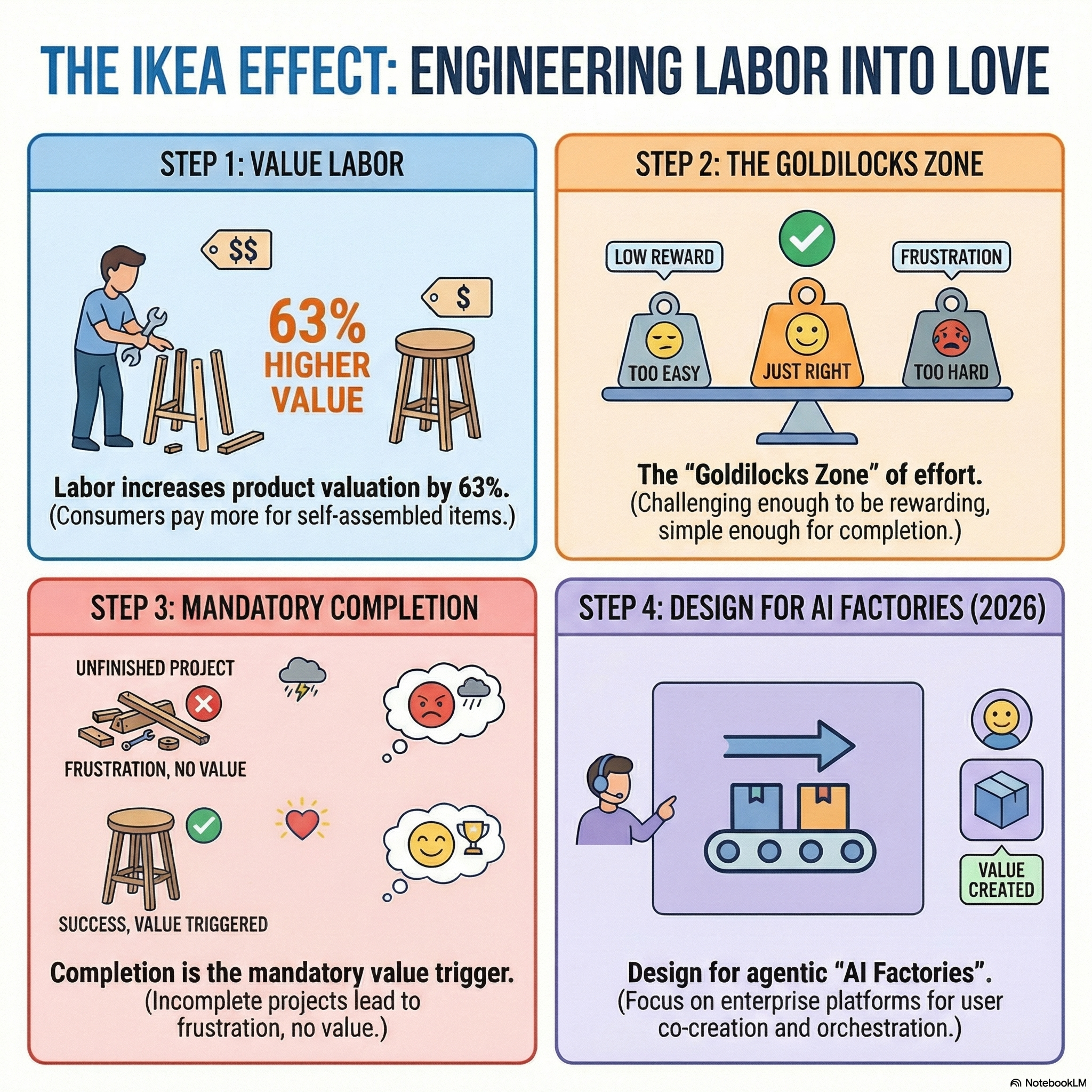
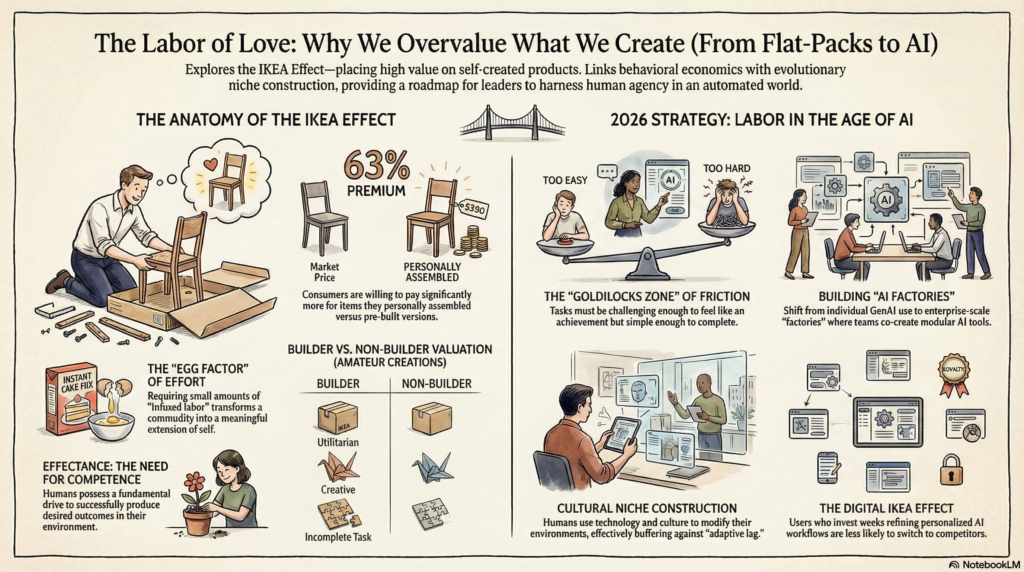
A landmark 2011 study by researchers from Harvard, Yale, and Duke revealed a striking insight: participants were willing to pay 63% more for furniture they assembled themselves compared to identical, pre-built items. In this context, the labor wasn’t a “cost”; it was a powerful value-multiplier.
This surge of pride marks your first step across a transformative bridge, moving from a world of environmental chaos to one of meaningful structure.
Crossing the Transformative Bridge: From Entropy to Order
From a psychological perspective, the act of building is a direct confrontation with Entropy—the natural state of disorganized, unorganized parts that hold potential but lack immediate utility. A pile of wood remains just a pile; it requires a “transformative bridge” of effort to become a functional home for your books.
This bridge is fueled by Effectance: the fundamental human need to successfully produce desired outcomes in our environment. We possess a deep-seated drive to feel competent and in control. When you impose order on a collection of parts, you’re not merely building furniture; you’re validating your ability to shape the physical world around you.
Your journey from chaos to cabinet typically follows a predictable path:
- The Entropic State: You begin with disparate parts and untapped potential.
- The Labor Phase: This is the “controlled friction” of the build—the physical manipulation and the mental effort required to follow a roadmap.
- The Structured Outcome: A functional reality that serves as a concrete mirror, reflecting your own competence back at you.
This feeling of “I did that” isn’t just a fleeting mood; it’s driven by specific biological mechanisms that translate labor into emotional connection.
The Mechanics of “Labor-Equity”: Why We Love What Hurts
Why does the “pain” of labor—the missing screws and confusing manuals—actually deepen our affection for the result? Two core psychological mechanisms underpin this phenomenon of “labor-equity.”
Effort Justification (Cognitive Dissonance)
When we invest significant effort into a task, we often experience psychological discomfort if the outcome seems mediocre. To resolve this “dissonance” (e.g., “I am a smart person, yet I spent four hours on this lopsided table”), our brains instinctively inflate the value of the result. This mental adjustment makes the extensive work feel justified and worthwhile.
The Endowment Effect (and Pseudo-Endowment)
We naturally value things more simply because we own them. The Endowment Effect explains this bias. However, “haptic feedback”—the actual physical touch and manipulation of items during creation—generates a sense of “pseudo-endowment.” We begin to feel the object is “ours” long before the project is completed, fostering an early bond.
Experimental data vividly illustrates a staggering gap in valuation, particularly when comparing utilitarian tools to creative projects:
| Experimental Item | Item Type | Builder Valuation | Non-Builder Valuation | Key Insight |
|---|---|---|---|---|
| IKEA Boxes | Utilitarian | ~$0.78 | ~$0.48 | Builders valued their work 63% higher; labor added functional pride. |
| Origami Cranes | Hedonic | ~$0.23 | ~$0.05 | Builders valued their “amateur” art 5x more than observers, often expecting others to perceive “expert” quality. |
| LEGO Sets | Hedonic | High | Low | Significant identity extension formed through playful construction. |
Corporate giants recognized this secret of “labor-equity” long before psychologists formally named it, leading to a revolution in product design.
The “Egg Factor”: A Masterclass in Designing Effort
In the 1950s, Betty Crocker introduced an “instant” cake mix that only required adding water. Despite its efficiency, it was a commercial flop. The process was too easy; it failed to trigger any sense of pride or personal investment. With no labor, there was no perceived value.
The ingenious solution? The “Egg Factor.” They altered the recipe to require the baker to add a fresh egg. This seemingly minor infusion of “labor and skill” was just enough to make the baker feel like they were genuinely baking a cake, rather than simply rehydrating powder. This is a prime example of “Friction-by-Design.”
However, there’s a crucial balance to strike: you must remain within the Goldilocks Zone. If a task is too easy, it becomes boring. Conversely, if it’s so difficult that you fail or destroy the project, the IKEA Effect vanishes entirely, replaced by frustration.
In our world of 2026, this concept has evolved into Agentic Co-creation. While you may have heard that “Prompt Engineering is Dead,” the reality is that today we don’t just ask AI for an answer; we actively build “Process Workflows.” By training your own AI agents and orchestrating their tasks, you invest “labor-equity” into digital systems. Consequently, you value your customized AI more than a standard corporate bot because you were the director of its development.
Building Your World: Niche Construction and Sustainability
This innate drive to build is an evolutionary trait known as Niche Construction. Much like beavers building dams, humans actively modify their environments to suit their needs. As the Laland Lab’s Adaptive-Lag Hypothesis suggests, we don’t just change our world; we employ “cultural niche construction” to buffer ourselves. We construct houses, heating systems, and digital tools so our “Stone Age brains” can feel at home in a high-tech era.
This “maker” instinct isn’t solely about survival; it’s deeply connected to stewardship. We are currently grappling with a Sustainability Paradox. In the U.S. alone, over 12.1 million tons of furniture waste are generated annually, with a staggering 80% ending up in landfills. However, the IKEA Effect offers a compelling solution: when you build or repair an item yourself, you are significantly less likely to discard it. “Fast furniture” can transform into a “lasting heirloom” because your personal labor creates an emotional bond that resists the landfill.
This principle extends beyond physical objects into our intangible worlds as well:
- In Hobbies: Mastering a “shabby” first painting provides more emotional resonance than simply buying a perfect print because it serves as a tangible record of your growth and effort.
- In Relationships: Bonds thrive on “mutual investment.” Enduring “thick and thin” together creates a shared niche that is far more valuable and resilient than a relationship that has never been tested.
The Biology of the Build: The Accelerator and the Brakes
Your brain is exquisitely hardwired for the act of building through a sophisticated “Frustration-Dopamine Loop.” Modern neuroimaging in 2026 has unequivocally shown that the “stop” signals associated with frustration actually prime your brain for an even greater reward.
We can conceptualize this process using the “Accelerator and Brakes” metaphor:
- Dopamine (The Accelerator): This acts as the forward drive, providing the “go” signal that propels you to finish the task. It delivers that hit of euphoria when the final piece clicks into place, signaling completion and reward.
- Serotonin (The Brakes): This hormone provides the patience needed to evaluate your work. It allows you to slow down, catch mistakes, and ultimately bond more deeply with your creation once it’s finished, fostering a sense of contentment and attachment.
Your Internal Brain Map for creation involves several key regions:
- Prefrontal Cortex: Functions as the “Project Manager,” handling planning, structural organization, and following manuals.
- Nucleus Accumbens: The “Reward Center” that signals intense pride the moment the object is “finished.”
- Norepinephrine: Manages your frustration levels, helping to keep you within the Goldilocks Zone so you don’t abandon the project prematurely.
Final Blueprint: The Power of Making
The ultimate lesson of the IKEA Effect is profound: we do not simply consume value; we actively imbue it through the labor of our lives. Our personal investment transforms mere commodities into something meaningful and deeply personal.
The Maker’s Advice:
The next time you build a shelf, master a new AI workflow, or embark on a new hobby, embrace the “wonky” and the “shabby.” Don’t fret if it isn’t perfect. The effort you invest is the true foundation of your pride and attachment. In a world grappling with millions of tons of waste and the allure of instant digital results, your labor is the only force that can truly transform a cold commodity into a cherished part of your soul.
We do not just find structure in the world; we create it, one bolt at a time, one line of code at a time, one shared experience at a time.