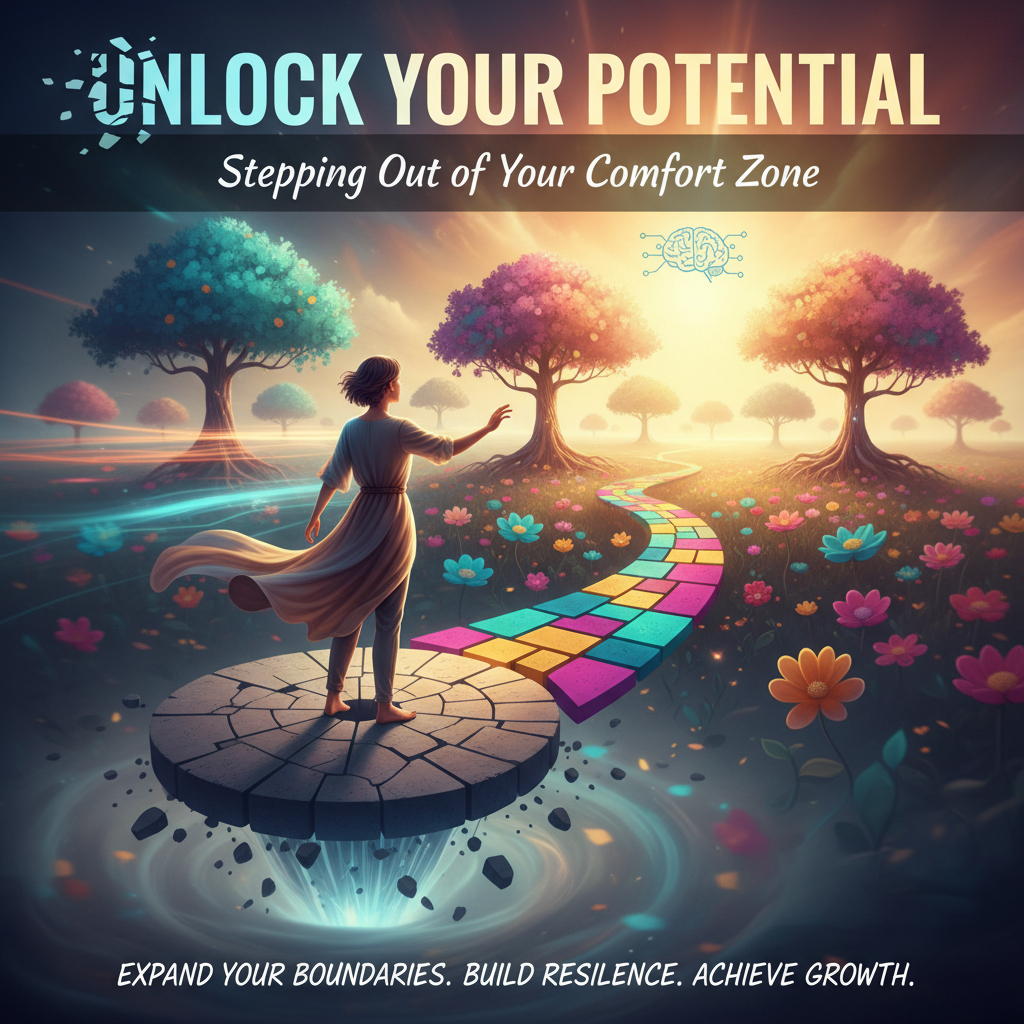
Unlock Your Potential: A Comprehensive Guide to Stepping Out of Your Comfort Zone
Welcome to your essential guide on personal growth and self-transformation. The “comfort zone” is a powerful, yet often limiting, concept that explains why we instinctively stick to familiar routines, even when we know there’s much more to achieve. This article will define what a comfort zone truly is, explore the compelling benefits of stepping beyond its boundaries into the “growth zone,” and offer a practical, step-by-step framework to help you confidently unlock your full potential.
1. What Exactly Is a Comfort Zone? Defining Your Familiar Space
At its core, your comfort zone is a mental, emotional, and behavioral space where activities and experiences feel familiar, safe, and manageable. It’s the collection of routines, habits, and patterns where you can operate with minimal stress, perceived risk, or fear of failure.
This isn’t a sign of weakness; it’s a fundamental aspect of human biology. The brain is hardwired to seek safety and avoid uncertainty. While this instinct protected our ancestors from physical dangers, in today’s world, it often prevents us from realizing our true potential by encouraging us to stick with what we already know.
1.1. The Invisible Rules: Understanding Your Personal Paradigm
To truly understand your comfort zone, you must first recognize the invisible rules that create it. This is your personal paradigm—a “mental map” that guides how you perceive the world. It’s composed of the underlying assumptions, values, and beliefs that shape your reality. Most of us are unconsciously governed by our paradigms; they are like the water a fish swims in—so pervasive they remain unseen.
Consider “Jane,” a professional in a competitive field. Her paradigm might include interconnected beliefs such as:
- “I must constantly work harder to achieve success.”
- “Taking breaks is a sign of weakness or laziness.”
- “I cannot afford to make any mistakes.”
These individual thoughts combine to form a paradigm that equates success with relentless effort and perfectionism. This mental map creates a comfort zone for Jane—a state of continuous work without sufficient rest, driven by an underlying fear of failure. This paradigm acts as a cognitive bias, a mental shortcut that, while intended to save energy, keeps Jane trapped in a cycle that no longer serves her growth.
Once you recognize the invisible walls of your paradigm, the natural next question becomes: what extraordinary rewards await you on the other side?
2. Why Leave Your Comfort Zone? The Power of the Growth Zone
While your comfort zone feels undeniably safe, staying there permanently inevitably leads to stagnation. The greatest rewards—such as increased confidence, the acquisition of new skills, and deeper resilience—are consistently found just outside its familiar boundaries. This transformative area is often referred to as the Growth Zone (or Stretch Zone), a space of productive discomfort where you can genuinely expand your abilities and capabilities.
2.1. Top 3 Benefits of Embracing Productive Discomfort
Venturing beyond your familiar routines actively builds critical psychological resources essential for long-term success and overall well-being. These include:
- Build Resilience and Confidence: When you cultivate resilience, you learn to view obstacles not as insurmountable threats, but as valuable opportunities to stretch and develop your abilities. Each time you successfully face a challenge and adapt, you build unwavering confidence in your capacity to handle future uncertainty. This self-assurance is the very heart of true resilience.
- Increase Your Self-Efficacy: Self-efficacy is your belief in your own capacity to succeed in specific situations. Successfully completing tasks just outside your comfort zone is the most powerful and effective way to build this crucial belief. Each incremental success reinforces the idea that you are capable, which in turn makes you more likely to embrace and take on future challenges.
- Rewire Your Brain for Growth (Neuroplasticity): Your brain is remarkably not fixed; it possesses an incredible ability to change and adapt throughout your life, a quality known as neuroplasticity. When you repeatedly practice new and initially uncomfortable behaviors, your brain actively forms new neural pathways. Over time, these actions become progressively easier until they feel “normal” or even second nature. This process is the neurobiological definition of expanding your comfort zone. The discomfort you feel is literally the sensation of your own potential being unlocked and realized.
To expand those borders safely and effectively, it’s crucial to understand the terrain ahead: the three distinct zones of personal growth.
3. The Three Zones of Personal Growth: Comfort, Growth, and Panic
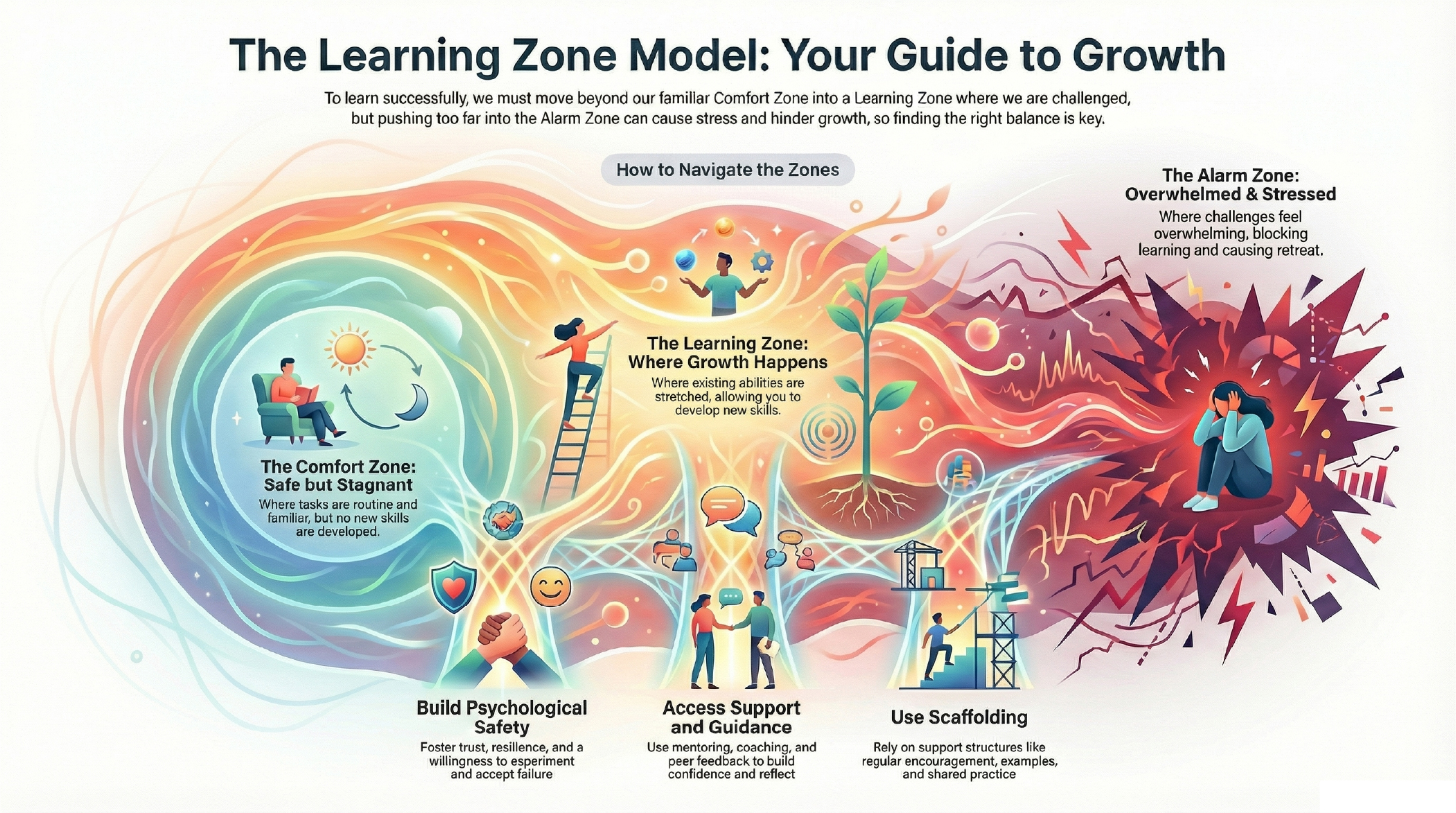
The journey out of your comfort zone isn’t a single, reckless leap from safety into chaos. Psychologists describe it as a natural progression through three distinct zones: the Comfort Zone, the Growth Zone (also known as the Stretch or Learning Zone), and the Panic Zone.
Understanding these zones is fundamental to effective personal growth. According to the Yerkes-Dodson Law, our performance improves with a moderate level of anxiety (achieved within the Growth Zone) but declines sharply when stress becomes overwhelming and debilitating (entering the Panic Zone). The ultimate goal is to consistently find that “sweet spot” of productive discomfort.
3.1. A Comparison of the Personal Growth Zones
Let’s break down what each of these zones actually feels like, so you can learn to recognize where you are at any given moment and navigate your growth more effectively.
| Zone | Your Experience | The Outcome |
|---|---|---|
| Comfort Zone | You feel safe, familiar, and in control. Activities are routine and manageable. | Security and low stress, but also complacency, stagnation, and missed opportunities. |
| Growth Zone | You feel a moderate, beneficial level of anxiety or stretch. You are challenged and actively learning new skills. | Optimal learning, increased self-confidence, expanded abilities, and enhanced performance. |
| Panic Zone | You feel overwhelmed, highly stressed, and paralyzed by fear. The challenge is too great, leading to shutdown. | Poor performance, heightened anxiety, decision paralysis, and a strong desire to retreat. Learning is blocked. |
We’ve all experienced the Panic Zone, and it’s a deeply uncomfortable place. The key is recognizing it not as a personal failure, but simply as a clear signal to take a strategic step back into the productive Growth Zone.
Now that you can distinguish between productive stretch and counter-productive panic, let’s turn this vital knowledge into a practical, step-by-step plan for consistent expansion.
4. A Practical Guide to Expanding Your Comfort Zone
Understanding the theoretical model of growth zones is the crucial first step. Now, let’s move from theory to practical application and build your personal engine for continuous growth. Expanding your comfort zone is a learnable skill that can be developed through intentional, consistent practice. It’s not about being reckless; it’s about exercising your agency—your inherent power to actively choose, influence, and direct your own development, rather than merely reacting to life’s circumstances.
4.1. Step 1: Question Your “Mental Map” (Your Paradigm)
The first and most powerful step in expanding your comfort zone is to make your invisible paradigm visible. Once you recognize the specific set of beliefs that define and limit your comfort zone, you can begin to question their validity and utility. Start by asking yourself reflective questions such as:
- “Is this belief I hold actually true for me, or is it an outdated assumption?”
- “Is there another, potentially more empowering, way to interpret this situation?”
- “What underlying assumption is truly driving my current behavior and choices?”
This internal dialogue is the essential starting point for all conscious and lasting personal change.
4.2. Step 2: Start with Small, Methodical Steps to Build Momentum
Leaving the comfort zone doesn’t require throwing caution to the wind or making drastic, overwhelming changes. Lasting and sustainable change comes from taking small, achievable steps that consistently build momentum and confidence. As Eleanor Roosevelt famously advised:
“Do one thing every day that scares you.”
To make this advice practical, break down any larger goals into smaller, manageable subgoals. This strategy ensures incremental success, which is the most effective way to build the self-efficacy needed to confidently tackle bigger challenges later on. For instance, if your ultimate goal is to speak confidently in public, a practical subgoal isn’t immediately giving a keynote speech. Instead, a more achievable subgoal might be to simply ask one question in a meeting this week.
4.3. Step 3: Create an “Intentional Discomfort Cycle” for Sustainable Growth
This powerful strategy involves creating a disciplined balance between seeking comfort and embracing growth, shifting you from a reactive state (avoiding discomfort) to a proactive one (strategically planning for growth).
- Establish Comforting Routines: First, intentionally create and maintain routines that provide structure, stability, and a sense of security in your daily life. By controlling the controllable elements, you build a secure foundation from which you can confidently explore and expand.
- Schedule Intentional Discomfort: Next, purposefully schedule activities that will gently place you in the Growth Zone. This could mean taking an introductory class in a completely new skill, initiating social contact with new acquaintances, or volunteering for a challenging but rewarding project at work. By making discomfort a planned and regular part of your schedule, you transform it from an intimidating threat into a deliberate and empowering practice.
This thoughtful cycle of grounding yourself in comfort and then intentionally stretching your boundaries creates a sustainable and effective model for long-term personal growth and development.
5. Your Journey to Growth: Key Takeaways & Moving Forward
Expanding your comfort zone is a continuous journey, not a final destination. This is an ongoing process of becoming a more resilient, capable, and authentic version of yourself. Remember these core principles as you embark on this transformative journey:
- Your Comfort Zone is Built on a Paradigm: Your comfort zone is fundamentally defined by your “mental map”—the often-invisible beliefs and assumptions you hold. The crucial first step to growth is to become aware of this map and bravely question its limitations.
- Growth Happens in the ‘Stretch’ Zone, Not the ‘Panic’ Zone: The ultimate goal is not overwhelming stress or debilitating fear, but rather a moderate, beneficial level of challenge. A manageable level of anxiety is optimal for learning, developing new skills, and significantly improving your performance.
- Take Small, Intentional Steps Consistently: Lasting and meaningful growth comes from consistent, small actions. Break down larger goals into achievable steps and intentionally schedule activities that gently push your boundaries in a supportive and empowering way.
- Embrace Discomfort as a Sign of Progress: Learn to view the feeling of being challenged or slightly uncomfortable as a positive sign that you are actively expanding your abilities, building resilience, and truly growing. As Abraham Maslow profoundly stated:
“One can choose to go back toward safety or forward toward growth. Growth must be chosen again and again; fear must be overcome again and again.”
Begin your journey today. Your potential awaits just beyond the familiar.