The Neuroscience of Music: How Sound Shapes Your Brain & Emotions
Have you ever felt a sudden shiver during a powerful musical crescendo? Or found yourself transported back in time by just a few notes of a familiar song? Perhaps you’ve struggled to dislodge a catchy chorus from your mind. These universal experiences aren’t random; they are the result of an intricate dance between sound, emotion, and the complex wiring of the human brain. This journey into the neuroscience of music will reveal not only what your brain is doing on music, but how music actively shapes the brain you have.
1. Music: The Ultimate Brain Workout for Enhanced Cognition
Listening to music is far from a passive activity for your brain. It’s one of the most cognitively demanding tasks a human can undergo, providing a comprehensive workout that engages and strengthens neural pathways like few other activities. This cognitive benefit of music makes it a powerful tool for brain health.
1.1. From Vibration to Melody: The Brain’s Auditory Journey
The journey from a simple air vibration to a meaningful melody in your mind is a remarkable feat of biological engineering. Here’s how sound becomes music:
- Vibrations in the Air: Sound originates as vibrations from a source, like a speaker, traveling through the air.
- The Ear’s Funnel: These vibrations enter the ear canal, causing the eardrum to vibrate.
- The Electrical Signal: The eardrum’s vibrations are meticulously transmitted and converted into an electrical signal.
- The Brain’s Interpretation: This signal travels along the auditory nerve to the brain stem, where your brain decodes and interprets the raw electrical data, reconstructing it into the rich tapestry of pitch, rhythm, and timbre that we perceive as music.
1.2. How Music Rewires Your Brain: Neuroplasticity in Action
Engaging with music activates almost all parts of the brain simultaneously. Research highlights that the only other activity stimulating the brain so broadly is social interaction. This widespread activation strengthens neural networks, leading to tangible cognitive benefits of music:
- Boosting memory
- Improving concentration
- Sharpening problem-solving skills
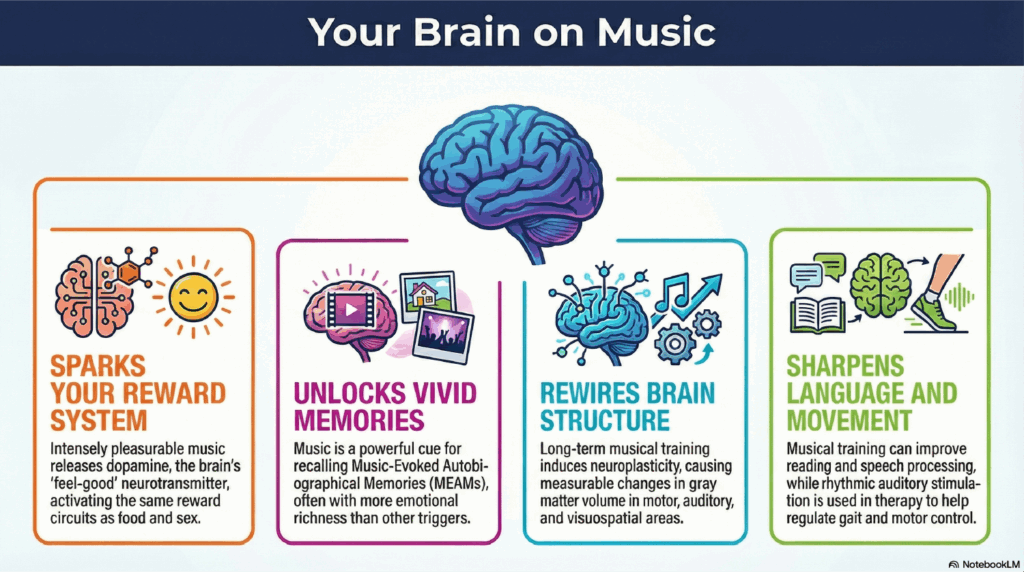
This “total brain workout” is more than a metaphor; it actively changes the physical structure of your brain through neuroplasticity. This is the brain’s remarkable ability to reorganize itself by forming new neural connections in response to experience. Long-term musical training can lead to observable anatomical changes, such as a larger corpus callosum (the neural bridge connecting the brain’s two hemispheres) and increased gray matter volume in motor, auditory, and visuospatial areas. This means every time you listen to a new song or practice an instrument, you are literally reshaping your brain.
This intricate workout generates a symphony of synchronized electrical signals, leading to the next level of music’s influence: its ability to shape your brainwaves.
2. Hacking Your Brainwaves: How Music Synchronizes Your Mind
2.1. Understanding Brainwave Frequencies: Your Mind’s States
Your brain is an electrochemical powerhouse, with billions of neurons communicating via electrical signals. When large groups of these neurons fire in synchronized patterns, they create rhythmic pulses known as brainwaves. Measurable with an electroencephalogram (EEG), these waves are categorized by their frequency (Hertz, Hz). Different frequencies correspond to distinct states of consciousness, from deep sleep to intense focus.
2.2. The Five Main Brainwave Frequencies
Your current mental state is largely determined by which brainwave frequency is dominant. Understanding these brainwave frequencies helps explain how music’s effect on brainwaves can influence your mood and focus.
| Brainwave | Frequency (Hz) | Associated State of Mind |
|---|---|---|
| Delta | 1–4 Hz | Deep, dreamless sleep, healing, and access to the unconscious mind. |
| Theta | 4–8 Hz | Deep relaxation, meditation, creativity, and dreaming. |
| Alpha | 8–14 Hz | Relaxed focus, positive thinking, and the “flow state.” |
| Beta | 14–30 Hz | Focused attention, analytical thinking, and problem-solving. |
| Gamma | 30–100 Hz | Deeper concentration, heightened perception, and memory recall. |
2.3. The Frequency-Following Effect: Entraining Your Brain with Music
One of the most remarkable ways music interacts with our brain is through the frequency-following effect. This is your brain’s natural tendency to synchronize its own electrical cycles to the rhythm of external stimuli, a process called entrainment.
A clear example is binaural beats. If you listen to a 440 Hz tone in your left ear and a 444 Hz tone in your right, your brain perceives an auditory illusion: a third tone pulsing at 4 Hz (the difference between the two frequencies). Your brain then begins to synchronize its own activity to this 4 Hz frequency, which falls within the Theta range. This illustrates how music with a certain tempo or rhythm can gently guide your brain toward a desired mental state—a slow, meditative piece might encourage relaxing alpha waves, while a faster, more complex composition could promote the beta waves needed for sharp focus.
This electrical entrainment sets the stage for a much deeper, chemical reaction that explains why music feels so powerfully emotional.
3. Why Music Moves Us: The Neuroscience of Emotion and Reward
Music’s ability to evoke joy, sadness, or nostalgia is not just poetic—it’s a biological reality rooted in the activation of two of the brain’s most critical networks: the emotion and reward systems. This is the core of the emotional impact of music.
3.1. The Brain’s Emotional & Reward Systems: Dopamine and Deep Feelings
When a song gives you chills or brings a tear to your eye, it directly interacts with evolutionarily older brain circuits responsible for emotion and survival.
- The Limbic System (The Emotion Center): Music is a powerful key to unlocking our emotional core. It stimulates key parts of the limbic system, including the amygdala, central to processing emotions, and the hippocampus, integral to consolidating memories. This deep connection explains why a particular song can instantly transport you to another time and place, invoking vivid memories and their associated emotions.
- The Reward System (The Pleasure Circuit): Ever gotten goosebumps from music? That’s your brain’s reward system at work. Listening to pleasurable music triggers the release of dopamine, the same neurotransmitter associated with rewarding experiences like eating delicious food. This dopamine rush reinforces the behavior, making you want to listen again and again.
3.2. Beyond Happy & Sad: The Cultural vs. Physical Nature of Musical Emotion
In Western music, we are conditioned to hear major keys as “happy” and minor keys as “sad.” While this association feels natural, research shows it’s not a universal human trait but a cultural convention. A cross-cultural study found that individuals from tribes unfamiliar with Western musical traditions did not share this major-positive, minor-negative association, sometimes perceiving minor scales as happy. This suggests our emotional interpretation of musical modes is learned, not innate.
3.3. It’s All About the Physics: Consonance and Dissonance
So, if the emotional label is cultural, what is the objective difference between major and minor chords? The answer lies in physics:
- The notes in a major chord have sound frequencies that form simple, whole-number mathematical ratios. Our brains perceive these simple ratios as pleasingly consonant, or “resolved.”
- The notes in a minor chord have more complex frequency ratios, which our brains perceive as less consonant.
What we label as “happy” or “sad” is our culturally trained interpretation of these objective physical properties of sound. Our brains simply register one as more harmonically stable than the other.
This deep emotional and cognitive processing also explains why our brains sometimes refuse to let a song go, leading to the inescapable phenomenon of the earworm.
4. That Catchy Tune: Unraveling the Mystery of Earworms (INMI)
Almost everyone has experienced it: a short fragment of a song that plays on an endless, involuntary loop inside your head. This phenomenon is more than an annoyance; it’s a window into how our brains process and store musical information. This section delves into earworms explained.
4.1. What Are Earworms? Involuntary Musical Imagery Explained
Scientifically known as Involuntary Musical Imagery (INMI), an earworm is a snippet of music that gets caught in a cognitive loop. It often emerges when the mind is in a relaxed or wandering state, corresponding to the activation of the brain’s “default mode network.”
4.2. The Anatomy of a Sticky Song: Why Some Melodies Get Stuck
While any song can theoretically become an earworm, certain characteristics make a tune more likely to stick:
- Repetition: Songs with repetitive melodic phrases and memorable choruses are prime candidates. Repetition helps solidify a musical pattern in long-term memory, making it easier for the brain to recall and loop.
- Simple Melody: Uncomplicated melodies with predictable patterns require less cognitive effort to process. Their simplicity makes them easy for the brain to latch onto and replay automatically. This is why commercial jingles and nursery rhymes are such common earworms.
- The Unfinished Factor (Zeigarnik Effect): Psychology’s Zeigarnik Effect states we tend to remember incomplete or interrupted tasks better than completed ones. Hearing only a fragment of a song can create a cognitive “itch.” In response, your brain may loop the melody in an attempt to “finish” the sequence.
4.3. Banish the Loop: Science-Backed Strategies to Stop an Earworm
If a persistent earworm is disrupting your focus, here are several science-backed techniques to stop an earworm:
- Listen to the full song: This can provide the sense of completion your brain is seeking, satisfying the Zeigarnik Effect and allowing the loop to end.
- Engage in a verbal task: Activities like solving a crossword puzzle, reading a book aloud, or having a conversation use the brain’s language centers, which can displace the musical loop.
- Chew gum: Research suggests that the act of chewing interferes with the auditory rehearsal processes that maintain an earworm, effectively scrambling the signal.
5. Your Personal Time Machine: Music’s Deep Connection to Memory
Music and memory share an intimate and powerful bond. A familiar melody can act as a potent cue, triggering a cascade of vivid memories that transport us back in time. This is the profound music and memory connection.
5.1. Music-Evoked Autobiographical Memories (MEAMs): Your Life’s Soundtrack
Personal memories triggered by music are known as Music-Evoked Autobiographical Memories (MEAMs). Studies show that MEAMs are often more vivid, detailed, emotional, personally significant, and contain more social content than memories triggered by other cues, like faces or pictures.
Neuroimaging studies have identified the medial prefrontal cortex (MPFC) as a critical hub for this experience. The MPFC supports self-referential processes, appearing to act as a nexus linking the structural features of a familiar song to the rich, personal context of an autobiographical memory. Critically, the MPFC is one of the last areas of the brain to atrophy in Alzheimer’s disease. This remarkable resilience may explain why music often remains a uniquely powerful key to unlocking memories, identity, and moments of lucid connection for individuals with Alzheimer’s and music, even when other cognitive functions have severely declined.
5.2. The Reminiscence Bump: Music and Identity Formation
Psychologists have long observed the “reminiscence bump“—the tendency for people to have the strongest and most vivid memories from their adolescence and early adulthood (roughly ages 10 to 30). This is a period of intense identity formation, and the music we listen to during these years becomes deeply woven into the fabric of who we are. Consequently, songs from our reminiscence bump period are exceptionally powerful triggers for MEAMs, evoking heightened emotional responses and a profound sense of nostalgia.
Conclusion: Music – The Universal Language of the Human Brain
From altering our brainwaves and sparking dopamine rushes to reshaping our neural pathways through neuroplasticity and unlocking our deepest memories, music is far more than just ordered sound. It is a powerful force that actively reshapes our brains, exercises our cognitive functions, and forges deep connections between sound, emotion, and memory. Whether it’s a song that gets stuck on repeat or one that unlocks a forgotten chapter of our lives, the interaction is a testament to the brain’s remarkable capacity. The profound and universal link between music and the human mind reveals a fundamental truth about our nature: we are, in essence, a uniquely musical species.