We’ve all been told to “take a deep breath” when stress hits. But what if this common advice is fundamentally flawed? This article dives deep into the science of stress and breathing, revealing why many popular “quick fix” techniques fall short and how you can truly leverage your biology to mitigate stress effectively.
Scientific research confirms that the fight-or-flight response, governed by our autonomic nervous system and HPA axis, is a vital survival mechanism. However, when unmanaged, chronic activation can lead to serious health issues like cardiovascular disease and immune dysfunction. Fortunately, mind-body interventions like targeted breathwork, physical exercise, and mindfulness can activate the parasympathetic “rest and digest” state, helping us regain balance. Social support and the release of oxytocin also play a crucial role in buffering stress, lowering cortisol, and enhancing emotional resilience. Moreover, a conscious mindset and awareness are powerful tools that can trigger brain plasticity and promote physical healing.
The “Deep Breath” Myth vs. Clinical Reality
In moments of pressure—like an urgent email or a looming deadline—the typical advice to “just breathe” often treats breathwork as a fleeting psychological band-aid. We’re led to believe that stress is merely a “mental game,” easily fixed by a quick pause and a few breaths.
However, the clinical reality is far more complex. Modern life often subjects us to what experts call “allostatic overload”—the cumulative physiological wear and tear on our brains and bodies that erodes our natural resilience. To effectively counter this, we must shift our perspective: stop viewing breathing as a simple mindset adjustment and start treating it as a powerful physiological lever.
A systematic review of 72 breathing interventions reveals a critical insight: most popular “quick fix” techniques fail because they overlook the biological demands of the autonomic nervous system. If your breathing practice lasts less than five minutes, uses a silent app, or you’re standing at your desk, you’re not just wasting time—you’re likely failing to create any meaningful biological change.
Takeaway 1: The Five-Minute Minimum
The widespread embrace of the “micro-reset” is a pervasive mistake in modern wellness. While a few deep breaths might offer temporary comfort, scientific data clearly shows a dose-response threshold for genuine stress reduction.
Analysis indicates that breathing sessions under five minutes frequently do not yield statistically significant results for stress relief. For busy professionals, the “Goldilocks zone”—where effectiveness truly begins—is at the five-minute mark. Crucially, the research found that once you cross this threshold, the practice is effective “regardless of specific length.” This means that making the leap from one minute to five minutes is a biological game-changer, whereas extending from five to ten minutes offers diminishing returns. Aiming for five minutes represents a high-signal, high-efficiency target for an impactful daily reset.
“Effective breath practices avoided… sessions <5 min… while session duration ≥ 5 min [was] effective regardless of specific length.”
Takeaway 2: The “Human Guidance” Requirement
In our pursuit of automation, many of us have outsourced wellness practices to silent metronomes and visual trackers. Yet, the systematic review highlights a vital “human factor”: out of 54 effective interventions analyzed, 44 utilized human-guided training, whether through a live instructor or a recorded human voice.
This isn’t about sentiment; it’s about mechanics. Human guidance provides essential “performance cues” and opportunities for clarification that a silent pacer simply cannot. For individuals experiencing high anxiety, the data is even more specific: at least two guided sessions are typically necessary to ensure the practitioner isn’t just going through the motions, but is actively achieving proper diaphragmatic engagement and respiratory entrainment. Without a guiding voice, breathwork can often remain a mechanical chore rather than a potent biological tool.
Takeaway 3: The Danger of “Fast-Only” Pacing
Not all regulated breathing techniques are inherently restorative. The systematic review explicitly cautions against “fast-only” breathing, defined as a pace exceeding 20 breaths per minute (bpm). Without specific counter-measures, this rapid pace can actually act as a physiological stressor, potentially increasing anxiety rather than reducing it.
Fast breathing, such as cyclic hyperventilation, is only effective for stress reduction when it is strategically paired with slower paces or breath “holds” to build CO2 tolerance. To truly optimize for a parasympathetic shift—the body’s biological “off-switch” for stress—you should prioritize patterns that enhance vagal tone. These include:
- Box Breathing: Employing equal counts for your inhale, hold, exhale, and another hold.
- Bumblebee Breathing (Bhramari): Creating a gentle humming sound during the exhale to naturally extend the breath.
- Ujjayi (Ocean Breath): Involving a slight glottic constriction that slows the flow of air, creating a soft ocean-like sound.
- Extended Exhales: Deliberately making your exhale significantly longer than your inhale.
Takeaway 4: The Biology of the “Safety Gatekeeper”
To fully grasp why these breathing mechanics are so crucial, we must look to molecular neuroscience—specifically, the “volume modulation” of the neuropeptide Oxytocin (OT). Far more than just a “cuddle hormone,” OT acts as a signal-to-noise booster in the brain, helping the limbic system accurately distinguish between a genuine threat and a safe environment.
When we consciously regulate our breath, we trigger the paraventricular nucleus (PVN) of the hypothalamus to release oxytocin. This vital peptide then acts on the centrolateral amygdala (CeL), where OTR-expressing cells function as a biological “gatekeeper.” By increasing the signal-to-noise ratio, OT empowers these cells to shut down the innate “freezing” response. This is essentially the manual override: conscious, regulated breathing is the physical act that allows the brain to finally discern a safe environment from a perceived threat.
“Activation of OTRs in emotional circuits within the limbic forebrain is necessary to acquire stress/threat responses. When emotional memories are retrieved, OTR-expressing cells act as gatekeepers of the threat response choice/discrimination.”
Takeaway 5: Why Your Standing Desk is Ruining Your Calm
Effective breathing is a physical skill that demands an optimized environment. The systematic review identified several “failure points” where even a perfect breathing technique can be rendered useless. The most common culprit is “involuntary diaphragmatic obstruction.”
Consider a clinical example: patients lying face-down on a procedure table (such as during a breast biopsy) found breathwork ineffective because their posture physically restricted the diaphragm’s movement. Similarly, extensive standing or frequent interruptions throughout your practice can neutralize its benefits. If your body is preoccupied with maintaining balance or bracing against a restrictive posture, the crucial “bottom-up” signal of safety often fails to reach the brain. To maximize the efficacy of your breath practice, you must be in a comfortable, seated, or supine position where your diaphragm has total freedom of motion.
Takeaway 6: The Universal Power of the Diaphragm
A final myth to dispel is that breathwork is exclusively for the “zen-inclined” or those with a calm disposition. Because regulated breathing acts as a powerful “bottom-up” biological intervention, it bypasses the need for a specific mental state or a naturally “calm” personality. It works directly on your Autonomic Nervous System, regardless of your current emotional state.
The meta-analysis powerfully confirms this universality, demonstrating consistent effectiveness across vastly different groups:
- Elite Athletes: Helping manage sympathovagal balance during high-stakes competition.
- Clinical Patients: Reducing anxiety in individuals with chronic hypertension or severe burn injuries.
- Youth: Assisting adolescents in navigating school-related allostatic load and daily stressors.
Ultimately, breathwork is a universally accessible, scalable, and cost-free tool. It empowers individuals, regardless of their background or clinical status, to take control of their own physiological regulation.
Summary: Re-Architecting Your Daily Reset
To move beyond simply “taking a breath” and truly begin “regulating your biology,” apply this evidence-based framework:
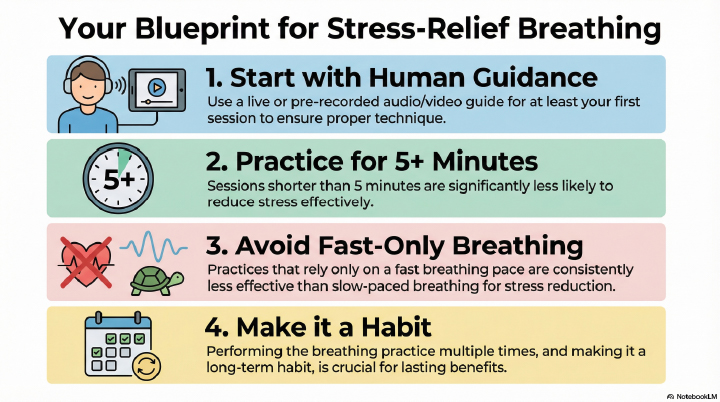
- The 5-Minute Rule: Commit to a minimum of 5 minutes for each session; this duration is critical for initiating the necessary biological shift.
- Voice Guidance: Utilize a human-voiced recording for your initial several sessions to ensure proper mechanics and technique.
- The 20 BPM Limit: Actively avoid “fast-only” paces (over 20 breaths per minute); instead, favor patterns with extended exhales and CO2-tolerating holds to enhance vagal tone.
- Posture and Space: Always sit or lie down in a comfortable position. Ensure your diaphragm is completely unobstructed and your environment is free of interruptions.
Now that you understand the molecular neuroscience of the “safety gatekeeper” in your amygdala, how will you re-architect your next five-minute reset? Don’t just “breathe”—leverage the profound biology of safety.