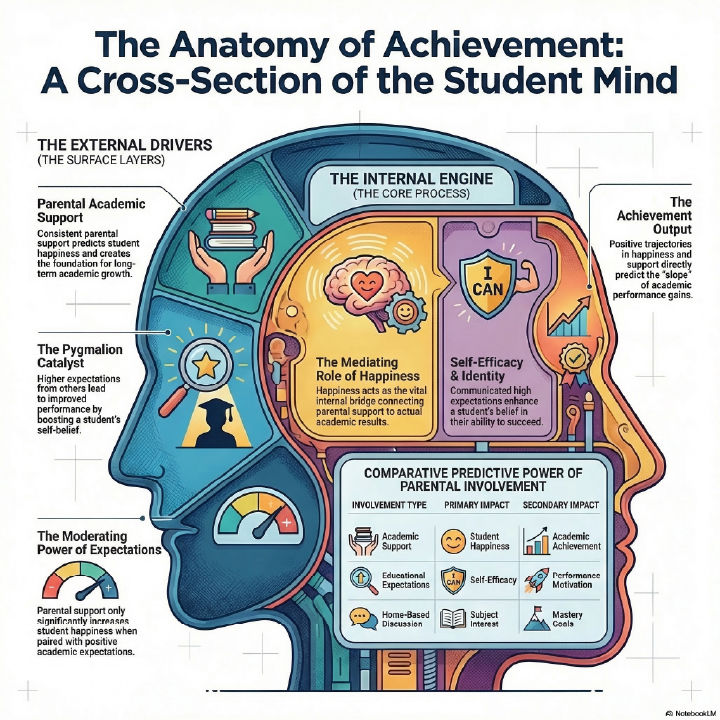
Understanding the multifaceted factors that influence academic achievement, personal development, and psychological well-being is crucial. Research consistently highlights how parental expectations and robust social support significantly predict a student’s success. These effects, however, are often mediated by a child’s intrinsic happiness and self-efficacy.
This article delves into the fascinating Pygmalion Effect, illustrating how the high expectations of authority figures can become powerful self-fulfilling prophecies, leading to improved performance. Beyond the classroom, we explore practical psychosynthetic exercises designed to foster self-awareness and spiritual growth through internal reflection. Ultimately, an individual’s ability to flourish is determined by a powerful combination of environmental influences, such as family and peer bonds, and inner psychological practices.
1. The Power of Perception: An Introduction
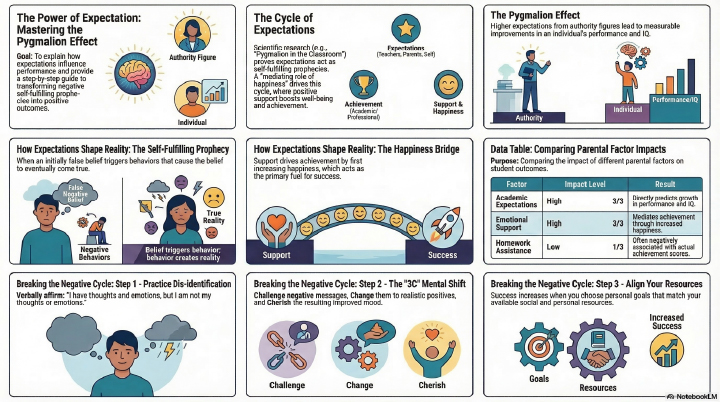
In the intricate architecture of human development, perception is far more than a passive lens; it acts as a dynamic blueprint for reality. As an educational psychologist, I view the expectations we hold for others as a form of internal scaffolding – silent structures that either support the ascent of potential or inadvertently limit the height of achievement. The renowned Pygmalion Effect reveals a profound truth applicable to every learner: an initially false belief, through the subtle shifting of behavior and environment, can genuinely become a tangible reality.
Pygmalion Effect: A social psychological phenomenon where higher expectations from others lead to improved performance.
Self-Fulfilling Prophecy: A concept where an initially false belief or expectation leads to behaviors that ultimately make that false belief come true.
The transformative power of this phenomenon is immense. When a mentor or educator genuinely envisions excellence within you, they don’t just observe it; they actively catalyze it. This powerful psychological mechanism was famously validated in a groundbreaking 1968 classroom study, which definitively proved how the mere ‘mental picture’ of a student’s potential could significantly alter their intellectual trajectory.
2. The Classic Study: ‘Pygmalion in the Classroom’ (1968)
Robert Rosenthal and Lenore Jacobson’s seminal experiment, ‘Pygmalion in the Classroom,’ provided compelling evidence that teacher expectations could literally elevate a student’s IQ. Researchers administered a disguised intelligence test to students. Following this, they identified a select group of students as ‘growth spurters’ – children supposedly destined for an intellectual ‘bloom’ in the coming year. Crucially, these ‘spurters’ were, in reality, selected entirely at random.
The only significant difference between these randomly chosen ‘spurters’ and the control group was the specific, positive expectation intentionally placed in the minds of their teachers. The results were astounding.
| Group | Description | Primary Findings |
|---|---|---|
| Experimental (Spurters) | Students randomly labeled as having high potential based on a fabricated ‘growth’ test. | Showed significantly higher gains in IQ scores, which could not be explained by retesting or natural aging. |
| Control Group | Students for whom no specific ‘blooming’ expectations were provided to teachers. | Showed standard cognitive growth but lacked the accelerated IQ gains observed in the ‘spurters.’ |
Key Findings on Demographics and Malleability:
- Age and Malleability: The most substantial gains were consistently found in the youngest children (first and second graders). Younger students are considered more ‘malleable’ because they typically have less established reputations and are more sensitive to the external influences of authority figures.
- Gender and IQ: The Pygmalion Effect manifested differently based on gender. Girls demonstrated pronounced increases in reasoning IQ, while boys showed greater gains in verbal IQ, often amplifying their existing pre-test strengths.
- Ethnicity and Counteracting Bias: One of the most hopeful demographic findings involved ‘Mexican-looking’ boys (those with darker skin tones). These students exhibited significant IQ gains when teachers held positive expectations for them. This suggests that the Pygmalion Effect can act as a powerful corrective force, potentially counteracting or neutralizing systemic racial and ethnic biases prevalent in educational settings.
These results conclusively proved that the observed gains were not a fluke of the test itself, but rather the outcome of a sophisticated psychological loop that translates belief into tangible, measurable behavior.
3. The Mechanics of the Prophecy: How Beliefs Change Behavior
The profound transition from a teacher’s internal thought to a student’s academic success occurs through a detailed ‘Step-by-Step Perception Process.’ This process is governed by how we Select (what information we pay attention to), Organize (how we structure and make sense of it), and Interpret (the meaning we assign to observations). However, this cycle is further reinforced by critical sub-mechanisms:
- Selective Retention: We tend to remember only the information that confirms our existing beliefs, often overlooking contradictory evidence.
- Closure: Our brains have an inherent tendency to ‘fill in’ missing information to draw conclusions that align with our pre-existing mental models and expectations.
- Context: We often interpret a student’s behavior based on the surrounding situation, frequently ignoring data that might contradict our initial prophecy.
This intricate process inevitably leads to Confirmation Bias, where a teacher essentially ‘filters’ a student’s performance to consistently match their expectations. For instance, if a ‘spurter’ underperforms, the teacher might selectively ignore it (Selective Retention) or view it as a temporary, uncharacteristic fluke (Closure). Conversely, when teachers expect success, they inherently create a ‘Warm Socio-Emotional Climate.’ This supportive warmth significantly fosters student happiness, which acts as a crucial mediator: a happy student is more engaged, more receptive to learning, and ultimately, more likely to achieve the IQ gains observed in the research.
The Expectation Loop
This table outlines how internal psychological processes held by a teacher manifest as visible, life-altering teaching actions:
| Teacher Inner Belief | Visible Teaching Action |
|---|---|
| ‘This student is an intellectual bloomer.’ | Asks richer, more challenging questions; provides more ‘opportunities to learn’ and grow. |
| ‘This student has limited capacity.’ | Offers simpler tasks; provides less constructive feedback; reduces the student’s autonomy and choice. |
| ‘The student’s failure is a temporary hurdle.’ | Provides more targeted, constructive feedback; offers specific growth strategies for improvement. |
| ‘The student’s success is an exception.’ | Ignores the success (Selective Retention) or fails to provide the necessary supportive climate for continued achievement. |
While this expectation loop is undeniably powerful, it is also highly nuanced, especially when we consider which students are most affected by these dynamic influences.
4. Nuance and Complexity: Vulnerability and Critiques
The Pygmalion Effect, while potent, is not a universal constant; it operates as a variable force that depends significantly on the individual student and their specific environment.
Vulnerable Populations
Research consistently indicates that students from low-income families, ethnic minority groups, and those identified as low achievers are often more susceptible to the impact of both positive and negative expectations. For these students, a negative prophecy can act as a significant barrier to their potential, but a positive one can serve as a powerful bridge to equity and academic success.
Methodological Critiques
Despite its widespread acceptance, the 1968 study faced legitimate critiques. Prominent researchers like Thorndike and Snow challenged aspects of its methodology. Thorndike pointed to ‘implausibly low’ initial IQ scores, suggesting these might have artificially inflated the perceived gains. Snow, on the other hand, questioned the precise mechanism, noting that many teachers in the study could not even accurately recall which students had been designated as ‘spurters.’
The Aftermath: 50 Years of Consensus
Modern research, building on this foundational work, acknowledges that while teachers generally make accurate assessments of their students, they often unconsciously hold lower expectations for students with special needs or those from marginalized backgrounds. Current findings demand an ‘Ecological View’ – a comprehensive approach that looks beyond the isolated teacher-student dyad. To foster true excellence, we must consider the individual, the family context, and the broader community in which the student lives and learns.
This ecological perspective becomes particularly visible when we examine the pivotal role of parental expectations and a child’s overall emotional well-being.
5. The Ripple Effect: Parents, Happiness, and Well-Being
Longitudinal data, such as that from Li et al. (2022), robustly reveals that parental academic support is a primary driver of a student’s academic trajectory. Crucially, however, this support operates through a specific and powerful mediator: Student Happiness. A supportive and encouraging climate at home significantly increases a child’s sense of well-being, which in turn acts as a powerful fuel for academic achievement.
Nevertheless, parental expectations are undeniably a ‘double-edged sword.’ When aspirations exceed a child’s realistic potential – a phenomenon known as overaspiration – it creates a negative reciprocal relationship. This ‘vicious cycle’ can severely undermine learning, particularly in subjects like mathematics, as the intense pressure often leads to increased anxiety and a subsequent decrease in performance.
3 Key Takeaways for Parents:
- Prioritize Autonomy Support over Control: Parental support is most effective when it is ’empathic and encouraging of volitional functioning.’ Parents should actively avoid psychological control or pressure-filled demands, which can inadvertently trigger a downward spiral of self-doubt and diminished self-efficacy in their children.
- Engagement Through Academic Discussion: Regular, open ‘school-parent communication’ and meaningful academic discussions with children are often more influential than merely assisting with homework. These interactions build a vital sense of partnership, foster genuine interest in learning, and strengthen the child’s academic identity.
- The Overaspiration Warning: It is critical to keep expectations realistically aligned with the child’s current growth and developmental stage. Unrealistically high goals can severely damage a student’s happiness and emotional well-being, effectively breaking the crucial link that leads to sustained academic success.
6. Illuminating the Inner Self: Practical Application
As a curriculum architect, I propose that a powerful antidote to the external pressures of the Pygmalion Effect lies in the practice of Psychosynthesis. If the expectations of others shape us from the outside, Psychosynthesis offers an internal force of ‘Self-Identification’ that empowers us to reclaim the ‘Director’s’ chair of our own lives. Through these practical exercises, we can learn to ‘dis-identify’ from limiting labels and reconnect with our authentic ‘Inner Guidance.’
Checklist: The ‘Who Am I?’ Exercise
- Step 1: Written Reflection. Find a quiet, undisturbed space. At the top of a blank page, write the question: ‘Who Am I?’ Begin recording your answers freely, without judgment or self-censorship. After each response, pause and ask the question again, allowing yourself to peel back the ‘layers of the onion’ and delve deeper into your true self.
- Step 2: Mental Imagery. Close your eyes gently and ask ‘Who Am I?’ once more. Be patient and open to whatever spontaneous image emerges in your mind’s eye. Record the details of this image, your feelings towards it, and what it might represent for you.
- Step 3: Movement and Sound. Stand up and ask the question a final time. Allow your body to respond intuitively through movement, sound, or even song. Trust your body’s innate wisdom to find a unique and personal completion to this powerful inquiry.
The Blossoming of the Rose
For even deeper spiritual growth, engage in this visualization: Imagine a closed rose bud, tightly folded. Slowly, visualize this bud gently opening, petal by petal, into a fragrant, magnificent rose bathed in sunlight. At the very center of this fully blossomed rose, visualize a Wise Being – a source of unconditional love, profound understanding, and infinite wisdom. Engage this Being in a silent dialogue; this is your personal source of Inner Guidance for navigating life’s complex choices and challenges. As you do this, consciously identify with the rose, realizing that you are the vibrant center of your own consciousness and will.
An Encouraging Word
Roberto Assagioli, the visionary founder of Psychosynthesis, often shared a profound reminder with his students: ‘Practice makes perfectly imperfect.’ This paradoxical affirmation encourages us to remember that we are never ‘finished’ works; instead, we are perpetually in a state of continual growth and evolution. You possess the inherent power to consciously choose your role in your own life story.
By recognizing that you are simultaneously both the actor and the director of your experiences, you can utilize your newfound awareness to heal your personality, refine your character, and actively direct your own personal and spiritual evolution. Use this profound understanding to foster greater equity and excellence within your own environment and within yourself. Remember, you are not defined by your circumstances; you are the architect of your own true Self.