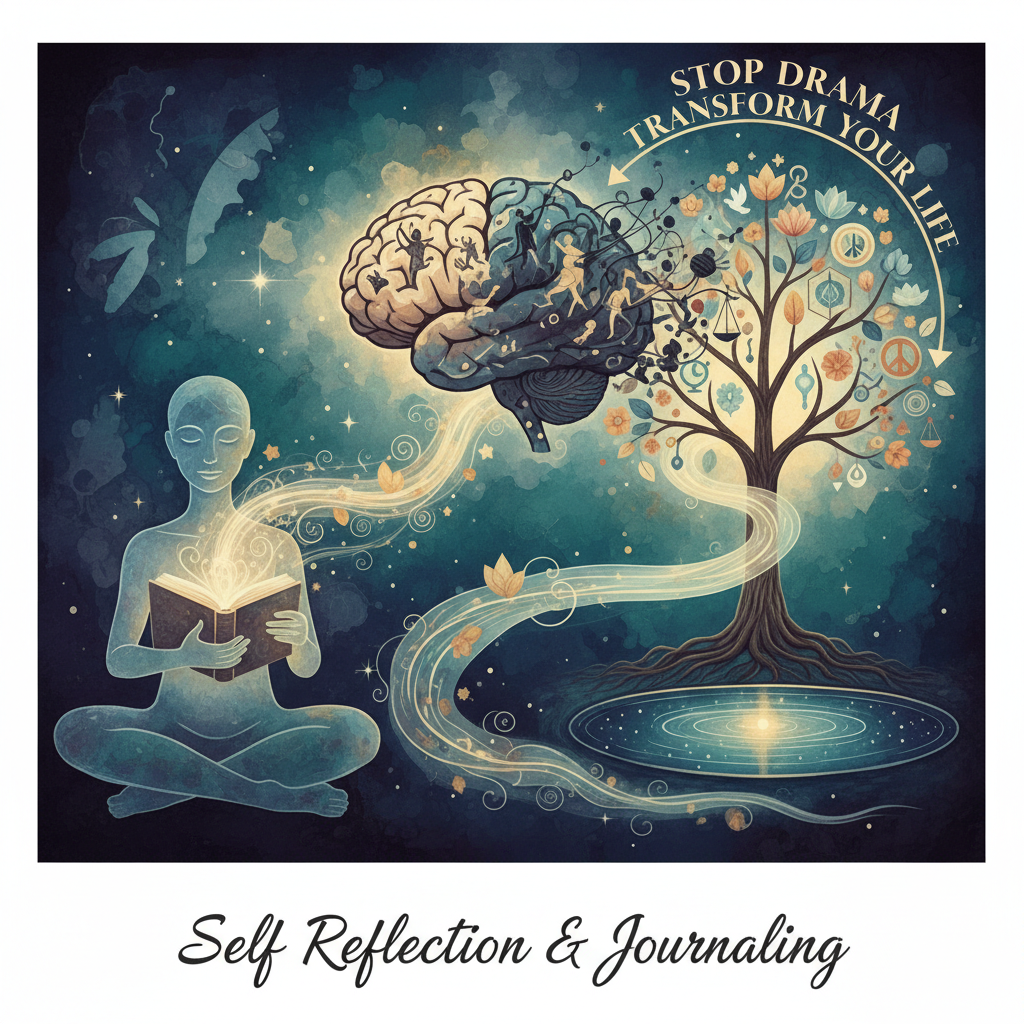
Stop the Drama: How Self-Reflection & Journaling Transform Your Life’s Story
Ever feel like your life is a constant soap opera? Full of repetitive conflicts, emotional rollercoasters, and a feeling that chaos follows you everywhere? For many, life feels like an endless loop of dramatic episodes, leaving us drained, confused, and wondering why drama seems to be our constant companion. If you’re tired of living a drama-filled life, this guide offers a powerful solution through self-reflection and journaling for self-awareness.
The profound truth is simple: our external world often mirrors our inner state. The conflicts we face, the people who irritate us, and the painful patterns that repeat are frequently external projections of our thoughts, unconscious beliefs, and unresolved emotions. As the renowned psychologist Carl Jung wisely observed:
Everything that irritates us about others can lead us to an understanding of ourselves.
This guide isn’t just about escaping drama; it’s about empowering you to become the conscious author of your own life story. It’s a practical starting point for using a reflective journal to understand this “mirror effect,” decode the vital messages your life is sending, and embark on a journey toward living a more intentional, self-aware, and peaceful life. Discover how journaling for personal growth can help you reclaim control.
1. Your Inner Mirror: How Thoughts and Beliefs Shape Your Reality
We often believe we perceive the world objectively, but what we truly see is an interpretation—a story our brain constructs based on our past experiences and deeply ingrained beliefs. Imagine looking at the world through a window. That window can be cloudy, smeared with the smudges of old emotions, fears, and distorted beliefs, leading you to experience a disappointing and conflict-ridden reality. Or, it can be sparkling clean, allowing you to engage with life openly and find fulfillment effortlessly. Understanding this “personal reality” is the first step to change.
Several key psychological concepts contribute to the “smudges” on our personal windows:
- The “Looking-Glass Self”: Our sense of self isn’t purely internal. It’s profoundly shaped by how we imagine others see us, how we imagine they judge that perception, and our resulting feelings. This continuous feedback loop impacts our self-perception.
- Behavioral Confirmation (Self-Fulfilling Prophecy): Our expectations about a person or situation often cause us to act in ways that make those very expectations come true. If you expect hostility, you might behave defensively, which in turn provokes hostility, confirming your initial belief. This illustrates the power of cognitive biases.
- Emotional Triggers: These are intense emotional reactions disproportionate to the current situation. They occur when a present stimulus activates stored associations in the brain’s alarm system (the amygdala), igniting an automatic fight-or-flight response rooted in past experiences. Recognizing these is crucial for emotional intelligence.
These concepts don’t operate in isolation; they intertwine to create a powerful feedback loop. Our past creates emotional triggers that shape our beliefs about how the world works. These beliefs then activate behavioral confirmation, causing us to act in ways that provoke the very reactions we expect from others. Finally, these reactions reinforce our looking-glass self—our story about how we are seen. This cycle is the smudge on the window, a distorted filter we often mistake for reality.
Journaling for mental clarity is the act of cleaning your window. It’s the consistent practice of noticing these smudges so you can begin to see yourself and the world with greater clarity. This “window” doesn’t just show you the world; it reflects the state of your inner life, offering powerful messages about what’s truly happening within you.
2. Decoding Life’s Messages: Insights from Your Inner World
Once you begin to pay attention, you’ll notice three common “messages” that offer direct insight into your inner patterns. These are the persistent smudges on your window that, once identified, can be understood and effectively cleaned.
1. Emotional Triggers: What Others Reflect About You (The Shadow Self)
When someone’s behavior sparks intense irritation, anger, or judgment within you, it often points to what Carl Jung termed the “shadow”—a part of yourself that you have disowned or repressed. This psychological projection occurs when we perceive a trait in someone else that we refuse to acknowledge in ourselves.
For instance, if you feel intense anger toward a person you perceive as inflexible, the “Law of Mirrors” suggests this isn’t just about their opinion. The emotional charge might stem from their inability to be open or their rigidity. Turning the mirror back on yourself, you might ask: “In what areas of my own life am I inflexible or unwilling to see another perspective?” Your strong reaction is a message reflecting a part of yourself.
2. Taming the Inner Critic: Overcoming Negative Self-Talk
The Inner Critic is that persistent negative internal voice that narrates your life with a stream of judgment and doubt. This voice isn’t inherently yours; it’s an internalization of messages received from parents, teachers, society, or past painful experiences. It reinforces limiting beliefs (“I’m not good enough,” “I’ll never succeed”) and can dominate your choices without your conscious awareness. This constant self-scrutiny creates feelings of unworthiness and fear of disapproval. To break free from this inner monologue, we must confront these internal stories directly. As researcher Brené Brown notes:
Having the courage to reckon with our emotions and to rumble with our stories is the path to writing our brave new ending.
Recognizing the Inner Critic is the essential first step to challenging its narrative and cultivating self-compassion.
3. Breaking Cycles: Understanding Repetition Compulsion
Do you find yourself attracting the same type of person in relationships or encountering the same kind of conflict at work repeatedly? This is often due to a psychological tendency known as “repetition compulsion.” We unconsciously repeat painful dynamics from our past in an attempt to finally “fix” them or achieve a different, more positive outcome. For example, someone who grew up with emotionally unavailable parents might repeatedly be drawn to partners who are similarly distant, hoping this time they can finally win the affection they never received. This illustrates the unconscious mind running on old programming, a dynamic C.G. Jung perfectly captured when he wrote:
Until you make the unconscious conscious, it will direct your life and you will call it fate.
These messages are not signs that you are broken; they are crucial signposts pointing you toward healing and personal transformation. Your journal is the map to navigate these insights.
3. Journaling for Self-Discovery: Your Essential Toolkit
Reflective journaling is far more than a simple diary of events. It’s an active, intentional process of exploring the thoughts, emotions, and behaviors connected to those events. It’s a dedicated, safe space to have an honest conversation with yourself, examine the smudges on your window, and begin to truly understand the stories you tell yourself. For anyone navigating the complexities of life, this practice offers tremendous benefits for self-improvement:
- Clarity & Perspective: Hear Your Own Thoughts. Writing down your thoughts gives them tangible form, allowing you to gain perspective and emotional distance. This practice helps cultivate a deeper understanding of your own motivations, values, beliefs, and goals, which often lie hidden beneath the surface of your busy mind.
- Emotional Regulation: Navigate Feelings with Confidence. Instead of being swept away by overwhelming emotions, journaling helps you identify, process, and regulate them effectively. You’ll start to spot patterns, understand your triggers, and develop healthier ways of responding, creating a valuable record of your emotional journey over time. This boosts your emotional processing skills.
- Judgment-Free Zone: A Safe Space for Expression. A journal is a private, judgment-free sanctuary, a healthy outlet for processing difficult emotions. By writing about challenging experiences, you release accumulated mental and emotional pressure, leading to a greater sense of calm, control, and stress relief in your daily life.
With these powerful benefits in mind, let’s explore three simple yet impactful exercises you can use to start your reflective journaling practice today.
4. Start Your Journey: Simple Journaling Exercises for Self-Awareness
These exercises are designed as simple, actionable first steps for your journaling practice. You don’t need any special skills—just a notebook, a pen, and a willingness to approach yourself with curiosity and compassion.
Exercise 1: Decoding Emotional Triggers (The Mirror Effect)
Purpose: This exercise helps you decode the “mirror effect” by examining your strong emotional reactions to other people, revealing potential aspects of your own shadow self.
This requires honesty and a bit of bravery. Remember to approach what you find with curiosity, not judgment. There are no ‘bad’ answers here. Think of a recent time you felt intensely irritated, annoyed, or judgmental about someone else’s behavior. In your journal, answer the following prompts:
- Describe the situation and the other person’s specific behavior that bothered you. Be as detailed as possible.
- What specific quality did that behavior represent to you? (e.g., arrogance, incompetence, laziness, selfishness, neediness).
- Now, turn the mirror on yourself. In what other areas of your life (at work, with family, in your private thoughts) do you sometimes display a version of that same quality? Be honest and approach this with compassion.
Exercise 2: Confronting Your Inner Critic
Purpose: This exercise helps you externalize the voice of your Inner Critic, identify its distorted thinking patterns, and consciously re-frame negative self-talk into something more balanced and true. This is a powerful cognitive reframing technique.
This isn’t about pretending negative thoughts don’t exist. It’s about recognizing they are often distorted stories, not facts, and gently offering yourself a more balanced perspective. Think of a recent negative thought you had about yourself. Write it down in your journal. Then, using the examples below as a guide, try to re-frame that thought into a more compassionate and realistic statement.
- Common Inner Critic Script: “It’s all my fault.”
How to Re-frame It: “I am one of many factors in this situation; I’ll focus on what I can control.” - Common Inner Critic Script: “This is a total disaster; the worst will happen.”
How to Re-frame It: “I am curious about what will unfold and can prepare for different outcomes.” - Common Inner Critic Script: “I’m only going to focus on the bad things.”
How to Re-frame It: “I can be honest about both the challenges and the positives in this situation.” - Common Inner Critic Script: “I should be better; I have to do this.”
How to Re-frame It: “I have a choice. I would like to do this because it aligns with my goals.”
Exercise 3: Uncovering Your Life’s Core Stories
Purpose: This exercise helps you uncover the underlying stories and beliefs that may be driving repeating patterns in your life. It’s a gentle introduction to “shadow work”—the process of exploring your unconscious mind.
This is a gentle way to begin exploring your inner world. Pick one or two prompts that resonate with you, and let your thoughts flow without censoring yourself. Just see what comes up. Write freely in your journal for 5-10 minutes.
- What did I have an emotional reaction to today?
- What’s behind that reaction?
- What feelings am I trying to avoid?
- How do I sometimes sabotage myself?
- What qualities in my parents do I seek to avoid in myself?
These individual acts of reflection are the building blocks of a more profound and integrated relationship with yourself.
5. Beyond Reflection: Cultivating a Life of Intentionality & Self-Connection
The ultimate goal of this self-reflection practice is not just self-awareness, but deep Self-Connection. This is more than simply knowing about yourself; it’s about building a trusting, compassionate, and guiding relationship with your inner world. Self-connection is a three-part process, leading to intentional living:
1. Awareness: Seeing Your Inner Landscape
This involves knowing your internal states, your core values, your emotional patterns, and your deeply held beliefs. This is the “seeing” part of the process—the moment you can finally name an emotion like “anxiety” or “sadness” instead of being swept away by its chaotic energy.
2. Acceptance: Embracing All Parts of Yourself
This means making room for all parts of yourself without judgment. It involves acknowledging your “shadow” traits, your fears, and your imperfections. It feels like welcoming home the parts of yourself you previously judged or disowned, recognizing that they, too, are an integral part of your story, fostering self-compassion.
3. Alignment: Living in Harmony with Your Values
This is about making conscious choices and taking actions that are guided by your values and inner awareness. Before, you might have accepted a project you hated out of fear of disapproval (reactivity). With alignment, you might pause, recognize the request conflicts with your value-driven choices for creative work, and proactively propose an alternative solution. This is about behaving in a way that is true to the authentic self you have come to know and accept.
This journey from reflection to connection is what allows you to shift from a reactive life—one driven by unconscious triggers and old patterns—to a proactive and intentional life. It’s the move from passively hoping things will change to mindfully taking steps to align your life with your true self, leading to profound personal transformation.
Conclusion: Embrace Your Journey of Self-Discovery
Understanding yourself is not a one-time fix but a continuous, lifelong growth practice. Some days, the mirror will be clearer than others, and that’s perfectly normal. The key is to be patient, persistent, and kind to yourself throughout this transformative journey. You are unlearning years of conditioned patterns, and that takes immense courage and profound self-compassion.
Your inner world powerfully creates your outer reality. By courageously looking in the mirror that your life provides, you reclaim the power to shape both. Your journey to a more peaceful, authentic, and drama-free life starts with a single journal entry. Start journaling today and begin writing your brave new ending.