
Learned Helplessness: Definition, Causes & How to Overcome
Have you ever felt trapped in a situation, convinced that no matter your efforts, the outcome wouldn’t change? Perhaps it was a challenging academic subject or a difficult work project where every attempt seemed to lead to failure, leaving you feeling stuck and powerless. This profound experience of giving up isn’t merely a fleeting mood; it’s a well-documented psychological phenomenon known as learned helplessness.
This powerful concept holds critical importance in clinical psychiatry and behavioral sciences. As psychologist Gustavo E. Tafet described in a 2025 editorial for Frontiers in Psychiatry, learned helplessness was “originally introduced to describe a phenomenon in which individuals develop the belief that they have no control over environmental stressors.”
This groundbreaking idea was first detailed by psychologist Martin Seligman, whose extensive research fundamentally transformed our understanding of how we respond to adversity. Seligman’s discovery was revolutionary because it marked a pivotal shift in psychology. It challenged the strict behaviorist view—which focused solely on observable stimulus and response—by proving that an organism’s beliefs and perceptions about control could profoundly shape its behavior.
This article will explore what learned helplessness is, how Seligman’s classic experiments revealed its mechanisms, and most importantly, how this disempowering pattern of thinking can be overcome. To truly grasp this concept, we must first examine the foundational research that brought it to light.
A Surprising Discovery: The Experiments That Defined the Theory
The theory of learned helplessness emerged from a series of carefully designed experiments in the 1960s. These studies, which began with animals and were later replicated with humans, offered a powerful insight into how we learn to become passive when faced with stress.
The Dogs in the Lab
The initial research, conducted by Martin Seligman and Steven Maier, involved dogs in a two-phase experiment. In the first phase, they divided the dogs into three distinct groups to test the effects of control over an unpleasant stimulus: a mild electrical shock.
A purely behaviorist prediction would suggest that all dogs receiving the same physical shocks would behave identically in the next stage, regardless of their ability to control them. The three groups were set up to test this very idea:
- Group 1 (The Control Group): These dogs were placed in harnesses for a period but received no shocks at all.
- Group 2 (The Escape Group): These dogs received electrical shocks but could stop them by pressing a panel with their noses. This group had control.
- Group 3 (The No-Escape Group): This group was “yoked” to Group 2, meaning they received the exact same shocks at the exact same time. However, there was nothing they could do to stop them. This group had no control.
The critical difference between Group 2 and Group 3 was not the amount of shock—it was identical. The key variable was controllability.
The Shuttle Box and the Shocking Result
In the second phase, all three groups of dogs were placed one at a time into a “shuttle box”—an apparatus with two chambers separated by a low barrier. A shock would be administered on one side, but the dog could easily escape by jumping over the barrier to the other side.
The results were astonishing because they directly defied the behaviorist prediction:
- Dogs from Group 1 (the control group) and Group 2 (the escape group) quickly learned to jump the barrier to safety.
- However, most of the dogs from Group 3 (the no-escape group) behaved completely differently. They didn’t even try to escape. They simply lay down and whimpered, enduring the shocks.
The difference wasn’t the shocks; it was the dogs’ cognitive conclusion about their own powerlessness. Based on their previous experience where their actions had no effect, they had concluded that there was nothing they could do to avoid the pain. They had developed learned helplessness.
From Animals to Humans
To determine if this phenomenon applied to people, researchers conducted similar experiments with human participants, substituting a loud, unpleasant noise for electrical shocks. The results mirrored the animal studies. Participants who had no control over the noise in the first phase often didn’t even try to stop it in the second, even when a lever to do so was readily available.
These powerful experiments demonstrated that the experience of uncontrollability—not the stressor itself—was what led to the passive, helpless response. This discovery led Seligman to identify the specific psychological effects this condition has on an individual’s mindset and behavior.
The Three Deficits: How Learned Helplessness Affects Us
Seligman and his colleagues proposed that being subjected to uncontrollable situations results in three specific and interconnected types of deficits that undermine a person’s ability to function effectively:
- Motivational Deficit: This is the failure to initiate a response. Because past efforts felt futile, the motivation to try new actions disappears. This manifests as “giving up,” even when escape or success becomes possible.
- Cognitive Deficit: This refers to the failure to learn that responses can be effective. It’s the internalized belief that circumstances are uncontrollable. Crucially, this is a learned perception, which may not accurately reflect the reality of a new situation.
- Emotional Deficit: This is the subsequent state of anxiety and depression that arises from the perceived lack of control. Seligman found a strong link between the experience of learned helplessness and the symptoms of depression, as both often involve passivity, low self-esteem, and a feeling of powerlessness.
These theoretical deficits are not just confined to the laboratory; they manifest in many real-world scenarios, impacting daily life.
Learned Helplessness in Everyday Life
The principles discovered in the lab provide a clear lens through which we can understand common human struggles and behaviors.
In the Classroom
Consider a student, Sarah, who has consistently struggled with math. After repeated failures on tests, despite diligent studying, she concludes, “I’m just bad at math.” This belief represents the cognitive deficit. Her subsequent decision to stop putting effort into homework, convinced it won’t make a difference, exemplifies the motivational deficit. This creates a self-fulfilling prophecy of failure, reinforcing her helplessness.
In Relationships
Learned helplessness can be a significant factor in situations like domestic violence. Repeated experiences where an individual’s attempts to appease or change an abusive partner’s behavior fail can lead them to feel they have no power to leave or alter the situation, even when resources or opportunities for escape exist.
Trauma, Agency, and the Freeze Response
Modern neuroscience offers another layer to this understanding. The passive, giving-up behavior observed in learned helplessness is a neurobiological parallel to the “freeze” response—a natural part of our brain’s reaction to overwhelming stress or trauma where action can feel neurologically impossible.
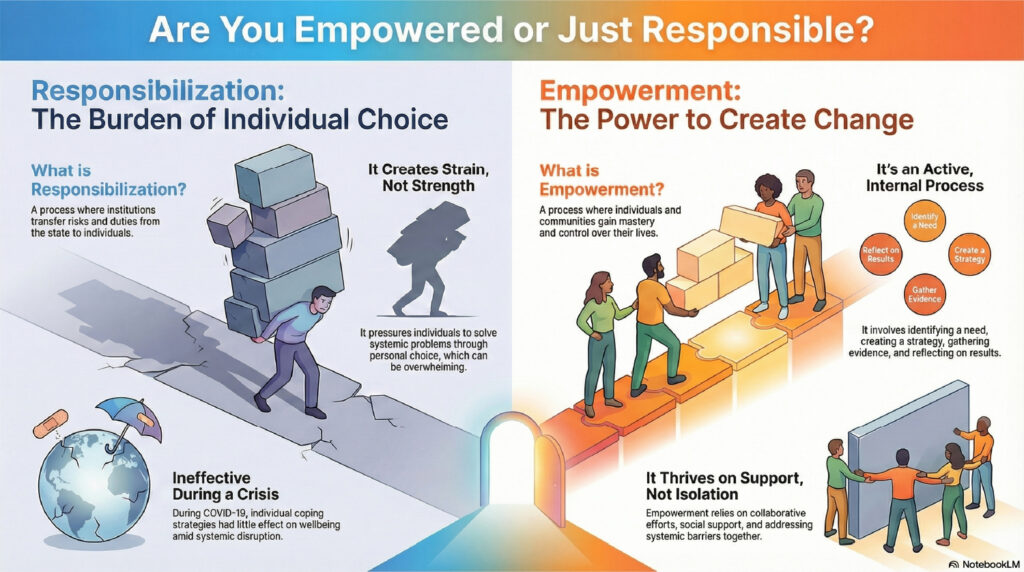
This state can be understood as the psychological erosion of agency—the capacity of individuals to act independently and make their own choices. Learned helplessness is the perceived absence of agency, a belief that one is no longer the cause of events in one’s own life. The goal of recovery, therefore, is to systematically rebuild that vital sense of personal power.
These examples can feel discouraging, but the most important word in the phrase “learned helplessness” is learned. And anything that is learned can also be unlearned.
Reclaiming Control: How to Unlearn Helplessness
The antidote to learned helplessness isn’t just wishful thinking; it’s a conscious process of relearning a sense of agency and control. The following are actionable strategies rooted in psychological research:
- Embrace “Learned Optimism”: Seligman later developed this concept as the direct counter to learned helplessness. It involves actively changing your “explanatory style”—the way you explain negative events to yourself. Instead of attributing bad outcomes to causes that are internal (“it’s my fault”), permanent (“it’s always going to be this way”), and global (“it ruins everything”), you learn to reframe them as external, temporary, and specific.
- Develop “Learned Controllability”: The core of resilience is the belief that you can respond effectively to stressors. As psychologist Gustavo E. Tafet explains, learned controllability is “the subjective perception of controllability” that can be developed and learned to counteract the effects of helplessness. This involves shifting your locus of control from external (believing that outside forces like luck or other people dictate your life) to internal (believing your own efforts and actions shape your outcomes).
- Focus on Effort, Not Ability: A classic 1975 study by psychologist Carol Dweck revealed a powerful tool for overcoming helplessness. The key is to change how you attribute failure. Instead of believing failure is due to a lack of ability (which feels fixed and uncontrollable), you can learn to attribute it to a lack of effort (which is changeable and within your control). This simple shift transforms a dead end into a learning opportunity.
- Seek Professional Support: Therapies like Cognitive Behavioral Therapy (CBT) are highly effective for overcoming learned helplessness. A qualified therapist can help you identify the automatic, helpless thoughts that keep you stuck, challenge their validity, and work with you to reframe them into more empowering and realistic beliefs.
- Build Momentum with Small Wins: A practical way to rebuild your sense of control is to set small, achievable goals. Each successfully completed task provides direct, experiential evidence that contradicts the core cognitive deficit of helplessness (“my actions don’t matter”). These small wins are not trivial; they are the building blocks that help to literally rewire the brain’s expectation of futility and restore a belief in your own effectiveness.
Conclusion: You Hold the Key to Your Freedom
Learned helplessness is a powerful psychological response born from the perception that we have no control over our circumstances. As Seligman’s foundational experiments demonstrated, this belief leads to profound motivational, cognitive, and emotional deficits that can impact every area of our lives.
However, this state is a learned belief, not a permanent trait. Learned helplessness erects a psychological cage built from past experiences. But because it is learned, we can become the architects of our own liberation. By actively changing our thoughts and behaviors, we reclaim our agency, and in doing so, we don’t just find the key—we dismantle the cage entirely.