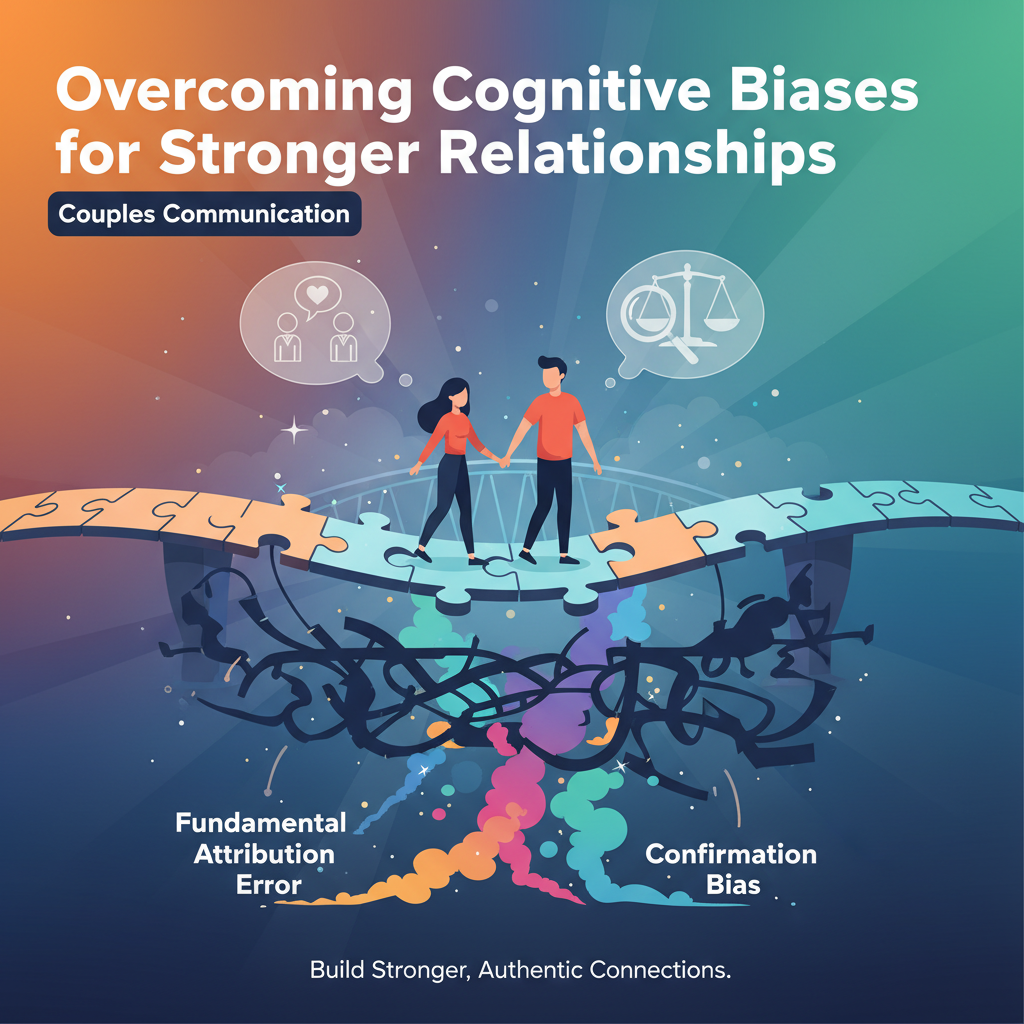
Are Brain Glitches Hurting Your Relationship? How Mental Shortcuts Create Conflict
Imagine this: you’ve planned a quiet evening together, but your partner arrives home an hour late. Your mind immediately jumps to a conclusion: “They don’t care about our time together. If they did, they would have made an effort to be on time.” By the time they walk through the door, you’re already upset, and what could have been a relaxing night escalates into a painful argument.
The real culprit here isn’t necessarily a lack of care—it might be a simple brain glitch. This kind of misunderstanding is often fueled by cognitive biases, which are natural mental shortcuts our brains use to make sense of a complex world. Think of them as your brain’s autopilot system; they help you make quick judgments without having to analyze every single piece of information.
While these shortcuts are incredibly efficient for navigating daily life, they can cause significant problems in our closest relationships, leading us to misinterpret our partners’ actions and intentions. This article will explore two of the most common and damaging cognitive biases that show up in romantic relationships: the Fundamental Attribution Error and Confirmation Bias. By understanding how these mental glitches work, you can learn to spot them and use practical strategies to override your brain’s autopilot, fostering a deeper, more authentic connection with your partner.
What Are Cognitive Biases? Your Brain’s Relationship Autopilot
In simple terms, cognitive biases are systematic patterns of thinking that can affect our perception and judgment. A useful analogy is to think of them as your brain’s “mental filing system.” To save time and energy, your brain quickly sorts new information into existing folders based on past experiences and beliefs. This is incredibly helpful most of the time, but sometimes, information gets misfiled.
These biases are a normal, hardwired part of human thinking—not a personal flaw or a sign of a bad relationship. Their purpose is to be efficient. However, this efficiency often comes at the cost of objectivity. When we’re on autopilot, we’re more likely to make snap judgments about our partner’s behavior without considering the full picture. This is where a simple misunderstanding can escalate into major conflict. Now, let’s look at one of the most common “misfiles” that happens in relationships.
The “It’s Just Who They Are” Trap: Understanding the Fundamental Attribution Error
Defining the Fundamental Attribution Error
The Fundamental Attribution Error is our tendency to explain our partner’s behavior based on their internal character while explaining our own behavior based on external situations.
In other words, when your partner does something you don’t like, you’re more likely to think, “That’s just the kind of person they are.” But when you do the same thing, you’re quick to blame the circumstances: “I was just stressed out,” or “I had a terrible day.” This creates a damaging double standard. But why does our brain do this? It’s rooted in a deep, subconscious need to believe the world is fair and predictable—a concept psychologists call the “just-world fallacy.” We attribute our partner’s mistake to their character (“they are irresponsible”) because it explains their behavior as a stable, predictable trait. In contrast, we attribute our own mistake to the situation (“I was stressed”) because it was a temporary, external factor. This allows us to feel safe, satisfying our deep-seated need to believe that as long as we are “good” people, bad things won’t happen to us.
Real-Life Impact: The Trash Scenario
Scenario: Your partner forgets to take out the trash.
- Your Automatic Thought (The Bias): “They are so irresponsible and inconsiderate. They never think about me.” (This attributes the action to their fundamental character.)
- An Alternative View (Challenging the Bias): “They must have had a chaotic morning, or they were distracted, and it simply slipped their mind.”
Why This Bias Damages Relationships
The primary negative impact of this bias is that it creates a cycle of misunderstanding and misjudgment in relationships. When you consistently attribute your partner’s mistakes to their personality, they feel constantly criticized for who they are rather than for a specific action in a specific context. This can make them feel hopeless and defensive, eroding trust and making it nearly impossible to resolve conflicts productively. This tendency to judge our partner’s character doesn’t just cause a single moment of conflict; it creates a negative label. And once our brain has a label, it launches a second, even more insidious glitch: it goes on a mission to prove that label is true.
The “I Knew It!” Filter: How Confirmation Bias Traps Couples
Unpacking Confirmation Bias
Confirmation Bias is our brain’s tendency to actively search for, interpret, and remember information in a way that confirms what we already believe, while ignoring evidence that contradicts it. Once the Fundamental Attribution Error has created a negative label—”they are irresponsible,” “they are a bad listener”—Confirmation Bias takes over as your brain’s biased detective, seeking only the evidence that proves your case. It’s the voice in your head that says, “See? I knew it all along.”
Real-Life Impact: The Listener Scenario
Scenario: You believe your partner isn’t a good listener.
- Your Automatic Thought (The Bias): During a conversation, you notice them glance at their phone for a second and think, “See! I knew it. They never pay attention to me.”
- What the Bias Ignores: You overlook the previous 10 minutes where they were making eye contact, nodding, and asking questions, because that information doesn’t fit your “bad listener” narrative.
The Dangers of a Biased Lens
The biggest danger of Confirmation Bias is that it traps couples in rigid, negative stories about each other, becoming a self-fulfilling prophecy. When you’re only looking for proof of your partner’s flaws, you will find it. This bias can diminish the power of apologies or positive changes, making it incredibly difficult to repair the relationship. Your partner’s efforts are filtered out, creating a powerful resistance to reconciliation. Fortunately, you can learn to switch off this filter and see more clearly.
From Autopilot to Awareness: Three Strategies for Stronger Relationship Connection
Awareness of these cognitive biases is the crucial first step toward positive change. You can’t control your brain’s automatic first thought, but you can control your second thought and your first action. By using conscious, intentional strategies, you and your partner can learn to see past these glitches and build a stronger, more resilient connection.
Strategy 1: Pause & Play Detective (Challenge the Fundamental Attribution Error)
Before you react to something your partner does, take a deep breath and pause. This pause is vital because our brains are wired for efficiency. Your first thought is almost always an automatic character judgment; it takes conscious effort—a second thought—to override that impulse and consider the situation. Actively challenge the Fundamental Attribution Error by asking yourself, “What are three other possible, situational reasons they might have done that?” Forcing your brain to search for external factors (e.g., they’re tired, they’re stressed from work, they were distracted by a problem) breaks the habit of jumping to a negative character judgment.
Strategy 2: Actively Challenge Your Own Story (Combat Confirmation Bias)
To fight Confirmation Bias, you have to become a collector of “counter-evidence.” Make a conscious effort to look for small pieces of proof that disprove your negative assumptions. For example, if your internal story is “My partner is always messy,” make a deliberate point to notice when they put a dish in the sink, hang up a towel, or clear their space. Acknowledging these small, positive actions—even just to yourself—helps to weaken the negative narrative and build a more balanced, accurate view of your partner.
Strategy 3: Communicate with Curiosity, Not Accusation
Ultimately, the only way to truly know your partner’s intentions is to ask them. However, the way you ask is critical. Accusations trigger defensiveness and shut down communication. Curiosity, on the other hand, invites connection and understanding. Practice rephrasing your automatic, accusatory thoughts into gentle, open-ended questions.
| Instead of This (Accusation) | Try This (Curiosity) |
|---|---|
| “You never listen to me.” | “I’m feeling a disconnect right now. Can you tell me what you heard me say?” |
| “Why are you always so late?” | “I was getting worried when you were late. Is everything okay?” |
| “You’re so inconsiderate for not taking out the trash.” | “I noticed the trash didn’t get taken out. Did you have a rough morning?” |
By replacing assumptions with questions, you give your partner the chance to explain their perspective and you create an opportunity for genuine connection instead of conflict. These strategies help move your relationship from one run by automatic assumptions to one guided by intentional care.
Conclusion: Build an Authentic Connection, One Conscious Choice at a Time
Our brains are wired with “glitches”—cognitive biases that, while efficient, can cause us to misinterpret, misjudge, and misunderstand the person we love most. These automatic thinking patterns can trap us in cycles of conflict and disconnection. But these biases are not our destiny.
By practicing self-awareness, we can learn to catch these mental shortcuts before they do damage. By pausing to consider alternative perspectives, we challenge our negative assumptions and make space for empathy. And by communicating with curiosity instead of accusation, we turn moments of potential conflict into opportunities for deeper connection. Understanding how our own minds work is one of the most powerful tools we have for building stronger, more fulfilling, and more resilient relationships. It allows us to move beyond our brain’s autopilot and build a truly authentic connection, one conscious choice at a time.