Unlock Authentic Fulfillment: Understanding Thick vs. Thin Desires & Mimetic Theory
Have you ever achieved a major goal, only to find yourself feeling profoundly unfulfilled? Most of us have. We spend years chasing a career, a lifestyle, or a relationship, and upon reaching the summit, we realize the view isn’t what we expected. This pervasive experience highlights a critical truth: not all desires are created equal.
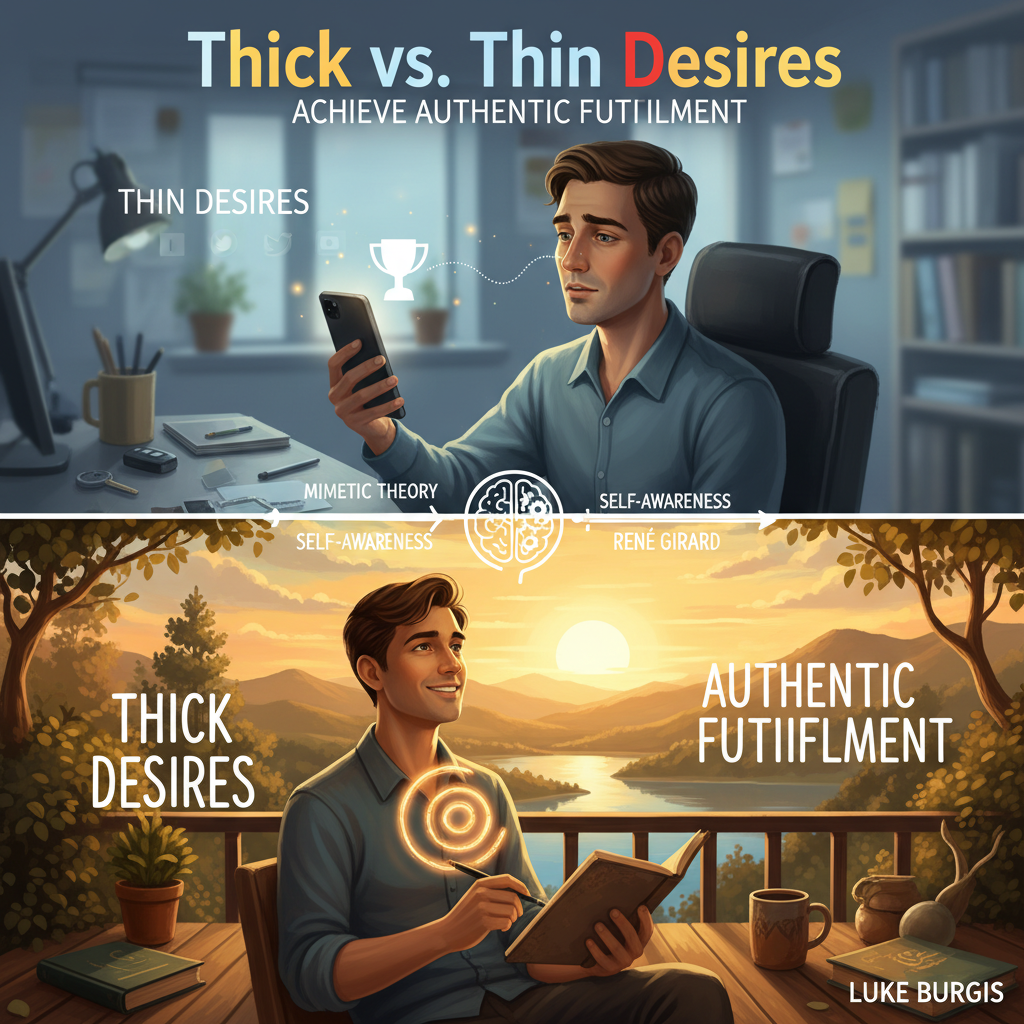
The wants that drive us can be categorized into two fundamental types: thick desires and thin desires. Understanding this distinction is the essential first step toward building a more meaningful and authentically fulfilling life. According to entrepreneur and author Luke Burgis, these concepts are defined as:
- Thick Desires: Authentic, enduring wants rooted in our core identity. They are like solid rock, built up over our lives, leading to deep, lasting satisfaction.
- Thin Desires: Superficial, fleeting wants often copied from others. They are like a layer of sand, easily blown away, and frequently leave us feeling empty.
This comprehensive guide will help you identify these two types of desire, understand the powerful social forces that shape them (including mimetic desire), and begin the journey toward cultivating a life guided by your own true wants. To start, we must explore the invisible mechanism that generates many of our desires.
The Invisible Force: How Mimetic Desire Shapes What We Want
Unlike animals, which operate on instinct, human beings often don’t instinctively know what to want when it comes to abstract desires—like careers, identities, or values. How do we decide? We look to other people. This is the core insight of mimetic desire, a concept developed by the influential philosopher René Girard. The term “mimetic” comes from the Greek mimesis, meaning “to imitate.”
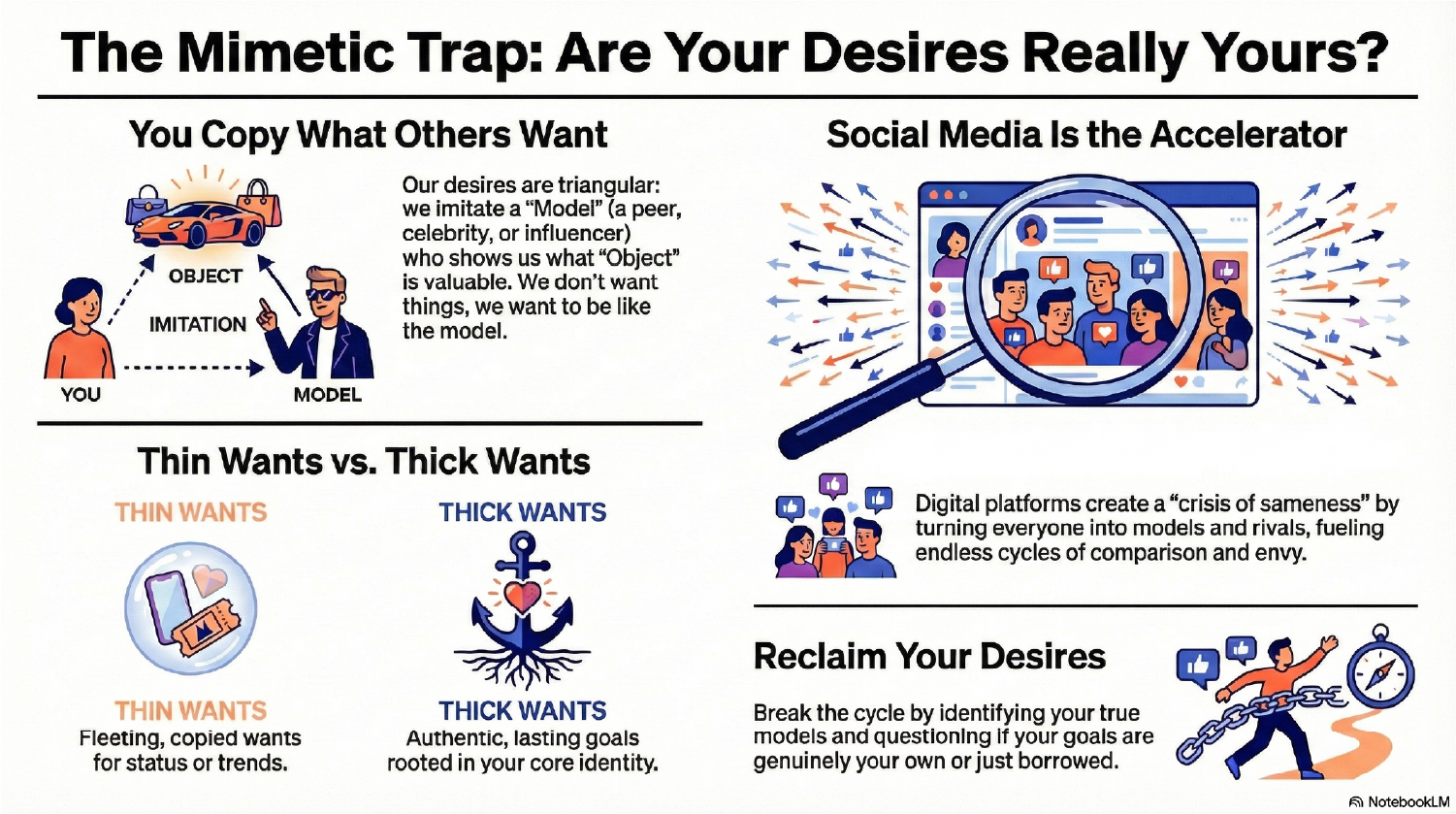
Girard’s theory reveals that your desire isn’t a direct line between you and the thing you want. Instead, it forms a triangle, where we are all caught within its dynamic:
- The Subject: You, the person who is desiring.
- The Object: The specific thing being desired (e.g., a career path, a new car, a relationship).
- The Model (or Mediator): The other person whose desire you are imitating.
We often desire objects not because they possess inherent value to us, but because a Model—a kind of “desire lighthouse”—has demonstrated their perceived value by wanting them first. This leads to a profound insight: the object itself is frequently just a token for a deeper, often unconscious goal. Girardians call this “metaphysical desire”: the yearning to be like the Model, to attain their perceived status or “Being.” When you admire someone’s success, you often don’t just want what they have; you want to be who they are.
Girard also noted that the distance between you and your model is crucial. When the model is distant and unreachable (an “external mediator” like a historical figure or a childhood hero), we can admire them without conflict. However, when the model is a peer in our immediate world (an “internal mediator”), the dynamic shifts dramatically—admiration quickly transforms into competition and rivalry. This powerful dynamic is the primary engine behind the superficial, borrowed thin desires that so often steer our lives.
Beyond the Surface: Where Thin Desires Manifest in Your Life
Thin, mimetic desires are most visibly at play in our major life choices. They represent the invisible scripts we unconsciously follow in our careers, relationships, and even the values we adopt. Recognizing these patterns is key to cultivating authentic desires.
The Mimetic Career Path
Many people discover their career paths are products of thin desires. You might change directions multiple times after a powerful new model—a mentor, a peer, or a public figure—reveals a different path that suddenly seems more appealing. This can lead to chasing a high-status job seen on social media or pursuing a field solely to impress others, rather than engaging in work that provides deep, personal meaning and aligns with your core identity.
Relationships Built on Imitation
Our choice of a life partner can also be highly mimetic. This often means pursuing a partner who fits a certain social script—the “trophy spouse” with conventional good looks, the “intellectual partner” who impresses our peers, or the “stable provider” our parents would endorse. These qualities become objects of desire because we have imitated others’ desires for what makes a “good” partner. This approach frequently leads to frustration because the desire isn’t authentically your own; it’s an attempt to acquire a person who fits a model, rather than building a connection based on genuine attraction and shared values.
Values and Lifestyles: Thick vs. Thin Desires in Action
The contrast between lives driven by thin desires versus thick desires is stark. The following table illustrates how these different motivations play out across key areas of life:
| Life Area | Driven by Thin (Mimetic) Desires | Driven by Thick (Authentic) Desires |
|---|---|---|
| Career | Pursuing a job for its status, wealth, or because a rival wants it. | Choosing work that provides a deep sense of meaning and personal satisfaction. |
| Relationships | Selecting a partner to gain social approval or imitate a model. | Building a connection based on core values and genuine attraction. |
| Lifestyle | “Keeping up with the Joneses”; buying products to signal status. | Adopting enduring values like truth, beauty, and goodness. |
Living a life shaped predominantly by imitation comes at a significant psychological cost, often leading to rivalry, chronic dissatisfaction, and anxiety.
The Steep Price of Imitation: Why Thin Desires Lead to Unfulfillment
When our lives are primarily guided by thin, mimetic desires, we inadvertently set ourselves up for a series of negative outcomes that can leave us feeling trapped and profoundly unfulfilled.
- Constant Rivalry: When we desire what our peers want—a dynamic of internal mediation—our models inevitably become our rivals. The person we admire for having a certain job or lifestyle transforms into an obstacle to us attaining it. This proximity fuels envy, bitterness, and conflict, transforming aspiration into a zero-sum competition.
- The Fulfillment Trap: Perhaps the most painful consequence is the emptiness that often follows the achievement of a borrowed dream. You get the promotion, buy the house, or enter the relationship you thought you wanted, only to feel a vague sense of dissatisfaction. As one commentator powerfully described it, it feels like “achieving someone else’s desires using someone else’s methods while wearing someone else’s identity.” This is the core of unfulfillment.
- The Social Media Amplifier: Platforms like Instagram and the influencer economy have supercharged mimetic desire. They collapse the distance between us and our models, making everyone a potential peer and rival. This creates a “crisis of sameness,” where millions are chasing the same curated lifestyles, fueling widespread anxiety and a constant feeling of inadequacy.
Fortunately, it is possible to break free from these destructive cycles and begin cultivating a more authentic life.
Cultivating Authenticity: A Practical Guide to Finding Your Thick Desires
The goal isn’t to eliminate all external influence—that’s impossible for humans. Instead, the aim is to build self-awareness so you can intentionally choose which desires to cultivate and which to let go. Here is a practical toolkit to help you begin the process of identifying your thick, authentic desires.
Listen To Your Life by Finding Your “Fulfillment Stories”
Your first task as an archaeologist of your own life is to unearth your “Fulfillment Stories.” This powerful exercise, developed by Luke Burgis, will reveal the hidden bedrock of your authentic desires. Take some time to identify 4-5 stories from your past when you engaged in an activity that brought you a deep sense of meaning, purpose, or profound satisfaction. Write these stories down in detail. Then, analyze them for a recurring theme, value, or pattern. That pattern is a powerful key to understanding your thick, authentic desires.
Create a Hierarchy of Values
Consciously defining your values helps you order and orient your desires. Your next task is to construct a personal hierarchy of values that truly reflects the kind of person you aspire to be. For example, you might intentionally place “community contribution” above “personal wealth,” or “creative expression” above “social status.” This clearly defined hierarchy will act as a filter, empowering you to cultivate desires that align with your vision for yourself and enabling you to let go of those that don’t.
Practice Recollection and Reflection
To truly hear the signal of your thick desires, you must tune out the noise. We are constantly pushed and pulled by mimetic forces, and without intentional space for quiet, we cannot listen to our own lives. Practices like meditation, journaling, or simply quiet, reflective time allow you to recognize fleeting mimetic urges for what they are and observe them without judgment. As the writer Parker Palmer eloquently stated, “before I can tell my life what I want to do with it, I must listen to my life telling me who I am.” This dedicated practice creates the essential space to connect with your deeper, more authentic self.
Moving from a reactive, imitative state to one of conscious intention is the foundation of a truly fulfilling life.
Reclaiming Your Autonomy: The Freedom of Authentic Desire
The distinction between fleeting, borrowed “thin” desires and fulfilling, authentic “thick” desires is critical to our overall well-being and sense of purpose. Thin desires, born from imitating others and fueled by mimetic theory, lock us into cycles of rivalry and ultimately leave us feeling empty and unfulfilled. In contrast, thick desires, which emerge from the core of our identity, provide enduring meaning, deep satisfaction, and genuine personal growth.
Self-awareness is the essential first step toward reclaiming your personal autonomy from the powerful, often invisible, forces of mimetic desire. The journey of self-discovery is fundamentally the process of distinguishing the solid rock of your identity from the shifting sands of imitation.
By consciously choosing to build your life on that rock, you claim the profound freedom to live a life that is truly, authentically yours. This awareness offers true liberation: the freedom to choose your wants, and in doing so, to build a more intentional, deeply satisfying, and meaningful life.