Delve into the fascinating world where psychology meets economics, exploring the biological underpinnings of our financial decisions. This article introduces the endowment effect, a widespread psychological phenomenon where individuals assign a higher value to items they already own. This bias is closely related to loss aversion—the powerful idea that the pain of losing something feels twice as intense as the pleasure of gaining it—and status quo bias, which fosters a preference for current circumstances over change.
While classic experiments, like the renowned Cornell mug study, suggest these behaviors are inherent cognitive shortcuts, cutting-edge research explores whether they stem from market beliefs or a strategic desire to secure a “good deal.” Further studies investigate how factors like gender and mathematical literacy influence these valuations, particularly in high-stakes gambling contexts. Scientists are also unraveling the neural pathways in the brain that differentiate rewards from punishments, aiming to pinpoint the biological origins of these complex choices. Collectively, these insights reveal how our emotions and evolutionary history profoundly disrupt traditional economic models of purely rational decision-making.
1. The Core Paradox: Why We Value What We Own
In the idealized world of traditional economic theory, an object’s value is assumed to be stable and objective. Logically, if you wouldn’t pay $5.00 for a coffee mug, you should be willing to sell it for any amount greater than $5.00. However, human behavior consistently challenges this “rational” calculus through a well-documented phenomenon known as the Endowment Effect.
The Endowment Effect describes the psychological bias where individuals place an arbitrarily higher value on an object simply because they possess it. This creates a significant disparity between two key economic measures:
- Willingness to Pay (WTP): The maximum price a buyer is prepared to offer for an item.
- Willingness to Accept (WTA): The minimum amount a seller demands to part with an item.
The classic “Mug Study,” conducted at Cornell University, famously demonstrated this. Students who were given a mug (endowed) demanded a median price of $7.12 to sell it, whereas potential buyers were only willing to pay a median of $2.87. This isn’t just a lab curiosity; it plays out in real-world, high-stakes markets. For instance, in real estate, sellers often significantly overvalue their “homes” compared to market reality. Similarly, in environmental policy, waterfowl hunters were found to value hunting rights at $247 (WTP) but demanded $1,044 (WTA) to relinquish them.
Key Insight: Loss Aversion
The mental pain associated with losing a possession is considerably more intense than the joy experienced from gaining an item of equivalent value. To our evolved brain, “losses loom larger than gains,” a powerful cognitive legacy from an ancient world where losing a vital resource could literally mean the end of survival for a lineage.
While these behaviors might appear “irrational” on a modern balance sheet, they become perfectly logical when viewed through the lens of an evolutionary legacy designed for immediate survival.
2. Concept 1: Evolutionary Salience (The Survival Filter)
To truly understand why our brains prioritize certain assets, we must consider Evolutionary Salience—the degree to which an item directly contributes to an organism’s survival and reproduction. Our neural circuitry is like a living museum, preserving Pleistocene survival strategies and constantly filtering the world through a lens of biological necessity.
Researchers Jones and Brosnan explored this by studying our closest primate relatives, chimpanzees (Pan troglodytes). Their findings suggest that the Endowment Effect (EE) is not merely a human cultural invention but a deeply rooted biological imperative that varies based on an item’s survival value.
| Item Category | Evolutionary Context & Magnitude |
|---|---|
| Evolutionarily Salient (Food) | High Salience: Chimpanzees exhibited a 42% Endowment Effect frequency with items like peanut butter and juice. The inherent risk of losing a tangible, high-energy resource significantly outweighed the potential gain of a preferred alternative. |
| Non-Salient (Toys) | Low Salience: For items such as ropes and bones, the Endowment Effect dropped to a negligible 3%. These items were treated as fungible, demonstrating no “irrational” attachment to ownership. |
The “Peanut Butter vs. Juice” Trade-off
In the study, chimpanzees who clearly preferred peanut butter would frequently refuse to trade their “endowed” juice for it. Because food represents a primary survival resource, the brain’s “hang on” algorithm was triggered with maximum intensity. Conversely, during “Rope vs. Bone” trials, the chimpanzees traded freely, as these items lacked the life-or-death urgency of caloric intake.
Crucially, humans exhibit this same biological pattern: we show a powerful Endowment Effect for tangible goods like mugs, but virtually no effect for abstract tokens or IOUs that merely represent those mugs. This observation confirms that our apparent irrationality is often a biological “hardware issue”; our brains are hardwired to overvalue “real” physical things while remaining perfectly rational about abstract representations. This insight leads us to a broader theory about when these internal valuation systems were actually forged.
3. Concept 2: Time-Shifted Rationality (The Mismatch Theory)
When a modern behavior appears “irrational,” it is often because we are examining it from the wrong historical context. Time-Shifted Rationality proposes that traits which seem like errors or biases today were, in fact, highly adaptive and “rational” in the ancestral environments where our species evolved. Essentially, we are running “old software”—evolutionary neural algorithms—on “new hardware”—the complex modern world of contract law, digital currency, and global trade.
This “Mismatch Theory” can be vividly understood through three primary analogies:
- The Moth and the Streetlamp: Moths evolved to navigate by the steady, distant light of celestial bodies. In a world with modern electricity, this same innate celestial navigation instinct causes them to spiral uncontrollably into artificial light sources—a behavior that was once efficient but is now a deadly trap.
- The Taste for Fats: In an ancestral environment characterized by caloric scarcity, the powerful drive to seek out dense fats and sugars was a survival masterpiece. In a modern world of abundant food, this exact same “rational” drive often manifests as widespread obesity and related health issues like heart disease.
- The “Hang On” Instinct: For millions of years, there were no legal systems, courts, or police to enforce a trade. If you gave up a tangible resource, you risked receiving nothing in return. Therefore, “hanging on” to what you possessed was the safest, most rational survival strategy for a species without established legal property rights.
Our ancestors survived precisely because they were deeply skeptical of loss. Today, we apply that same deep-seated caution to diverse assets like stock portfolios and used cars, even though modern legal protections have largely rendered that intense level of attachment unnecessary.
4. The Neural Tug-of-War: Emotion vs. Analysis
Economic decision-making within the human brain is far from a unified process. Instead, it represents a constant tug-of-war between neural pathways that evolved millions of years apart. When an item feels “real,” tangible, or evolutionarily salient, the ancient, emotional centers of the brain often override the newer, more analytical ones.
The Decision-Making Divide:
- Ancient Neural Pathways (Limbic Cortex):
- Focus: Immediate survival and tangible goods.
- Function: Triggers the “Limbic Alarm”—the emotional Endowment Effect. It perceives the potential loss of a salient item as a direct physical threat.
- Triggers: Food, physical possessions, immediate rewards.
- Modern Neural Pathways (Prefrontal Cortex):
- Focus: Deliberative, analytical, and abstract reasoning.
- Function: Recognizes the security of contracts and the fungibility (interchangeability) of money.
- Triggers: Tokens, money, abstract rights, future possibilities.
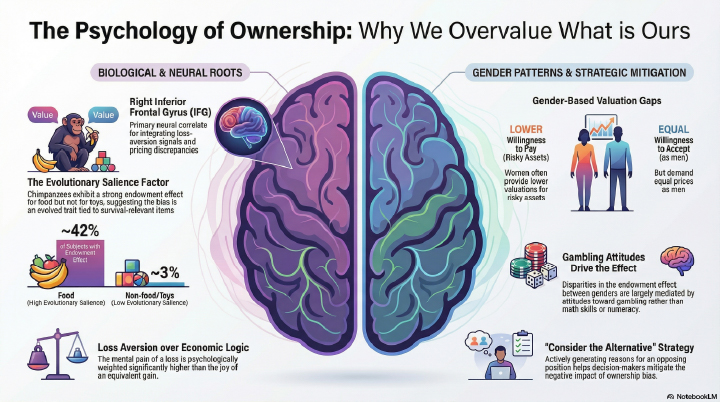
The reason we often struggle with complex financial decisions—yet trade physical money for goods with relative ease—is that money and abstract rights are evolutionarily novel concepts. They typically fail to trigger the “Ancient” emotional alarm. We can remain rational about a bank balance because our limbic system does not instinctively recognize those digits as immediate “survival resources.” Understanding this fundamental neural conflict is the crucial first step toward reclaiming greater control over our financial behaviors.
5. Synthesis: Key Takeaways for the Aspiring Learner
To truly comprehend economic behavior, one must look beyond the mere spreadsheet and delve into the biological heart of the human actor. What often appears as “irrationality” is, in many cases, simply a deeply ingrained survival strategy that has outlived its original context.
Checklist for Comprehension:
- Historically Rational: Do you recognize that behaviors often labeled “irrational” (like overvaluing a possession) were frequently crucial survival advantages in our evolutionary past?
- The Salience Factor: Can you identify how the tangibility and immediate relevance of an item (Evolutionary Salience) trigger a stronger emotional attachment than abstract assets?
- Environmental Novelty: Do you understand that modern markets, currency systems, and contract law are evolutionarily new, creating a “mismatch” where our ancient instincts may not be well-suited for complex contemporary trading?
- Neural Conflict: Are you aware of the brain’s internal “tug-of-war” between the emotional limbic cortex and the analytical prefrontal cortex in decision-making?
Summary Statement: To construct an accurate and comprehensive model of human behavior, we must thoroughly integrate the life sciences with the social sciences. We are not simply “rational actors”; rather, we are biological organisms whose economic choices are profoundly rooted in a long and complex history of survival, scarcity, and the fundamental biological imperative to protect what matters most.