
Unmasking the Dangers of Consensus and Preventing Catastrophic Failures
Have you ever held back a crucial idea in a team meeting, choosing silence over potential disagreement? This common human tendency to conform, when amplified in high-stakes environments, can evolve into a perilous phenomenon known as groupthink. It’s a psychological pitfall where the collective desire for harmony and consensus trumps critical evaluation, leading even the smartest groups to make irrational or dysfunctional decisions.
Coined by William H. Whyte Jr. in 1952 and later popularized by Irving Janis, groupthink is a form of “rationalized conformity.” The core issue is simple: members begin to value agreement more than accuracy. To minimize conflict, they suppress dissenting viewpoints, ignore alternative solutions, and sideline rigorous evaluation. The tragic result is a loss of independent thinking and creativity, where the group’s collective intelligence becomes less than the sum of its parts.
This article delves into the serious consequences of groupthink through true stories of major failures in government and business. By examining what went wrong, we can understand why brilliant teams fall prey to these pitfalls and identify the crucial warning signs that signal groupthink’s dangerous presence. Understanding these lessons is essential for anyone aiming to foster effective decision-making and prevent organizational failures.
What is Groupthink? The Perils of Prioritizing Harmony
Groupthink doesn’t arise from a conscious intent to make poor choices. Instead, it subtly emerges from specific conditions – antecedent factors – that make a group vulnerable to conformity pressures. Recognizing these underlying causes is the first crucial step toward preventing its insidious grip.
Key Warning Signs and Contributing Factors:
- High Group Cohesiveness: While strong bonds can be an asset, highly cohesive groups risk prioritizing harmonious relationships over rigorous decision-making. Members may avoid disagreement to prevent friction, even if it means overlooking critical flaws.
- Faulty Group Structure: Groups lacking impartial leadership, diverse perspectives, or formal procedures for debate are highly susceptible to groupthink. Without mechanisms that encourage constructive challenges and protect dissenters, the prevailing opinion – often that of the leader – can go untested and unchallenged.
- Intense Situational Context: External pressures, such as tight deadlines, a sense of crisis, or public scrutiny, can force groups into rushed and poorly considered consensus. In such environments, the urgency for a quick decision often overrides the necessity for a correct and well-vetted one.
When these warning signs are ignored, the results can be catastrophic. Our first case study provides a tragic, real-world example of how a brilliant team succumbed to these exact pressures.
Case Study 1: The Challenger Disaster – A High-Stakes Failure of Groupthink
The Space Shuttle Challenger tragedy remains a harrowing cautionary tale, illustrating how groupthink can lead to fatal errors even among the brightest minds at institutions like NASA.
Setting the Scene: January 28, 1986
On a bitterly cold Florida morning, the nation watched with bated breath. The launch of the Space Shuttle Challenger was more than a routine mission; it was a powerful symbol of progress, featuring Christa McAuliffe, the first teacher in space. The event was poised to captivate millions and reinforce the image of space travel as safe and routine.
The Critical Conflict and Suppressed Dissent
Behind the scenes, a grave conflict was escalating. Engineers from Morton Thiokol, the company responsible for the shuttle’s rocket boosters, issued a stark warning. The unusually low launch-day temperatures, they argued, could compromise the rubber O-rings sealing the booster joints, potentially leading to a catastrophic failure. Their technical data strongly supported delaying the launch.
How Groupthink Took Hold at NASA
Despite clear expert warnings, a dangerous confluence of situational pressures and a flawed decision-making structure led NASA management to overrule its engineers:
- High-Stakes Situational Context: NASA was under immense pressure. The agency was eager to maintain national attention and aimed for a potential mention in President Ronald Reagan’s State of the Union address that very evening. This intense publicity push fostered a self-imposed schedule where delays were perceived as failures, and technical dissent threatening the timeline was actively discouraged.
- Faulty Group Structure: In the final pre-launch meetings, the engineers’ critical warnings were not adequately weighed. The decision-making process lacked formal procedures to properly evaluate expert dissent against operational pressures. The overwhelming focus on meeting a public deadline ultimately overrode critical technical facts.
The Disastrous Outcome
Just 73 seconds after liftoff, the national dream shattered into a televised nightmare. An O-ring failed, and the Challenger broke apart, tragically killing all seven crew members. The disaster was a national trauma, grounding the entire space shuttle program for nearly three years as NASA grappled with its profound organizational failure.
This tragedy powerfully demonstrates that groupthink is a pervasive threat in any high-pressure environment. As we’ll see in our next case study, it can be just as destructive in the corporate boardroom as it is in a mission control center.
Case Study 2: Corporate Giants Stumble – Marks & Spencer and British Airways
While the consequences of groupthink at NASA were tragically immediate, the phenomenon can be equally devastating in the corporate world, leading to the slow and painful collapse of once-invincible companies.
Setting the Scene: Icons of British Industry
In the 1990s, Marks & Spencer (M&S) and British Airways (BA) were more than just successful businesses; they were British institutions, perceived as titans of industry. Considered “blue chips and darlings of the London Stock Exchange,” both boasted long histories of profitability and seemed immune to market volatility.
The Illusion of Invulnerability and Its Cost
Years of unparalleled success inadvertently fostered a predominant symptom of groupthink: an illusion of invulnerability. This shared sense of invincibility created an echo chamber within their boardrooms, blinding them to the significant risks of their ambitious globalization strategies. This unchecked confidence was a direct result of strong Group Cohesiveness and a Faulty Group Structure that, after decades of success, lacked robust mechanisms for meaningful self-critique. Dissent was stifled not by overt pressure, but by a powerful, unstated consensus that their continuous success was an undeniable certainty.
This overconfidence, born from a culture of unquestioning agreement, led to poorly conceived strategies that ultimately backfired. When market conditions shifted, both companies were severely unprepared. The result was a stunning and rapid financial decline:
| Company | Share Price Collapse (1998-1999) |
|---|---|
| Marks & Spencer | From 590 to less than 300 |
| British Airways | From 740 to 300 |
Both companies, once celebrated for their sector-wide performance and stability, suffered immense losses that erased years of shareholder value. Their stories, like that of the Challenger, powerfully illustrate how a culture of conformity can transform past triumphs into a clear blueprint for future failures.
Fostering Critical Thinking: Strategies to Prevent Groupthink
The compelling narratives of the Space Shuttle Challenger, Marks & Spencer, and British Airways offer critical lessons about the dangers of unchecked consensus and the importance of critical thinking in decision-making. For students, team members, and future leaders alike, understanding these pitfalls is essential for building groups that are not just harmonious, but also genuinely wise and effective.
Key Takeaways for Effective Decision-Making:
- Beware of External Pressure: The rush for publicity at NASA created an environment where thoughtful risk assessment became impossible, demonstrating how external pressures can severely compromise sound judgment.
- Guard Against Internal Overconfidence: Years of success at M&S and BA bred an “illusion of invulnerability,” preventing leaders from critically questioning their own strategies. Success, without introspection, can be a dangerous blindfold.
Proactive Strategies to Combat Groupthink:
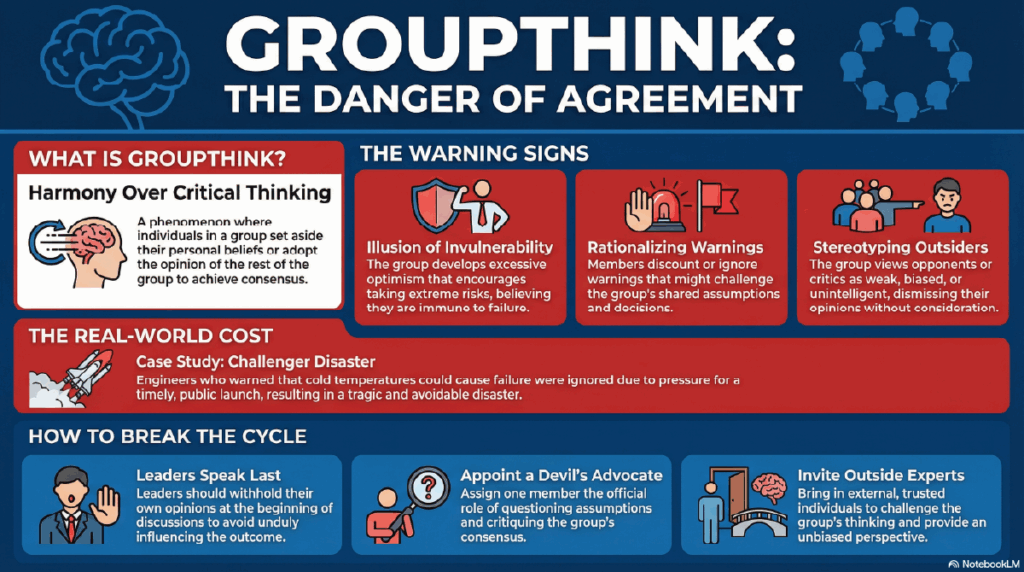
So, how can we actively prevent groupthink and foster a culture of genuine wisdom in a crowd? The solution lies in deliberately building an environment that values independent thought and robust challenge:
- Cultivate Diverse Teams: Actively assemble heterogeneous groups, bringing together individuals with varied points of view, backgrounds, and expertise. This inherent diversity naturally introduces different perspectives.
- Foster Psychological Safety, Not Just a “Devil’s Advocate”: While many teams designate a “devil’s advocate,” research shows this can often be ineffective as individuals may be less persuasive when arguing a position they don’t truly believe. A far more powerful strategy is to cultivate an environment where all team members feel safe and empowered to voice sincere, genuine dissent without fear of retribution or judgment.
- Establish Clear Decision-Making Procedures: Implement formal processes that mandate critical evaluation, require multiple perspectives, and protect channels for dissenting opinions to be heard and considered.
- Leaders Must Encourage and Protect Dissent: Effective leaders actively solicit contrasting opinions, refrain from stating their preference too early, and visibly protect those who voice unpopular but valid concerns.
In your next team project or organizational meeting, have the courage to be the sincere dissenter. Your role isn’t merely to poke holes; it’s to ensure the group thoroughly considers every angle, a task essential for reaching the best possible outcome. True collaboration demands more than just getting along. It requires the courage to think critically, to speak up when something feels wrong, and to value constructive disagreement as much as friendly consensus. The wisest crowds are not those that speak with one voice, but those that orchestrate many different, well-reasoned voices into a truly informed and robust decision.