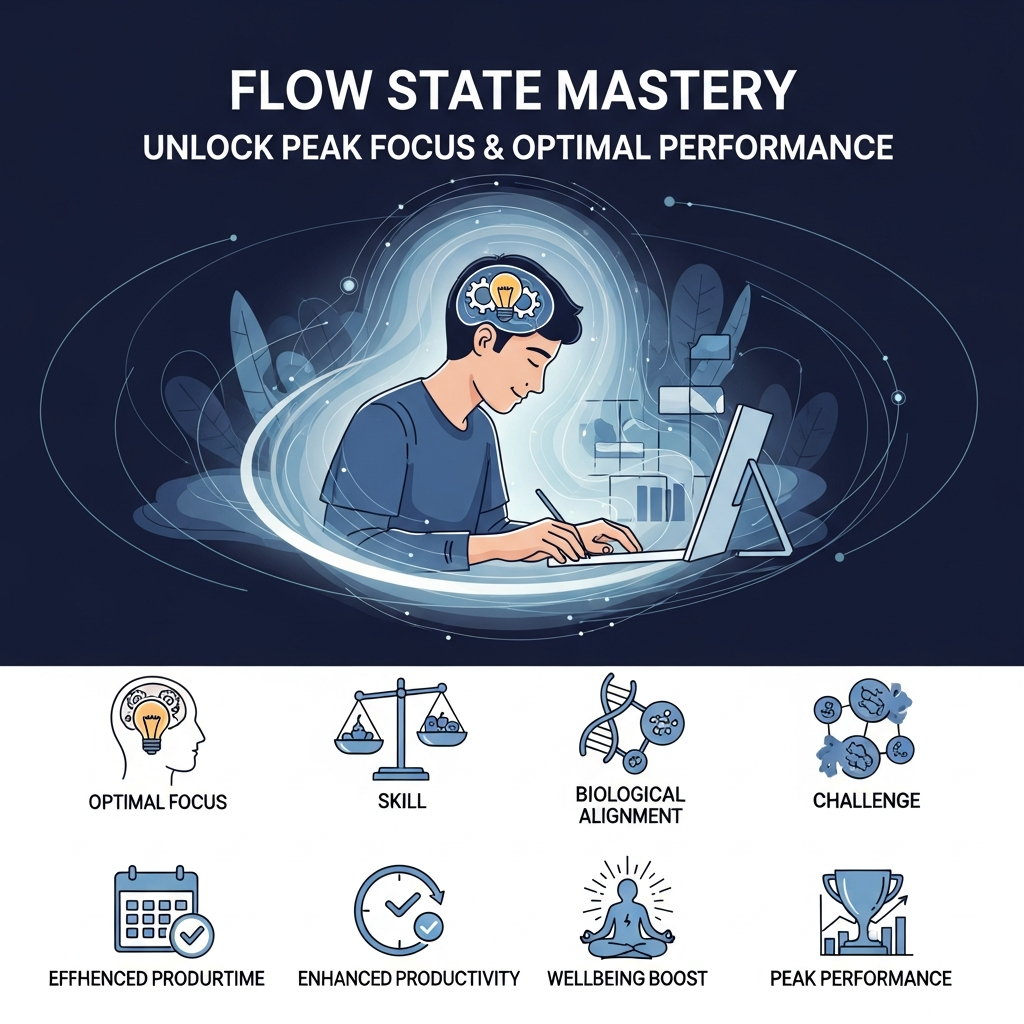
Welcome to an in-depth exploration of the Flow state, a peak mental zone where productivity, well-being, and biological health converge. This article delves into how focused concentration and a precise balance of skill and challenge can unlock unparalleled performance. We’ll also examine the critical role of circadian alignment, strategic light exposure, and personalized chronotypes in optimizing your internal clock for sustained focus and overall wellness. By embracing flexible, results-oriented models over rigid schedules, you can cultivate a holistic approach to thriving in both work and life.
1. The “Zone” Decoded: Defining the Flow State
In the realm of Positive Psychology, the scientific study dedicated to understanding what makes life worth living, the concept of “Flow” stands as a pinnacle of human cognitive achievement. Popularized by the renowned psychologist Mihaly Csikszentmihalyi, Flow is best described as an experience of “effortless attention.” It’s a state where an individual becomes so deeply absorbed in an activity that their sense of self fades away, and action merges seamlessly with awareness.
Csikszentmihalyi chose the term “Flow” after noticing a consistent theme in his interviews: subjects frequently used the metaphor of a river, describing feeling “carried away” or “flowing along with a current” during these profound experiences.
“A state in which people are so involved in an activity that nothing else seems to matter; the experience is so enjoyable that people will continue to do it even at great cost, for the sheer sake of doing it.” — Mihaly Csikszentmihalyi
The Strategic Value of Flow:
- Autotelic Satisfaction: The activity itself becomes the reward, fostering intrinsic motivation and long-term persistence without the need for external incentives.
- Neuro-Cognitive Efficiency: By silencing the “internal critic,” Flow liberates uninhibited creativity and facilitates radical innovation.
- Emotional Resilience: Regular Flow experiences are strongly correlated with higher levels of life satisfaction and improved autonomic regulation, contributing to emotional well-being.
- Cognitive Endurance: Flow transforms challenging, demanding work into an energizing and enjoyable experience, significantly reducing the risk of burnout.
Recognizing these profound benefits and the psychological characteristics of Flow is the essential first step toward cultivating this powerful mental state in your own life.
2. The 8 Pillars: How to Identify Flow in Action
To master the Flow state, it’s crucial to recognize its distinct internal signatures. These eight factors represent a transformative shift from conscious, effortful execution to a state of subconscious mastery.
| Factor | The Learner’s Experience |
|---|---|
| Clear Goals & Immediate Feedback | You have an absolute roadmap; every action is instantly validated by clear, real-time results. |
| Focused Concentration on the Present | All distractions vanish; your mind is completely locked into the singular, immediate moment. |
| Challenge-Skill Balance | You are operating at your “threshold,” where the task is demanding enough to be engaging but still comfortably within your reach. |
| Sense of Agency & Control | You feel a deep, instinctive control over the outcome, unaffected by external variables or uncertainties. |
| Loss of Self-Consciousness | The “internal critic” and self-doubt quiet down; you stop evaluating yourself and simply perform. |
| Temporal Distortion | Your perception of time is altered; hours can feel like minutes, or seconds can expand into significant windows. |
| Action-Awareness Merger | Movement and thought become a single, fluid unit; you stop “thinking” about the steps and just instinctively “do” them. |
| Autotelic Nature | The task is performed for its own sake, even at great personal cost, as the process itself is the primary and most profound reward. |
These internal sensations are not abstract; they translate directly into tangible, high-performance activities across diverse domains of human excellence.
3. The Flow Spectrum: Examples Across Disciplines
While the underlying neurochemistry of Flow remains consistent, its manifestation can vary significantly depending on the structure, rules, and demands of a specific discipline. Let’s explore how Flow appears in different contexts:
Sports
Athletes often describe Flow as experiencing “a totally clear head” or being “in the zone.” This intense focus is vividly exemplified by high-performance icons like Michael Phelps. His famous pre-race “scowling face” isn’t a sign of anger, but rather of successful Flow initiation – his body is primed for peak output, and the water becomes his only reality.
Art
Flow is frequently more accessible in creative pursuits such as music, dance, and writing. The inherent structures and rules of these disciplines often guide the creator into a profound state of immersion. In this “creative trance,” artists often lose track of environmental stimuli, becoming a mere conduit for their work until the Flow state is eventually broken.
Education
In an academic setting, Flow is characterized by total immersion in a subject. It manifests when a learner is so deeply engrossed in a “groove” of study that they are genuinely surprised when a lecture ends, or realize they’ve forgotten a meal because the intellectual challenge of problem-solving was more rewarding than physiological needs.
Work
Professional Flow involves intense, “heads-down” immersion. Knowledge workers achieve this by actively silencing the incessant demands of an “Always-On” culture. In this state, cognitively demanding tasks are completed with surgical precision, exceptional speed, and remarkable efficiency.
While Flow is a universal peak state, it is important to distinguish it technically from other related concepts of focus.
4. Flow vs. Deep Work vs. Hyperfocus
For high-achieving individuals, understanding the distinctions between these states is crucial for applying the correct cognitive tool to the task at hand.
| State | Initiation & Timing | Primary Environment | Level of Control |
|---|---|---|---|
| Flow | Achieving a precise balance between high challenge and high skill, often emergent. | Varied: Creative, athletic, or professional environments. | High: You maintain awareness of goals and possess a strong sense of agency within the task. |
| Deep Work | Intentional, deliberate focus on a cognitively demanding workplace task. | Professional/Academic: Typically structured office settings. | High: A conscious choice to work without distraction to produce valuable output. |
| Hyperfocus | Triggered by intense interest or fascination, regardless of the task’s inherent difficulty. | Random: Often associated with ADHD or high-interest hobbies. | Low: Individuals may struggle to disengage or shift attention to other necessary tasks. |
The journey from mere focus to genuine Flow necessitates navigating the precise “Goldilocks Zone” of difficulty, where challenge perfectly meets skill.
5. The Goldilocks Zone: Balancing Challenge and Skill
The very engine of Flow is the Challenge-Skill Balance, also known as the Zone of Proximal Development (ZPD). This is the metaphorical “sweet spot” where your current capabilities are stretched to their absolute limit without causing excessive stress or frustration.
Boredom (Too Easy)
If a task provides no resistance or novelty, the mind quickly becomes disengaged and wanders, preventing Flow.
Flow Hack: Increase the challenge by adding a “speed” constraint, introducing a more complex methodology, or setting a higher standard for quality.
Anxiety (Too Hard)
If the challenge vastly exceeds your current skill level, you will likely experience stress, frustration, and mental paralysis, blocking any chance of Flow.
Flow Hack: Break the daunting task into smaller, manageable “micro-goals” to lower the perceived challenge and rebuild your sense of agency and confidence.
Flow (The Sweet Spot)
The optimal objective is to operate in a state where the challenge is approximately 4% higher than your current skill level. This delicate balance maintains maximal engagement and fosters a dynamic sense of growth.
Achieving this crucial mental balance is only truly possible when your internal biology is harmoniously synchronized with your external efforts.
6. Biological Anchoring: Chronotypes and Light Management
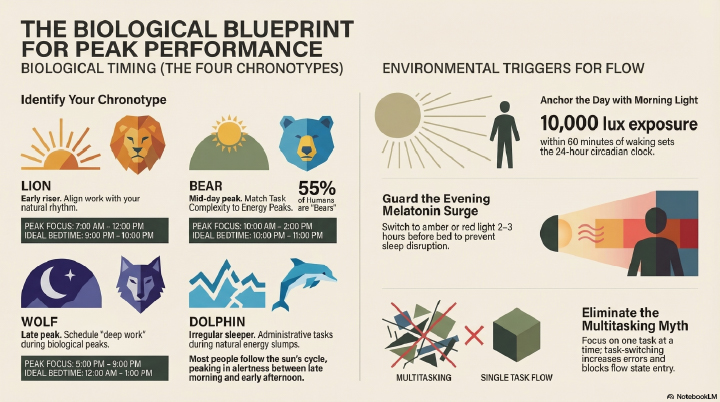
Flow is not just a mental state; it’s a profoundly biological event. By identifying your unique “Chronotype,” you can strategically anchor your peak focus windows to your natural circadian rhythm. Harnessing light therapy within the first hour of waking, for instance, has been shown to yield 2.5 times better results in alertness and mood regulation.
🦁 The Lion (Early Riser)
- Peak Focus Window: Dawn until midday.
- The Light Hack: Utilize 10,000 lux morning light (e.g., a Happy Lamp) within 30 minutes of waking to firmly anchor your circadian rhythm and prevent disruptive evening energy crashes.
🐻 The Bear (Solar Synchronizer)
- Peak Focus Window: 10 a.m. – 2 p.m. (Naturally in sync with the sun’s arc).
- The Light Hack: Prioritize abundant outdoor sunlight exposure in the late morning to effectively mitigate the common “midday slump” and reinforce your natural solar cycle.
🐺 The Wolf (Night Owl)
- Peak Focus Window: 5 p.m. – 9 p.m. (The quintessential night owl schedule).
- The Light Hack: Avoid bright light in the early morning to prevent natural sluggishness. Use light therapy in the afternoon only if it does not interfere with your natural sleep onset.
🐬 The Dolphin (Irregular Sleeper/Creative)
- Peak Focus Window: 10 a.m. – 2 p.m. (Often sporadic creative sparks).
- The Light Hack: Transition to absolute darkness and red-shifted light 2-3 hours before bedtime. This protects delicate melatonin levels and helps prevent insomnia.
Synchronizing your biology is the vital internal step; the subsequent external step involves meticulously building a fortress of focus to protect that precious state.
7. Building a Fortress of Focus: Reducing Digital and Environmental Distractions
The Flow state is chemically fragile and astonishingly easy to disrupt, particularly by the pervasive “Always-On” culture of modern life. A comprehensive environmental audit is essential to prevent cognitive fragmentation and maintain deep focus.
- Snooze Notifications: Proactively engage “Do Not Disturb” modes on all devices to shield yourself from the costly “switch cost” of task-switching.
- Batch Inbox Checks: Designate specific, scheduled windows for responding to communication. This prevents “attention residue” from lingering distractions.
- The 5 Lux Rule for Sleep: Ensure your sleep environment is pitch black. Even minimal dim light (as low as 5 lux) can disrupt critical clock gene expression and metabolic function, impacting overall energy and focus.
- Strategic Caffeine Timing: Wait 1-2 hours after waking before consuming caffeine. This allows natural cortisol to clear morning fog before caffeine blocks adenosine receptors, providing a smoother, more effective boost.
- Red Light Transition: Switch to amber or red-spectrum light bulbs 2 hours before bed. This allows for natural melatonin production while still providing necessary visibility.
- Digital Detox Boundaries: Establish clear, non-negotiable boundaries for screen use to prevent the “hyper-connectivity” that can lead to emotional exhaustion and fragmented attention.
These tactical adjustments form a unified Pre-Flow Ritual, systematically preparing your entire system for the compounding effects of biological and environmental alignment.
8. Conclusion: The Integrated Resilience Effect
The Nomurano framework posits that Flow is far from a mere fluke; rather, it is the direct result of system-wide alignment. When you meticulously align your circadian rhythm, biological needs, and external environment, you unlock an Integrated Systems Effect. Stable, high-quality sleep enhances insulin sensitivity, which in turn regulates glucose levels and significantly reduces stress reactivity. This creates a powerful, compounding resilience effect where your optimized metabolism actively supports your ability to focus, and your enhanced focus, in turn, profoundly elevates your overall quality of life.
Three-Step Flow Starter:
- Block Your Window: Use your identified chronotype to pinpoint your personal peak 2-hour focus window. Treat this time as a non-negotiable “deep work” sanctuary, guarding it fiercely.
- Define Micro-Goals: Calibrate your task to the Challenge-Skill Balance (ZPD) by defining a goal that is “just hard enough” and includes a clear, immediate definition of success.
- Execute the Audit: Clear your path by silencing all devices, strategically delaying caffeine intake, and ensuring your physical environment is optimally configured for the current time of day and your specific task.
By consciously prioritizing biological and environmental alignment over sheer intensity, you can transform Flow from an elusive, accidental occurrence into a repeatable, consistently mastered skill that empowers every aspect of your life.