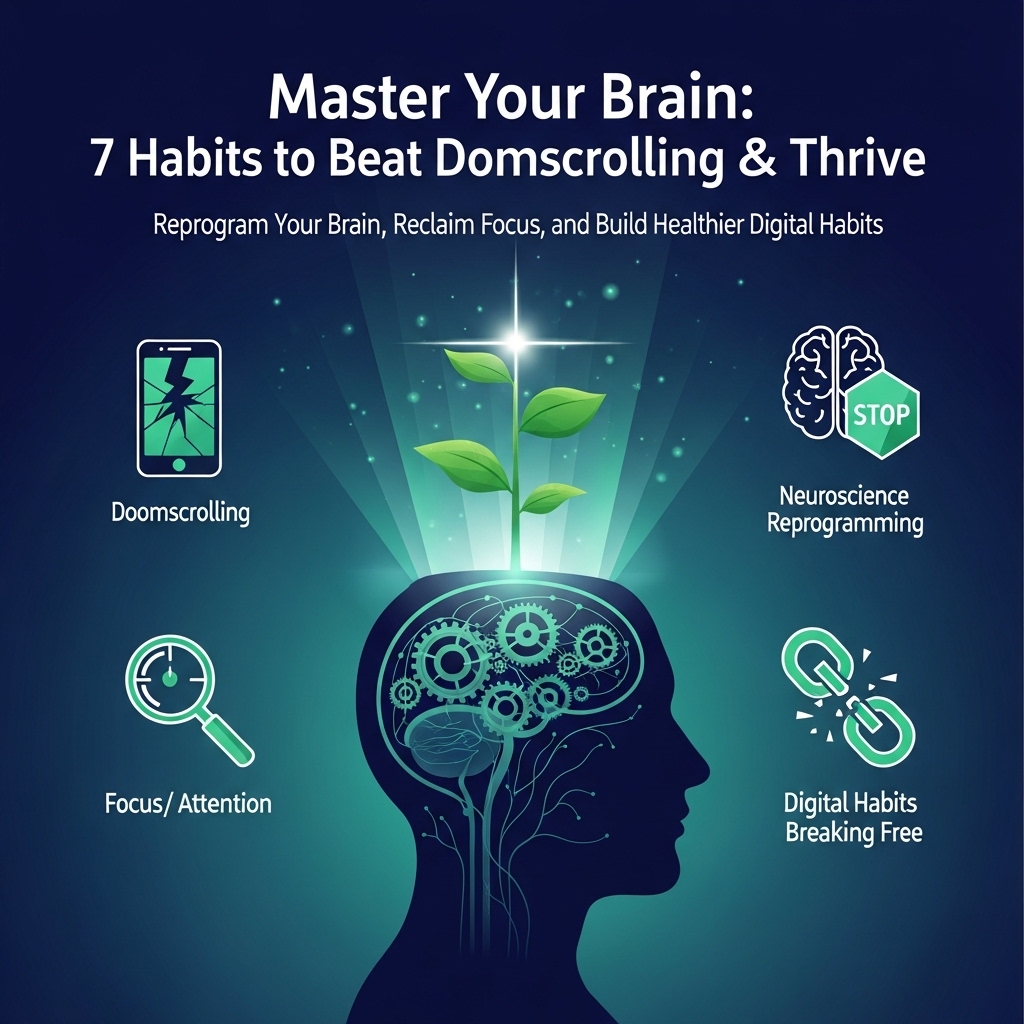
Our modern lives exist at the fascinating intersection of digital technology, neuroscience, and mental health. This article delves into a specific phenomenon: doomscrolling. We’ll explore how addictive algorithms and variable reward schedules exploit the brain’s dopamine pathways, creating compulsive habit loops. This cycle often leads to decision fatigue, depleting cognitive resources and impairing judgment, reducing self-control, and increasing anxiety or depression.
To counteract these effects, we’ll examine practical interventions. These include building meticulous routines, setting time-aware ‘decision budgets,’ and utilizing chronological feeds to disrupt automated scrolling. We’ll also consider how AI personalization could either worsen these issues through infinite memory or mitigate them via adaptive forgetting techniques. Ultimately, maintaining well-being in our digital age requires a blend of behavioral discipline, intentional environmental design, and accessible supportive treatment resources.
1. Your Brain on Autopilot: Understanding Habits
Imagine navigating between 33,000 and 35,000 decisions every single day. To prevent cognitive overload, your brain relies on a crucial survival mechanism: automaticity. While we often use the word ‘habit’ casually, behavioral neuroscience defines a true habit by two strict criteria:
- It must be insensitive to a reduction in the value of the outcome (you continue the behavior even if the reward is no longer desirable).
- It must be insensitive to the contingency between the action and the result (you do it regardless of the perceived link between your action and its consequence).
This shift to autopilot is a vital energy-saving strategy. Though your brain makes up only 2% of your body weight, it consumes a staggering 20% of your total glucose. Conscious, deliberate decision-making in the cortex is metabolically expensive. To conserve energy, your brain naturally offloads repetitive behaviors to subcortical structures. This ‘limited pool’ of mental resources is then preserved for novel challenges, enabling your neurobiology to adapt, survive, and thrive. To navigate this intricate system effectively, we must first explore the anatomical ‘engine room’ where these powerful patterns are forged: the Basal Ganglia.
2. The Engine Room: Mapping the Striatum
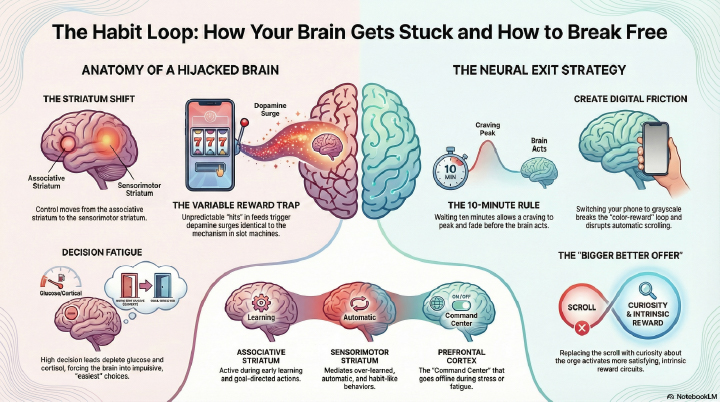
The striatum serves as the primary entry point for information into the basal ganglia, acting as a neural filter that decides which sensory inputs should be translated into motor actions. However, learning isn’t a static process; it involves a sophisticated hand-off between two distinct regions of the striatum:
| Region Name | Developmental Stage | Primary Function | Impact of Disruption |
|---|---|---|---|
| Associative Striatum | Early Learning | Goal-directed action; sensitive to outcome value. | Disrupts the acquisition of new skills; can cause a premature shift to rigid habits. |
| Sensorimotor Striatum | Late Learning | Stimulus-Response (S-R) habits; procedural ‘doing.’ | Prevents the expression of well-learned habits; forces the brain back into high-energy goal-directed mode. |
The Evolution of Control: From Striatum to Cortex
The ‘Classical View’ once suggested that practice simply moved control from the cortex to the basal ganglia. However, modern research, particularly by F. Gregory Ashby and his colleagues, has refined this understanding. While we know control shifts from the associative to the sensorimotor striatum during practice, newer hypotheses propose that at the highest levels of mastery, behaviors may become striatum-independent. In this advanced stage, automaticity is mediated entirely within cortical-cortical pathways, bypassing the basal ganglia altogether. This ‘training’ of the cortex by the striatum represents the ultimate goal of procedural learning. To power this transition and signal which behaviors are worth the energy of ‘hard-wiring,’ the brain relies on its primary chemical motivator: Dopamine.
3. The Fuel: Dopamine and the Reward Loop
Dopamine is frequently misunderstood as merely a ‘pleasure chemical.’ In reality, it is the crucial neurotransmitter of motivation and anticipation. It doesn’t signal how much you like something, but rather how much you want it.
Through Reinforcement Learning, the brain releases dopamine when it encounters an ‘unexpected reward.’ This surge facilitates Long-Term Potentiation (LTP)—the physical strengthening of synapses. Modern behavioral design cunningly exploits a specific mechanism known as Variable Ratio Reinforcement, often dubbed the ‘Slot Machine Effect.’ When rewards are unpredictable—like the varying quality of a social media feed—dopamine spikes are higher and more frequent, making the behavior significantly more addictive than if the reward were guaranteed.
This chemical fuel drives the Habit Loop, a powerful three-part cycle that reinforces learning:
- Trigger: A sensory cue or an internal feeling (e.g., anxiety, boredom, or restlessness).
- Behavior: The routine action taken in response (e.g., scrolling, snacking, or checking notifications).
- Result: A momentary ‘reward’—usually a brief numbing of discomfort or a hit of novelty—that reinforces the trigger for the next time.
While the striatum efficiently manages the execution of these loops, the ‘Command Center’ of your brain is constantly attempting to balance these impulsive behaviors with your long-term goals and emotional safety.
4. The Command Center and the Emotional Anchor: PFC and Amygdala
The Prefrontal Cortex (PFC), particularly the Infralimbic Cortex, functions as the brain’s ‘Command Center.’ It’s responsible for executive function, planning, and inhibitory control—the part of you that plans for finals or decides to go to the gym. However, its authority is often challenged by the Amygdala, the ‘Emotional Anchor’ responsible for threat detection and emotional memory.
Between these two crucial regions lies the Hippocampus, serving as a vital transition point. It converts short-term memories into long-term storage and provides the essential context the PFC needs to make informed decisions.
The Vicious Cycle of Decision Fatigue
The PFC is highly susceptible to Decision Fatigue. As you make thousands of choices throughout the day, your brain’s glucose reserves deplete, and your hormonal environment shifts. Stress triggers the release of Cortisol and Adrenaline. While these hormones are useful for short-term alertness, they actually impair the PFC’s ability to perform complex reasoning. This creates a biological ‘vicious cycle’: high decision loads increase anxiety and cortisol, which further weakens the PFC’s inhibitory control. In this compromised state, the amygdala’s negativity bias takes over, prioritizing threatening information and driving you toward the easiest, most impulsive ‘autopilot’ behaviors. This biological vulnerability is precisely the point of entry for modern digital hijackers.
5. Modern Hijackers: Algorithms and Doomscrolling
In the digital age, our ancient survival mechanisms are being exploited by what we call ‘Dopamine Hijacking.’ AI-driven algorithms are not designed for your well-being; instead, they are optimized for engagement-for-profit. This transforms what might be considered ‘digital heroin’ into something far more potent, like ‘fentanyl,’ through hyper-personalized, high-speed feeds.
The Three Forces Hijacking Your Brain:
- Intermittent Reinforcement: Using the ‘Slot Machine Effect,’ platforms ensure you never know which scroll will provide the next ‘hit,’ keeping you compulsively locked in the loop.
- Negativity Bias: Algorithms exploit the amygdala’s natural preference for threats, constantly pushing outrageous or frightening content. Your brain finds this biologically impossible to ignore.
- Anxiety as a Trigger: We often reach for our phones to escape the cortisol spikes of daily stress. Paradoxically, the negative content we find often increases our anxiety, creating a self-reinforcing loop of ‘doomscrolling.’
This constant overstimulation can lead to Digital Amnesia, as the brain becomes too overtaxed to allow the Hippocampus to consolidate meaningful information. To reclaim your focus, you must leverage the very same reward-based learning system that built these habits to effectively dismantle them.
6. Mapping the Way Out: The Science of Habit Change
To break free from the cycle of ‘autopilot,’ you can engage the ‘Three Gears‘ method—a practical framework for updating your brain’s internal reward values:
- Gear 1: Mapping the LoopClearly identify the trigger (e.g., the feeling of anxiety), the behavior (e.g., the 2 a.m. scroll), and the actual result (e.g., dry eyes, neck pain, increased stress). Understanding the loop is the first step to disrupting it.
- Gear 2: Getting DisenchantedPerform a ‘body check.’ Instead of fighting the urge, consciously notice how the behavior feels while you are doing it. By focusing on the ‘Yuck’ factor—such as the tightness in your chest or the mental fog—you provide your PFC with updated, real-time data. This allows your brain to update the ‘reward value’ of scrolling from ‘relief’ to ‘exhaustion’ or discomfort.
- Gear 3: The Bigger Better Offer (BBO)Replace the shallow dopamine hit with genuine curiosity. When an urge hits, simply observe it. Neuroscience shows that most urges peak and fade within 60 to 90 seconds. Getting curious about the physical and mental sensations of the urge is intrinsically rewarding and provides a ‘Bigger Better Offer’ than mindlessly scrolling.
Building Speed Bumps: The Power of Friction
Drawing on frameworks from experts like Catherine Price (environmental design) and Cal Newport (digital minimalism), you can strategically add ‘friction’ to disrupt your autopilot responses:
- Grayscale Mode: Removing the vibrant colors from your screen makes the ‘variable rewards’ less stimulating. This effectively ‘disenchants’ the brain’s visual reward system, making your phone less appealing.
- The 10-Minute Rule: When the urge to check your phone arises, commit to waiting just 10 minutes. This allows the craving to pass its 90-second peak and keeps your PFC online and in control.
- Digital Minimalism: During study sessions or important tasks, keep your phone in another room. Research consistently shows that merely having a phone visible reduces cognitive capacity, as your brain expends energy resisting the urge to check it.
7. Summary Table: Brain Region Roles at a Glance
Understanding these key brain regions can empower you to better manage your habits and well-being:
| Region | Primary Role in Habit/Memory | Student Takeaway |
|---|---|---|
| Prefrontal Cortex (PFC) | Executive function and inhibitory control (specifically the Infralimbic Cortex). | When you are stressed or tired, this ‘Command Center’ goes offline; don’t rely solely on willpower. |
| Hippocampus | Converting short-term memory to long-term consolidation. | Overstimulation and lack of quality sleep prevent this region from ‘saving’ what you’ve learned. |
| Amygdala | Emotional memory and threat detection. | Powers your negativity bias; it treats a ‘bad headline’ with the same primal urgency as a physical predator. |
| Striatum | The gatekeeper that shifts goal-directed action into Stimulus-Response (S-R) habits. | Mastery moves control from the Associative to the Sensorimotor side, and eventually to the cortex itself. |
| Basal Ganglia | The subcortical ‘engine’ for procedural learning and habit formation. | Its primary role is to ‘train’ the cortex to handle repetitive tasks automatically to save precious energy. |