Master Your Studies: Proven Techniques for Smarter Learning & Lasting Understanding
Introduction: Escaping the Cramming Cycle for True Learning
The life of a student is a constant balancing act, juggling intense workloads, looming deadlines, and the pressure to perform. Faced with a flood of information, many fall into the familiar cycle of late-night cramming, fueled by caffeine and the desperate hope that something—anything—will stick. This approach isn’t just stressful and exhausting; it’s remarkably ineffective for long-term learning and genuine academic success.
This comprehensive guide presents a powerful premise: effective studying is not an innate talent, but a skill that can be systematically learned and significantly improved. True academic achievement isn’t about the sheer number of hours you put in; it’s about how you strategically use those hours to maximize retention and comprehension.
Drawing from cutting-edge cognitive science and educational psychology, this manual provides a toolkit of evidence-based study techniques. Our purpose is to help you move beyond passive rereading and into a world of active, strategic learning. By understanding how your brain actually learns, you can work with its natural processes to unlock your full potential, reduce test anxiety, and master even the most difficult topics with lasting confidence.
1. Understanding Your Brain: The Engine of Learning
To use any tool effectively, you must first understand the machine it’s designed for. The same holds true for effective study techniques. Understanding the “why” behind these strategies—how they align with your brain’s cognitive architecture—makes them far more powerful and easier to apply for smarter learning.
1.1. Your Brain’s Three-Part Memory System
Researchers have identified three fundamental parts of our memory system that work in concert to process the world around us and facilitate memory consolidation:
- Sensory Memory: This is the initial, ultra-brief filter for everything in your environment. It takes in information from all your senses and holds it for less than half a second, deciding what is important enough to pay attention to.
- Short-Term (Working) Memory: Once you focus on a piece of information, it enters your working memory. Think of this as your brain’s mental notepad – it’s where you actively process new information. However, this notepad is surprisingly small, with a strictly limited capacity.
- Long-Term Memory: For information to be truly learned and recalled, it must be transferred from your working memory to your long-term memory. This is the vast, organized filing cabinet where knowledge is stored for future retrieval and lasting understanding.
The flow of information from sensory input to long-term storage is not seamless. The most critical bottleneck in this entire system is your Working Memory, which can only hold and process a small amount of new information at one time before becoming overloaded. This is why you can’t easily multiply 48 x 76 in your head while also trying to remember a new phone number someone is telling you. The notepad gets full, and information starts falling off. This single limitation is the key to understanding why some study methods work and others fail, especially when trying to boost memory.
1.2. Managing Your Mental Bandwidth: Cognitive Load Theory
Cognitive Load Theory (CLT) is an instructional framework built around the brain’s limited working memory. It explains that every learning task places a “load” on your brain. The goal of effective study strategies is to manage this load intelligently. There are three types of cognitive load:
| Type of Load | Definition | Analogy for Students |
|---|---|---|
| Intrinsic Load | The inherent difficulty of the material itself. A complex physics equation has a higher intrinsic load than a simple vocabulary word. | This is the complexity of the puzzle itself. A 1000-piece puzzle has a higher intrinsic load than a 10-piece one. |
| Extraneous Load | Unnecessary mental effort caused by how information is presented. This includes confusing instructions, a distracting study environment, or poorly designed materials. | This is trying to build IKEA furniture with blurry instructions, in a dark room, while a toddler is screaming. It’s the useless mental effort that gets in the way of the actual task of deep learning. |
| Germane Load | The desirable, productive mental effort used to process new information, connect it to what you already know, and build long-term understanding (schemas). | This is the focused effort of figuring out how the puzzle pieces connect to form a larger picture. It’s the “aha!” moment of deep understanding, critical for student success and learning strategies that work. |
The central insight of Cognitive Load Theory is this: your total mental energy is finite. The more working memory you waste on extraneous load, the less you have available for the germane load required for deep learning. Effective study strategies are designed to minimize distractions and inefficient methods, freeing up your mental bandwidth to focus on what truly matters for memory retention.
1.3. The Reality of Forgetting and the Power of Sleep
Forgetting isn’t a failure; it’s a natural and predictable feature of our memory. In the 19th century, psychologist Herman Ebbinghaus discovered the “Forgetting Curve,” which demonstrates that after we learn something, we gradually forget more and more of it as time passes.
However, we have a powerful, built-in tool to combat this curve: sleep. Sleep is not a passive state of rest but a critical part of the learning process responsible for memory consolidation. Consolidation is the process where the brain organizes, strengthens, and files away the day’s memories, transferring them from the fragile notepad of short-term memory to the secure archives of long-term storage.
Pulling an “all-nighter” is counterproductive because it robs your brain of the essential time it needs to consolidate what you just spent hours trying to learn. A good night’s sleep, especially after a study session, is one of the most effective study aids you have for boosting memory and achieving student success.
With this foundational knowledge of how your brain processes, stores, and forgets information, you are now equipped to use study techniques that leverage these natural systems for maximum effect and smarter learning.
2. Your Toolkit for Deep Learning: Four Core Techniques for Academic Success
The following four techniques are the practical application of the cognitive principles discussed above. They are evidence-based, effortful, and designed to create deep, durable knowledge rather than fragile, short-term memorization. These are the effective study techniques that will transform your learning approach.
2.1. Technique 1: Chunking — Taming Complexity for Better Retention
What it is:
Chunking is the strategy of breaking down large amounts of information into smaller, meaningful, and more manageable groups, or “chunks.”
Why it works:
This technique directly addresses the limited capacity of your working memory. Instead of trying to hold a dozen individual items on your mental notepad, you group them into a few high-order units. This prevents cognitive overload and makes complex information easier to process, retain, and recall, significantly boosting memory.
How to use it:
- Identify Patterns: Scan your notes or textbook and look for information, concepts, or steps that are naturally related.
- Group and Label: Group these related items together under a single, meaningful label or concept. For example, the steps of a specific chemical reaction can become one chunk called “The Haber-Bosch Process.”
- Practice Retrieval: First, practice recalling the chunk’s label. Then, practice “unpacking” the chunk by recalling the individual pieces of information within it.
2.2. Technique 2: The Feynman Technique — The Ultimate Test of Understanding
What it is:
Developed by Nobel Prize-winning physicist Richard Feynman, this technique is built on a simple premise: “If you want to understand something well, try to explain it simply.” True understanding is the ability to distill a complex idea into plain language, a cornerstone of deep learning.
Why it works:
Explaining a concept in simple terms forces you to move beyond memorizing jargon and confront the gaps in your knowledge. From a cognitive load perspective, this method forces you to reduce the intrinsic load by simplifying the material to its core components. When you get stuck, you’ve identified an area where more productive germane load—the deep thinking that builds schemas—is required. This is an excellent learning strategy to ensure lasting understanding.
How to use it:
- Choose Your Concept: Write the name of the concept you are studying at the top of a blank sheet of paper.
- Teach it to a Novice: Write out an explanation of the concept using only simple words, as if you were teaching a bright middle-schooler or a friend from a completely different major. Avoid all complex language and technical terms.
- Identify Gaps & Review: Whenever you get stuck, find your explanation confusing, or are forced to use jargon, you have identified a gap in your understanding. Go back to your source material (textbook, lecture notes) to fill that gap until you can explain it in simple terms.
- Simplify and Refine: Rework your explanation, creating powerful analogies to clarify the concept, until it is so simple and clear that anyone could understand it.
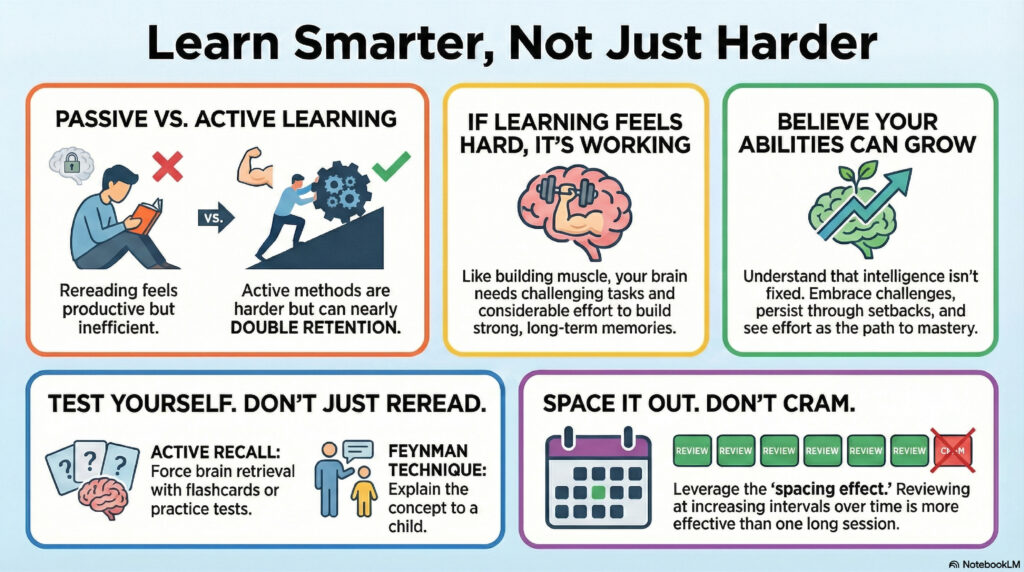
2.3. Technique 3: Active Recall — Retrieving, Not Rereading
What it is:
Active Recall, also known as retrieval practice or the “testing effect,” is the act of actively retrieving information from your memory. It is the opposite of passive review, where you simply reread or look at your notes. This is a fundamental effective study technique.
Why it works:
Passive rereading creates a dangerous “illusion of competence” because you are merely recognizing information, not truly recalling it. You see a familiar term and think, “Oh yeah, I know that,” but you can’t actually explain it from memory. The act of struggling to retrieve information is more difficult, but this is exactly where the learning happens. From a cognitive load perspective, this struggle is productive germane load—the mental effort that builds strong neural pathways. It minimizes wasteful extraneous load (rereading) and maximizes the deep work of memory consolidation. If the Forgetting Curve is the disease, Active Recall is the cure. Each act of retrieval flattens the curve, pushing the memory further into the future and significantly boosting memory and retention.
How to use it:
- Utilize Practice Tests: Quiz yourself using questions from past exams or the end of textbook chapters. Do this without looking at your notes.
- Create Your Own Questions: Act as the teacher. As you study, write down questions you think might appear on an exam. You can then use these to quiz yourself or trade them with a study partner.
- Master Flashcards: Don’t just flip the card over after a brief pause. Force yourself to actively write down the answer from memory before you check if you are correct. This simple change transforms flashcards from a passive review tool into an active recall powerhouse.
2.4. Technique 4: Spaced Repetition & Interleaving — Making It Stick for the Long Haul
What they are:
- Spaced Repetition: This technique involves studying information over an extended period with increasing intervals between review sessions, directly combating the Forgetting Curve. It is the opposite of cramming and vital for long-term retention.
- Interleaving: This involves mixing different topics or types of problems within a single study session, rather than studying one topic for a long, continuous block (known as “massed practice”).
Why they work:
Both are forms of desirable difficulties—effortful learning strategies that may slow down performance in the short term but lead to vastly superior long-term retention. In Cognitive Load Theory terms, these difficulties are the application of productive germane load. Spacing forces your brain to work harder to recall information that it has almost forgotten, which strengthens the memory. Interleaving helps your brain learn to differentiate between different concepts and choose the correct strategy for solving a problem, which is a critical skill for exams and lasting understanding.
How to use them:
Combine these two techniques into a powerful study schedule. Instead of studying one subject for three hours straight, break your time into smaller blocks. For example, spend 50 minutes on Calculus, then 50 minutes on Chemistry, and then 50 minutes on Biology. During your weekly review, don’t just study this week’s material. Plan to spend time reviewing key concepts from the previous week and even a month ago. This combination of spacing and interleaving builds durable, flexible knowledge that will last well beyond the final exam, ensuring student success.
3. Building Your Focus Fortress: Mastering Your Mind & Environment
Having the right effective study techniques is only half the battle. To execute them effectively, you also need to master your focus, your mindset, and your environment. These are the “operating system” for smarter learning.
3.1. Adopt a Growth Mindset for Resilience
Your mindset is your underlying belief about your own abilities, and it profoundly affects how you respond to challenges. Adopting a growth mindset is foundational for student success and applying demanding learning strategies.
| Fixed Mindset | Growth Mindset |
|---|---|
| Believes intelligence and talent are static. | Believes intelligence can be developed through effort. |
| Avoids challenges to avoid failure. | Embraces challenges as opportunities to grow. |
| Sees effort as pointless or a sign of weakness. | Sees effort as the path to mastery and improvement. |
| Feels helpless and gives up easily. | Learns from failure and persists with determination. |
The study strategies in this guide are effortful by design. A fixed mindset perceives the “desirable difficulty” inherent in active recall as a sign of personal failure. A growth mindset correctly interprets that same mental effort as a sign that productive germane load is being applied and true learning is happening. Adopting a growth mindset is the foundation for resilience and the successful application of every other technique in this manual for smarter learning.
3.2. Master the Art of Deep Work to Boost Focus
In a world filled with distractions, the ability to concentrate is a superpower. Author Cal Newport defines “Deep Work” as focused effort performed without distraction that pushes your cognitive abilities to their limit. This is the state where real deep learning happens.
Here are practical steps to build your own “Focus Fortress” and enable deep work for effective study:
- Tame Your Environment: Your physical space dramatically impacts your mental space. Declutter your desk to reduce visual noise. Ensure you have good lighting. Most importantly, silence and put your phone away—out of sight, out of mind.
- Use a “Start Signal”: The hardest part of a study session is often just getting started. Create a simple, repeatable ritual to signal to your brain that it’s time to focus. This could be putting on a specific pair of noise-canceling headphones, opening a particular study app, or writing your session’s goal at the top of a fresh page.
- Block Your Time: Treat your study sessions like non-negotiable appointments. Schedule specific blocks of time in your calendar for deep work. Within these blocks, use the Pomodoro Technique to maintain high concentration: work for 25 minutes with full focus, then take a 5-minute break. After four cycles, take a longer break of 15-30 minutes.
3.3. Beat Procrastination for Good: Actionable Strategies
Procrastination is rarely a sign of laziness. More often, it’s an emotional response to feeling overwhelmed, fearing failure, being fatigued, or simply lacking a clear plan of action. Here are three effective strategies to overcome procrastination:
- Break It Down: A large, daunting project like “write a 15-page research paper” is a recipe for procrastination. Deconstruct it into small, concrete, actionable steps. Your first step isn’t “write the paper”; it’s “research five articles for the introduction” or “write the first paragraph.” This is a key learning strategy.
- Set Artificial Deadlines: Don’t let the real deadline be your only motivator. Trick your brain by setting your own due date a few days before the actual one. This creates a safety net, reduces last-minute stress, and builds momentum to carry you across the finish line with confidence.
- Seek Feedback Early: Perfectionism often fuels procrastination. Don’t wait until your work is “perfect” to share it. Presenting an early draft to a professor, TA, or study partner allows you to catch mistakes before they become major problems and saves you from time-consuming rewrites later. This also encourages active learning.
4. A Holistic Approach: Fueling Your Brain for Peak Performance
Your cognitive performance is directly linked to your physical well-being. To learn effectively and achieve student success, you must take care of the organ doing the learning: your brain.
- Prioritize Sleep: As mentioned, sleep is non-negotiable for memory consolidation and lasting understanding. An all-nighter before an exam is one of the worst things you can do, as the learning from that day is far less likely to be stored in long-term memory. Aim for consistent, quality sleep to allow your brain to do its essential work and boost memory.
- Move Your Body: Physical exercise is a powerful cognitive enhancer. It increases blood flow to the brain, which supports the growth of new neurons (a process known as neuroplasticity). Even a short walk can improve focus and mental clarity, contributing to smarter learning.
- Eat for Your Brain: A balanced diet provides the fuel your brain needs to function optimally. Foods rich in antioxidants and vitamins can support cognitive function and overall brain health, directly impacting your ability to employ effective study techniques.
5. Conclusion: Your Journey to Becoming an Effective & Confident Learner
The path to becoming a successful student isn’t about working harder; it’s about working smarter. The core message of this guide is to prompt a fundamental shift in your approach: move away from passive, inefficient habits like rereading and cramming, and embrace an active, effortful, and strategic learning process for academic success.
By integrating powerful effective study techniques like Chunking, the Feynman Technique, Active Recall, and Spaced Repetition into your routine, you are not just memorizing facts for a test; you are building a deep, flexible, and lasting foundation of knowledge. These are the learning strategies that lead to lasting understanding.
These are more than just study tips. They are tools for life—tools that will empower you to become a more effective, confident, and less-stressed learner, ready to master any challenge that comes your way. Your journey to smarter learning starts now, ensuring you achieve student success and unlock your full potential. Embrace these proven methods to boost memory and transform your educational journey.