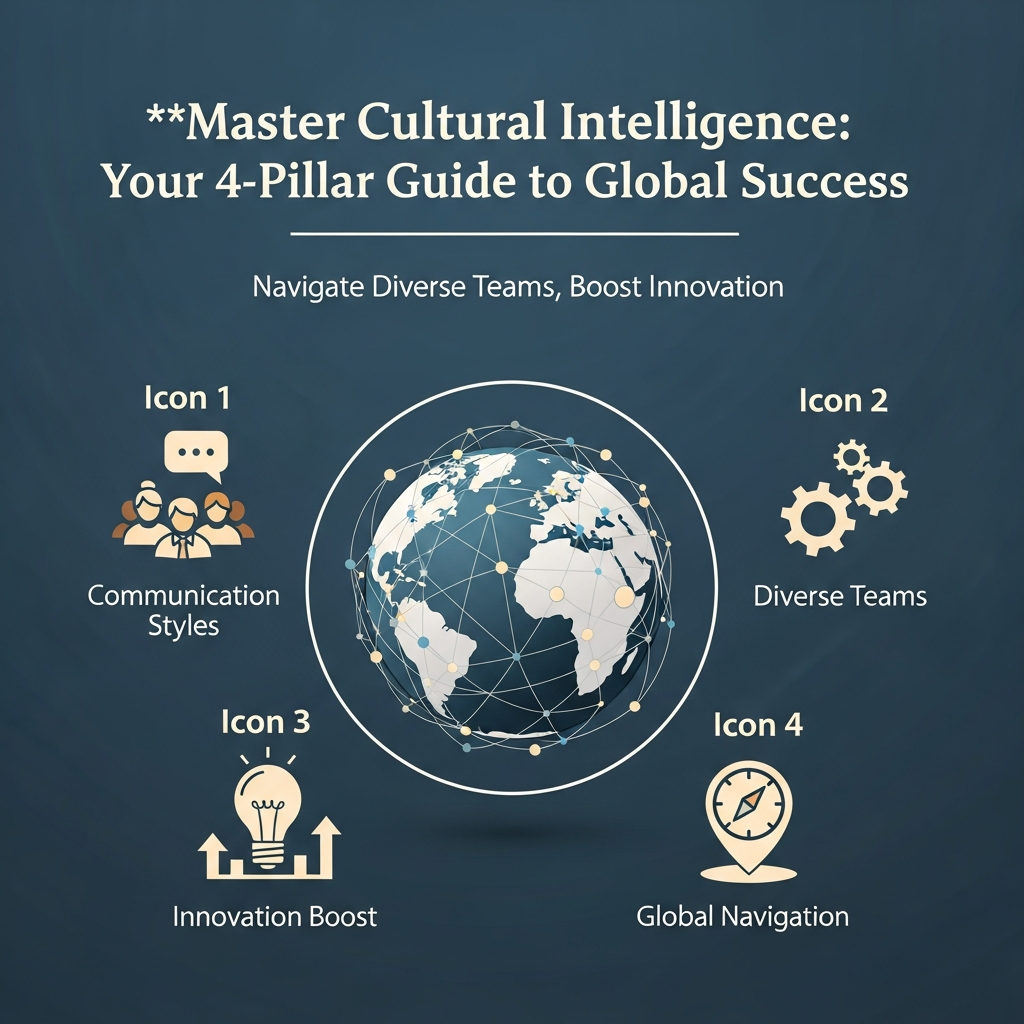
Master Cultural Intelligence: Your 4-Pillar Guide to Global Success
In our rapidly globalizing world, characterized by advanced technology and diverse workforces, Cultural Intelligence (CQ) has become an indispensable skill. Navigating varied professional landscapes successfully requires more than just technical expertise; it demands a deep understanding of human diversity. This article explores how misinterpreting nonverbal cues, like body language and silence, can create significant friction in multicultural teams. While organizations leverage AI for streamlined communication, the human element remains crucial for deciphering subtle cultural nuances and emotional subtexts.
Leadership strategies are also adapting to the complexities of remote and hybrid work environments, where digital fatigue can erode trust. To counter these challenges, experts recommend structured intercultural training and proven frameworks like the Culture Map to bridge communication gaps. Ultimately, successful global engagement hinges on balancing technological efficiency with an empathetic, profound understanding of diverse human interactions.
The Developmental Pathway to Intercultural Mastery
Effective navigation of global markets goes beyond mere empathy; it necessitates a structured progression through the developmental hierarchy of Cultural Intelligence. To lead with impact, individuals must advance through three distinct cognitive and behavioral stages:
- Cultural Awareness
- Definition: Developing a heightened sensitivity to the existence of both similarities and differences among various cultural groups.
- The “So What?”: This foundational stage shifts individuals from a “know-it-all” to a “learn-it-all” mindset. As exemplified by Satya Nadella at Microsoft, acknowledging that one’s own cultural baseline is not universal is critical for growth.
- Cultural Competence
- Definition: An advanced understanding that an individual’s perspective is a composite of complex cultural backgrounds and unique personal experiences, coupled with an active awareness of one’s own cultural assumptions.
- The “So What?”: This transition is essential for identifying internal filters and biases that can distort how we interpret the world. Without it, a leader remains confined within their own subjective reality.
- Cultural Intelligence (CQ)
- Definition: The sophisticated ability to relate and work effectively across cultures, demonstrating the capacity to adapt behavior to function in diverse settings or with people from different backgrounds.
- The “So What?”: This represents the leap from theoretical knowledge to “mastery in motion.” High CQ enables seamless collaboration and goal achievement where others might only perceive friction.
This developmental pathway provides the structural foundation for the specific cognitive frameworks required to navigate diverse human interactions effectively.
Deciphering the “Why”: The Value of High CQ
Cultural Intelligence is a primary catalyst for enhancing organizational performance and personal leadership efficacy. The evidence is compelling:
- Accelerated Innovation and Productivity: Culturally aware teams are 36% more likely to be innovative and report a 17% increase in productivity.
- Empathy and Equitable Care: In healthcare, CQ is crucial for delivering compassionate, equitable care, significantly improving patient safety, and fostering the empathy required to meet diverse patient needs.
- Strategic Market Expansion: Leaders with high CQ are adept at localizing strategies and forging global partnerships that drive increased ROI. These culturally intelligent leaders are frequently selected for strategic global roles.
- The “Learn-it-all” Advantage: Satya Nadella’s transformative leadership at Microsoft demonstrates that valuing diverse perspectives and adopting a learning-centric approach directly correlates with a more collaborative and adaptable organizational environment.
- Precise Global Decision-Making: High CQ empowers leaders to synthesize diverse viewpoints during strategic sessions, ensuring that initiatives, such as global product launches, are both culturally sensitive and comprehensively developed.
Understanding these profound benefits underscores why mastering the fundamental framework of communication context is a critical business and personal priority.
The Spectrum of Communication: High-Context vs. Low-Context
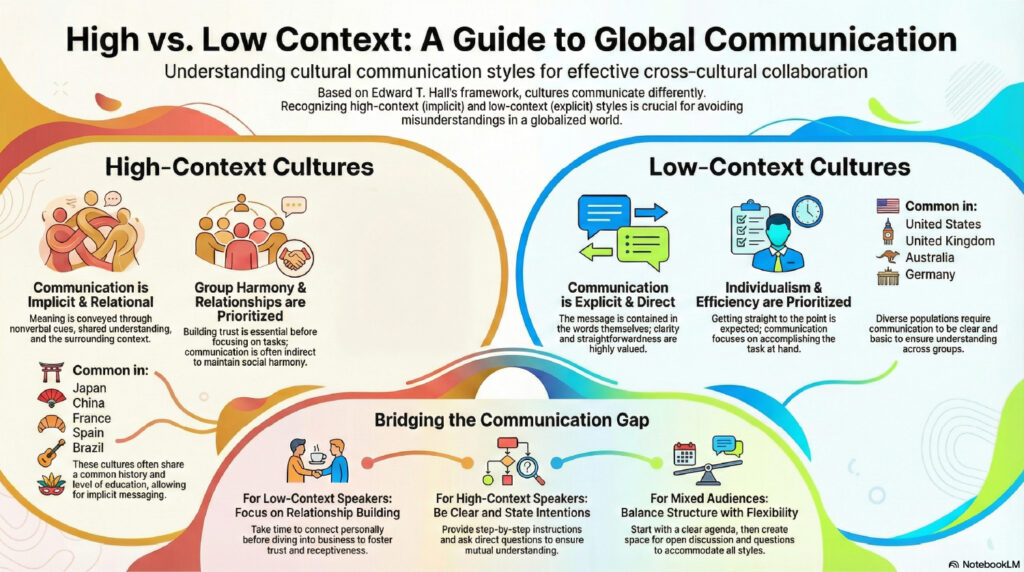
The most vital framework for applying CQ is the distinction between high-context and low-context cultures, a concept pioneered by anthropologist Edward T. Hall.
| Feature | High-Context (e.g., Japan, China, Guatemala, France, Spain) | Low-Context (e.g., United States, Germany, Netherlands, UK, Australia) | Primary Benefit/Goal |
|---|---|---|---|
| Communication Style | Indirect and Implicit: Meaning is embedded in the environment and “reading between the lines.” | Direct and Explicit: Communication is straightforward, focusing on literal message content. | Group Cohesion and Relationship Maintenance vs. Clarity and Efficiency |
| Non-Verbal Cues | High Reliance: Tone, body language, gestures, and status are essential for meaning. | Low Reliance: Words carry the primary information; non-verbal cues are secondary. | Protecting Relationships vs. Avoiding Ambiguity |
| Orientation | Relationship-Oriented: Values shared history, trust-building, and group harmony. | Task-Oriented: Values individual achievement, efficiency, and directness. | Shared Trust vs. Individual Results |
| Time Orientation | Polychronic: Flexible view of time; focus on relationships over rigid schedules. | Monochronic: Linear view of time; focus on punctuality, deadlines, and schedules. | Fluidity vs. Punctuality |
Consultant Insight: Industry and Technology Nuance
Context is not solely defined by geography. Industry norms can often override national tendencies; for example, the Agricultural Industry frequently leans toward a high-context, relational style even within low-context countries like the U.S. Furthermore, CQ now extends to technology. Research from the University of Leeds indicates that Power Distance (acceptance of hierarchy) is a top predictor of AI Trust; individuals from high-power-distance cultures are often more likely to trust AI decision-makers, perceiving them as fairer than human ones.
Understanding these varying context levels serves as the necessary foundation for developing the four specific capabilities of the CQ model.
The Four Pillars of Cultural Intelligence (The CQ Model)
Cultural Intelligence is comprised of four distinct capabilities that empower individuals to navigate and function effectively in culturally diverse settings:
- 1. CQ Drive (Motivation)
- Description: An individual’s interest, persistence, and confidence in functioning effectively in diverse settings.
- Practical Action: Actively volunteer for multicultural committees or projects to build your cross-cultural stamina and interest.
- 2. CQ Knowledge (Cognition)
- Description: Understanding how cultures are similar and different, including their values, history, and communication norms.
- Practical Action: Study the dimensions of a specific culture using reputable resources to build a knowledge base, while strictly avoiding over-generalization.
- 3. CQ Strategy (Metacognition)
- Description: How you make sense of culturally diverse experiences. This involves the “Plan, Aware, Check” framework.
- Practical Action: Implement the Plan, Aware, Check method: Strategize before an interaction, maintain awareness during the interaction, and critically check your assumptions afterward. Keep a diary of cultural observations to refine these strategies.
- 4. CQ Action (Behavior)
- Description: The ability to adapt speech, verbal actions, and non-verbal behaviors appropriately across various cultural contexts.
- Practical Action: Practice “behavioral flexibility”—soften direct feedback when collaborating with high-context teams and provide clear, step-by-step instructions for low-context groups.
While CQ Strategy helps an individual plan internally, it is the visible adaptation of “CQ Action” that effectively bridges the gap between different groups.
Mastery in Motion: Adapting Verbal and Non-Verbal Behavior
True CQ Action culminates in modifying how you present yourself to foster trust and rapport. These are not mere “performances” but essential professional adjustments.
Verbal Adjustments
- Direct vs. Indirect Feedback: In high-context cultures, feedback should be “softened” (e.g., suggested as an alternative approach) to preserve face. In low-context cultures, clear and direct feedback is often perceived as a sign of respect and efficiency.
- Instructional Clarity: When engaging low-context groups, provide explicit, step-by-step instructions with clear rationales. For high-context groups, use narratives, metaphors, or storytelling to convey the “big picture” before requesting specific actions.
- Question Framing: In relationship-focused cultures, employ open-ended questions (e.g., “How can we adapt this?”) rather than binary “Yes/No” questions to encourage more nuanced, face-saving dialogue.
Non-Verbal Cues
- Eye Contact: While many Western professionals view direct eye contact as a sign of confidence, numerous Asian and African cultures may perceive intense eye contact as aggressive or disrespectful.
- Personal Space: Expectations for personal space vary significantly; Northern Europeans typically value greater distance, whereas individuals from the Middle East or Latin America may stand much closer to signal engagement and trust.
- Gestures: The “thumbs-up” sign is positive in Western contexts but can be highly offensive in parts of the Middle East. Never assume a gesture is universal.
These behavioral shifts are the visible manifestations of the profound internal reflections required for sustained intercultural mastery.
Turning Insight into Action: A Self-Reflection Guide
To transition from cultural awareness to genuine intelligence, consistent self-reflection is paramount. Use these guiding questions to audit your intercultural interactions:
- On Awareness: What specific similarities and differences between our cultures might be influencing this group right now?
- On Competence: Why is the other person saying or doing what they are doing? How are my own cultural assumptions shaping my interpretation of their behavior?
- On Intelligence: Based on what I’ve observed, what specific “CQ Action” (e.g., modifying speech or personal space) can I take to improve my interaction with this person?
Consultant-Grade Resources for CQ Mastery
To establish your baseline and develop a robust professional development plan, utilize these high-value resources:
- The Society for HR Management (SHRM): Provides specialized reports and expert perspectives on the strategic application of CQ in the workforce.
- Georgetown University Health Policy Institute (HPI): Offers comprehensive cultural competence and diversity resources, particularly relevant for healthcare.
- Wibbeke’s Seven Dimensions of Culture: A critical framework for understanding and navigating leadership styles across global boundaries.
- Harvard Business Review: Features the standard Cultural Intelligence questionnaire and insightful articles on “Mastering the Art of Global Leadership.”
- CommonPurpose.org: Provides valuable insights and assessments for developing global leadership and Cultural Intelligence.
- Cultural Intelligence Center (culturalQ.com): Considered the gold standard for in-depth, professional CQ assessments and development.
- MindTools.com: Features expert interviews and articles on navigating cultural dimensions, including their popular “Kiss, Bow, or Shake Hands” series.