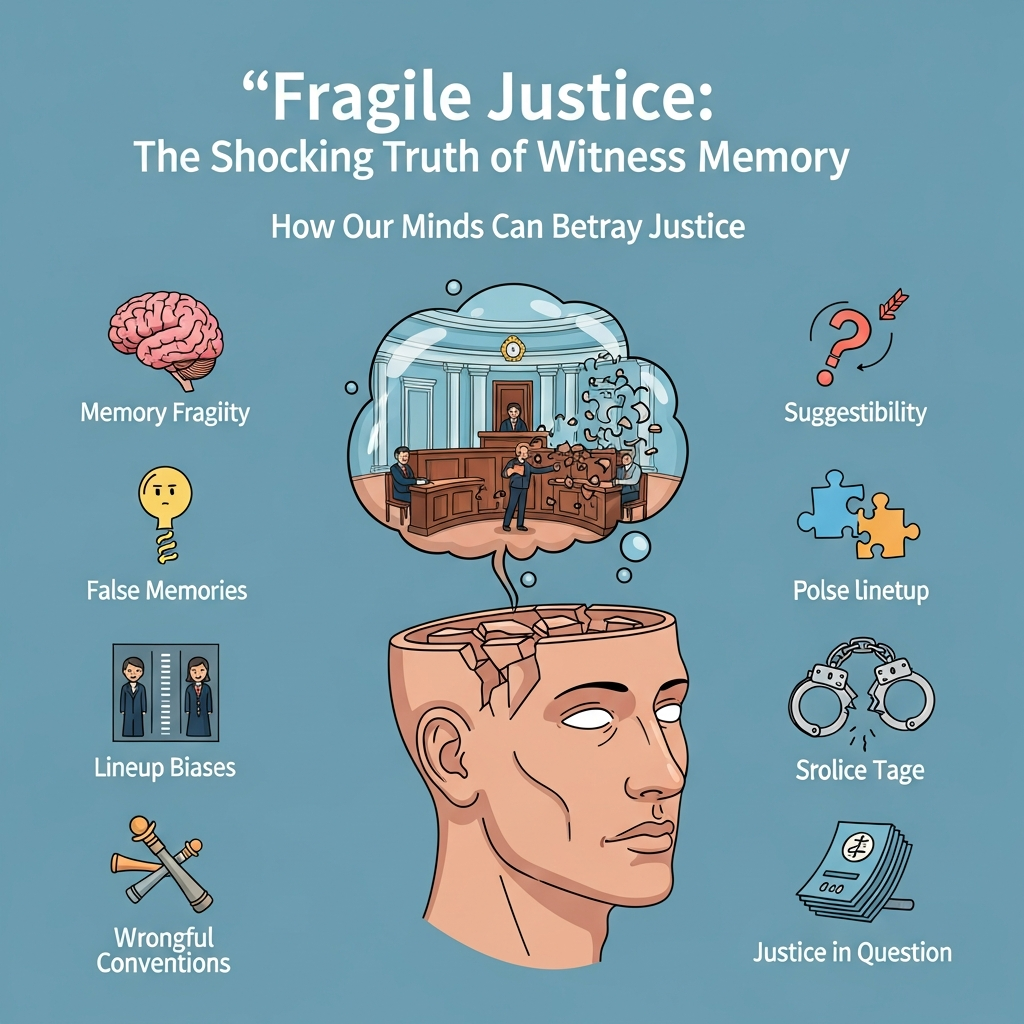
Phenomenon Breakdown: The Fragility of Witness Memory
Eyewitness testimony is often considered the bedrock of criminal justice, a seemingly unshakeable account that can sway juries and determine fates. Yet, scientific research consistently reveals a troubling truth: human memory is far from a perfect recording device. Instead, it is a reconstructive process, vulnerable to distortion, suggestion, and the passage of time. This article explores the delicate nature of witness memory, dissecting the psychological phenomena that can lead to devastating inaccuracies and wrongful convictions.
The Paradox of Eyewitness Testimony
In a courtroom, few moments are as impactful as a witness confidently pointing out a defendant. This creates a central paradox in forensic psychology: the ‘power versus precision’ gap. While jurors find confident eyewitnesses incredibly compelling, cognitive psychologists know that a witness’s confidence often bears little relation to their actual accuracy. We instinctively treat memory as a high-definition video, but science proves it’s a fluid narrative, prone to gaps, internal biases, and external contamination.
The tragic case of Ronald Cotton powerfully illustrates this human cost. In 1984, Jennifer Thompson, a rape victim, meticulously ‘studied’ her attacker’s face, determined to ensure justice. She identified Cotton in both a photo spread and a physical lineup. Based primarily on her certain testimony, Cotton was sentenced to life in prison. He served over a decade before DNA evidence not only exonerated him but also identified the true perpetrator, Bobby Poole.
The DNA Reality Check
- Faulty eyewitness testimony has been implicated in at least 75% of DNA exoneration cases.
- This makes it a higher contributor to wrongful convictions than any other single factor.
This stark discrepancy underscores that memory is not a fixed video file; it’s a living record constantly edited from the moment an event concludes.
The Misinformation Effect: Contamination by Suggestion
The misinformation effect occurs when a witness’s memory of an incident is altered by information they encounter after the event. This contamination often stems from leading questions or subtle linguistic cues that can overwrite the original memory trace.
A foundational study by Loftus, Miller, & Burns (1978) demonstrated this. Subjects viewed a slideshow of a car hitting a pedestrian after passing a stop sign. When later asked the leading question, ‘How fast was the car traveling when it passed the yield sign?’, many subjects began to ‘remember’ seeing a yield sign. Even minute linguistic shifts influence recall. For example, asking a witness if they saw ‘the broken headlight’ (implying one existed) produces significantly more false ‘yes’ responses than asking if they saw ‘a broken headlight.’
| Original Event Detail | Misleading Prompt/Result |
|---|---|
| Car hits pedestrian after passing a Stop Sign. | Leading question asks about a Yield Sign; subjects later select the yield sign slide as ‘original.’ |
| No mention of a broken headlight. | Using the definite article ‘the’ (the broken headlight) leads to significantly higher false confirmations than using ‘a.’ |
| A mundane scene with no barn. | Researchers mention a ‘barn’ that wasn’t there; subjects later incorporate this large, non-existent object into their recall. |
This process clearly demonstrates how easily the mental ‘record’ can be edited. These distortions are amplified when memories move from the individual to the social sphere.
The Power of ‘Social Proof’: Co-Witness Contamination
After a crime, witnesses naturally want to discuss what they saw. However, as forensic consultants, we emphasize that co-witness conversation isn’t just ‘chatting’; it’s a forensic contamination event. Witnesses tend to reinforce each other’s common memories while unconsciously contaminating individual recollections to achieve ‘social proof’ or conformity.
In the ‘Eric the Electrician’ study, pairs watched a video of a man stealing items from a house. Using polarized glasses, researchers showed each person in the pair slightly different details.
Key Findings from the ‘Eric the Electrician’ Experiment:
- Individual Baseline: Witnesses who did not discuss details with their co-witness maintained a relatively high accuracy rate of 79%.
- Contamination Impact: For details that co-witnesses discussed together, accuracy plummeted to 34%.
- Conformity Harm: Subjects frequently allowed the (incorrect) reports of their peers to corrupt their own memories, adopting their partner’s errors to maintain a shared narrative.
When witnesses talk, they effectively ‘pollute’ the evidence pool, making it impossible to determine whose memory was original and whose was adopted.
Anatomy of the Lineup: Target Present vs. Target Absent
Suspect identification typically involves photo spreads containing one suspect and several ‘foils’ (or fillers)—individuals known to be innocent but who match the witness’s initial description. The psychological mechanics of the lineup differ significantly based on whether the actual perpetrator is present.
In a laboratory setting, ‘mock witnesses’ (research subjects) reveal the two primary ways identifications fail:
| Lineup Type | Correct Action | Common Error |
|---|---|---|
| Target Present | Correctly identify the perpetrator. | Failure to pick: Choosing an innocent foil or stating the perpetrator is not present. |
| Target Absent | State that the perpetrator is not present. | False identification: Selecting a foil (identifying an innocent person). |
Witnesses often feel pressure to make a choice. Consequently, a ‘Target Absent’ lineup is particularly dangerous, frequently resulting in a false identification. The witness may select the person who most closely resembles their memory, rather than acknowledging that the actual criminal is not among the options.
False Memory: The Creation of ‘The Unhappened’
False memories are not simple ‘tip-of-the-tongue’ slips; they are rich, complex recollections of entire events that never occurred. Research proves that suggestion and guided imagery can implant ‘the unhappened’ into the human mind.
- ‘Lost in the Mall’: A quarter of subjects were convinced they were lost in a shopping mall as children and rescued by an elderly person—an event their families confirmed never happened.
- ‘Bugs Bunny at Disneyland’: Subjects ‘remembered’ meeting Bugs Bunny at Disneyland. This is a physical and corporate impossibility (Bugs Bunny is a Warner Brothers character, not Disney). Yet, the suggestion created a vibrant, authentic-feeling memory.
The 3 Stages of Memory Implantation and Distortion:
- Encoding: This initial process can be influenced by external suggestions, which redirect attention and effectively ‘poison the well’ before the memory is even stored.
- Consolidation: During this stage, suggestions (like seeing a suspect’s photo or hearing a co-witness’s account) integrate with original memory traces, overwriting the ‘raw’ data with a suggested narrative.
- Retrieval: The act of remembering is a reconstruction. External cues, such as leading questions, trigger a process that pulls in suggested misinformation, as the brain fills in gaps with plausible but incorrect details provided by the interviewer.
Cognitive Frameworks: Schemata and the Narrative Fallacy
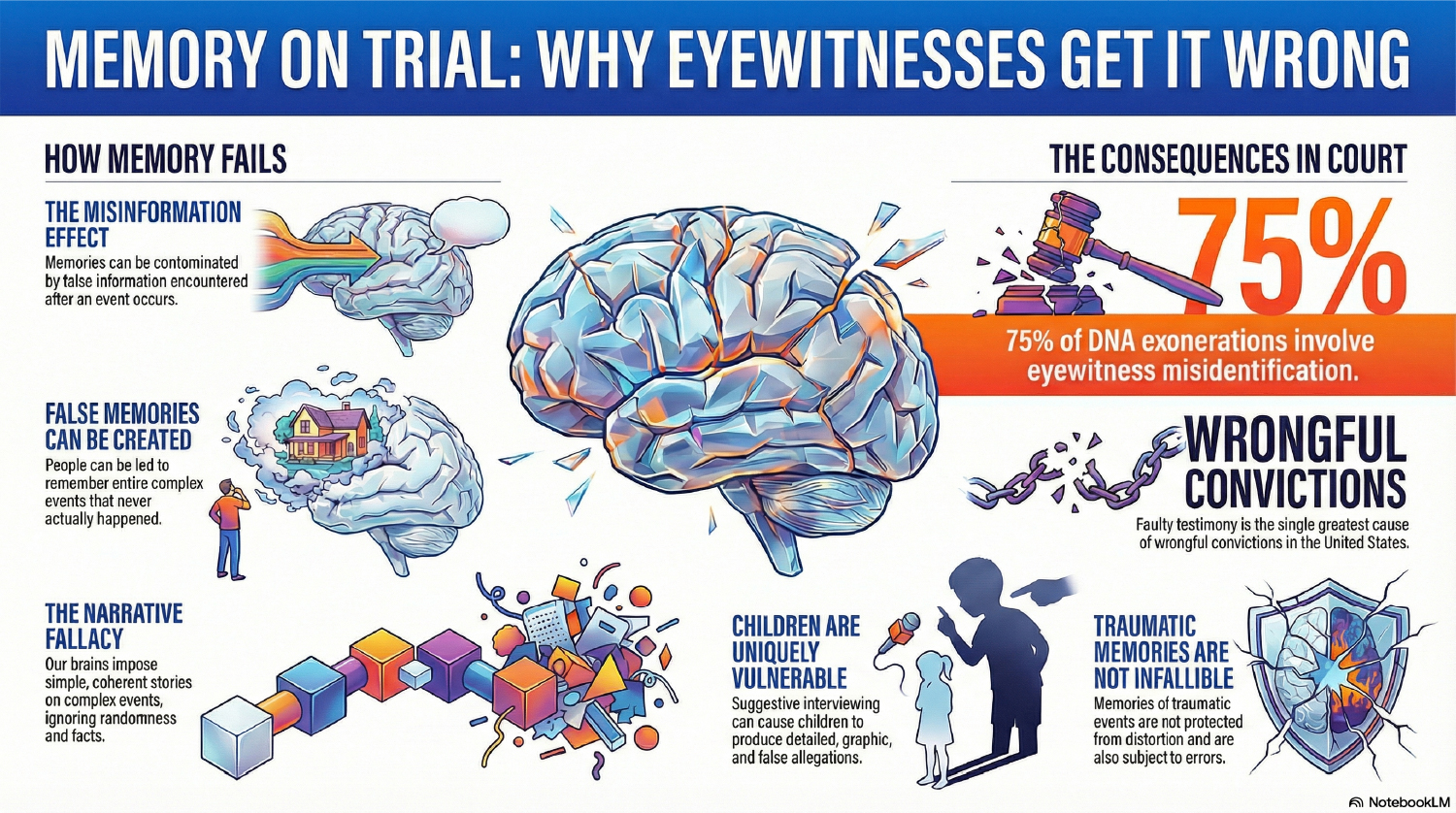
To understand why these memory errors occur, we must look at the brain’s drive for cognitive efficiency.
- Schemata: These are ‘memory templates’ or mental shortcuts. If you recall a library, your ‘library schema’ (shelves, books, quiet) automatically fills in details. You might ‘remember’ seeing books on a specific shelf simply because they should be there, even if that shelf was empty.
- Narrative Fallacy: This is the inherent human tendency to weave random, complex, or contradictory events into a coherent story. We crave a linear cause-and-effect narrative, even when randomness prevails.
- Cognitive Efficiency: These mental shortcuts are crucial for daily survival, preventing information overload. However, they pose a significant risk for legal accuracy, as the brain often prioritizes a ‘good story’ over a ‘true record.’
Safeguarding Justice: The NICHD Protocol
To protect the ‘sterile environment’ of a witness’s mind, especially children’s, the NICHD Protocol stands as the gold standard. It’s a structured interview process designed to maximize free recall and minimize the contamination seen in cases like McMartin or Wee Care Nursery.
| Protocol Phase | Primary Goal | Sample Prompt |
|---|---|---|
| Rapport Building | Create a supportive environment and build a relationship. | ‘Tell me about things you like to do.’ |
| Episodic Training | Prime the witness for open-ended style using a neutral, non-investigative event. | ‘Tell me everything that happened on your last birthday.’ |
| Substantive Phase | Elicit core allegations using strictly open-ended, non-suggestive prompts. | ‘Tell me everything about why you are here today.’ |
Final Synthesis: Protecting the Truth
For students of psychology and practitioners of law alike, the implications are clear: memory is not a file to be retrieved, but a reconstruction to be protected. Every leading question, co-witness conversation, and biased lineup is a potential source of contamination. Investigative techniques must be handled with the same hygiene as a surgical site. Once a memory is contaminated, the original truth may be irrevocably lost.