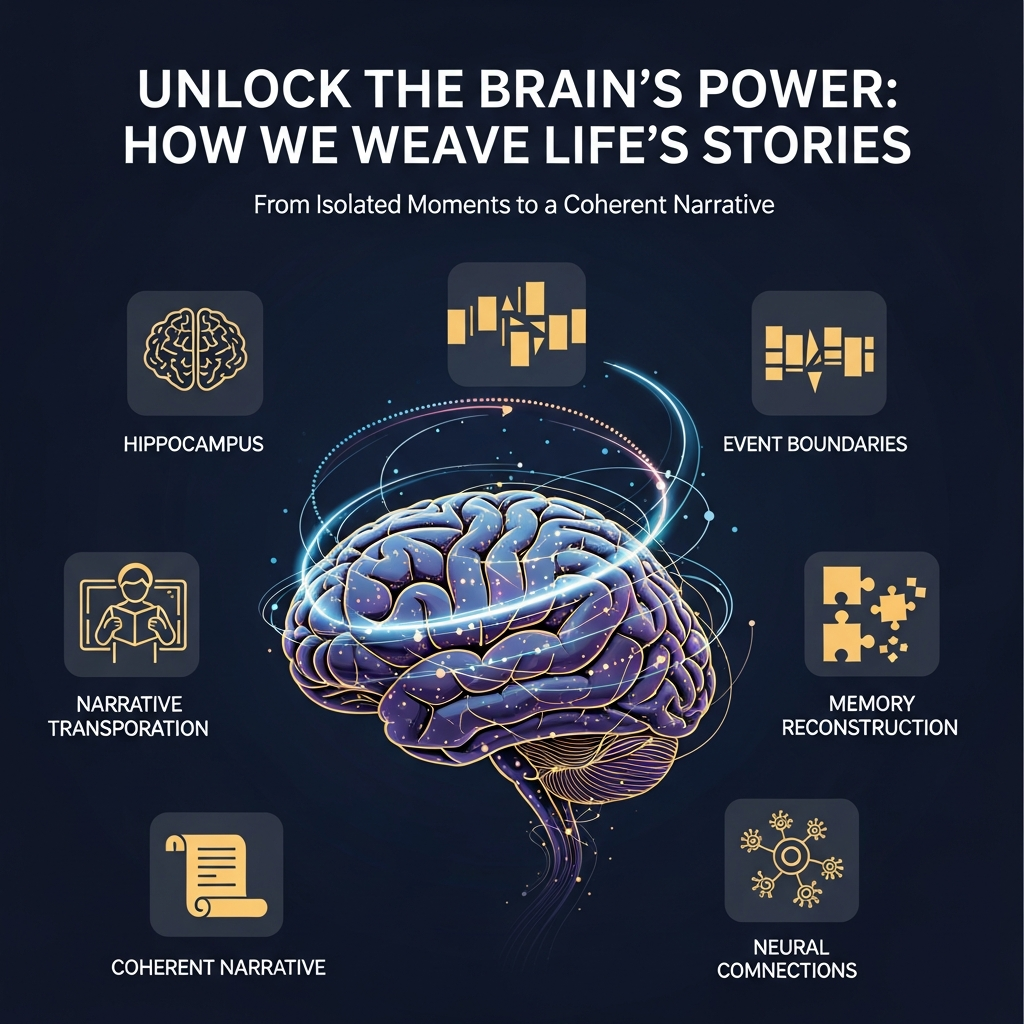
Our lives unfold as a continuous flow of experiences, yet our brains don’t record everything like a raw video feed. Instead, the brain acts as a masterful editor, segmenting our reality into distinct units called “events.” The remarkable challenge for our biology is to connect these isolated events, transforming scattered moments into a coherent, meaningful narrative.
At the heart of this process lies the hippocampus, a deep brain region crucial for building bridges between past lessons and present experiences. By integrating events that occur at different times into a single, cohesive story, the hippocampus effectively turns the “snapshots” of our daily lives into the “cinema” of our personal history.
The Mechanism of Event Boundaries
How does the brain discern where one story ends and another begins? This crucial process is known as segmentation. The brain actively identifies “event boundaries”—significant transitions in our environment that signal a shift in the current situation or narrative.
Key Concepts:
- Event Boundaries: These are specific points where the brain perceives a transition. Examples include a person entering or leaving a room, a change in location, or a temporal shift (e.g., “the next day”). These boundaries prompt the brain to conclude one mental model and initiate a new one.
- Episodic Memory: This memory system is responsible for storing specific personal experiences, encompassing the “what, where, and when.” It allows us to mentally revisit particular events and relive them.
These event boundaries are more than just separators; they serve as a biological signal for the brain to start building connections. When the brain encounters a boundary, it triggers a retrieval process, actively seeking to determine if the new event relates to anything previously stored in memory.
The Hippocampus: The Master Integrator
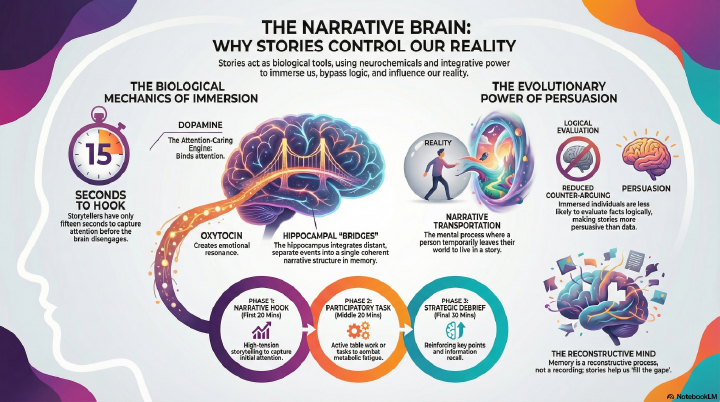
The right hippocampus is the primary driver of this integrative process. Neuroimaging studies have revealed a specific period of heightened activity known as the “Boundary Epoch.” This critical window occurs approximately 6.1 to 14.64 seconds (TRs 5–11) after a new event begins. During this time, the hippocampus isn’t just processing the present moment; it’s actively reaching back—minutes, hours, or even days—to find a “linker” event.
The Hippocampal Integration Process: Three Essential Steps
- Perception of a Boundary: The brain detects a shift in the ongoing narrative (a new event commences), which activates the right hippocampus.
- Retrieval of Related Past Events: If a recurring character, theme, or context is present, the hippocampus is triggered to retrieve a related past memory and bring it into the current mental model.
- Reinstatement of Activity Patterns: Crucially, the hippocampus “reinstates” the unique neural signatures (brain activity patterns) of the earlier event during the encoding of the new event. This neural overlap creates the biological bridge, effectively “threading” the two events together into a continuous narrative.
It’s vital to note that this bridging process hinges entirely on narrative coherence—meaning the new information must logically “fit” with the old to be integrated.
Coherent vs. Unrelated Narratives: Why Some Stories Stick
Not all shared features or overlaps lead to an integrated story. Consider these two scenarios involving a neighbor named Melvin:
- Coherent Narrative (CN): In Event 1, you see Melvin locked out of his house while a pizza bakes in his oven. The next day (Event 2), Melvin tells you his kitchen is covered in ash. Because Event 2 explains the outcome of Event 1, your brain integrates them into a single, logical story.
- Unrelated Narrative (UN): In Event 1, Melvin is locked out with a pizza in the oven. Later (Event 2), you see Melvin in a completely different context, perhaps attempting to hide from art sponsors at a gallery. While the character (Melvin) overlaps, the two stories are distinct and independent.
Research indicates that Event 2 serves as the critical “Integrator” moment. In a coherent narrative, the neural reinstatement of Event 1’s patterns during Event 2 actually predicts how well you will remember both events later.
Comparing Coherent and Unrelated Narratives
| Criteria | Coherent Narratives (CN) | Unrelated Narratives (UN) |
|---|---|---|
| Structural Connection | Events are interrelated; understanding Event 2 depends on Event 1 (e.g., the pizza and the ash). | Events share a feature (like Melvin) but describe different, independent situations. |
| Hippocampal Response | Reinstatement of neural activity patterns from Event 1 during the encoding of Event 2. | Lower pattern similarity; the brain treats the events as distinct, competing units. |
| Recall Detail | Leads to higher retention; Event 2 reinstatement predicts the ability to recall integrated details. | Lower retention; details are often lost, or memories of the two events compete and interfere with each other. |
When a narrative demonstrates coherence, it often triggers a profound psychological state known as “transportation.”
Narrative Transportation: The Feeling of Being “In” the Story
Narrative Transportation Theory describes the compelling sensation of becoming completely “lost” within a story. This immersive experience is a neurochemical state, primarily driven by two key forces:
- Attention (Dopamine): The release of dopamine, which binds to the prefrontal cortex, signals that the story is rewarding and worthy of our limited cognitive resources and sustained focus.
- Emotional Resonance (Oxytocin): Oxytocin is released when we develop an emotional connection or stake in the characters, creating a powerful “craving” to see the story through to its conclusion.
The Six Elements of Transportation:
- Empathy: The capacity to understand and deeply feel the experiences, emotions, and perspectives of the characters.
- Character Identification: A specific form of empathy where the listener perceives a character as similar to themselves, making it easier to fully enter and engage with the story world.
- Mental Imagery: The vivid and spontaneous creation of pictures and sensations in the mind, allowing one to imagine the story unfolding as if personally experiencing it.
- Quality: The logical flow, internal consistency, and overall “fit” of the narrative, which enables easy detachment from reality and immersion into the story.
- Physical Situation: The absence of external distractions in the surrounding environment, which allows for total mental detachment and focused engagement with the narrative.
- Prior Knowledge: Existing information, background, or familiarity with the story’s themes or setting, which helps the brain to engage and navigate the story’s world more quickly and deeply.
The Reconstructive Nature of Memory
Despite the strong “bridges” built by the hippocampus, our memories are not permanent, immutable records. Memory is inherently reconstructive, not a precise recording device.
The biological reason for this inherent fragility lies in the “labile state.” When you retrieve a memory, it temporarily becomes chemically unstable. To be maintained in long-term storage, it must undergo a process called reconsolidation, which requires new protein synthesis. This brief window of instability is a double-edged sword: it allows the brain to update a story with new, relevant information, but it also leaves the “bridge” open to distortion, modification, and bias.
Memory: Myth vs. Reality
- Myth: Memory functions like a video recorder, capturing an indelible and perfectly permanent account of events.
- Reality: Memory is more akin to a “Darwin Machine” that produces variations. We often fill in gaps with logical inferences, expectations, and personal biases.
- Myth: High confidence in a memory directly correlates with its accuracy.
- Reality: Confidence and accuracy are frequently “decoupled.” High stress levels and exposure to misinformation can create strong confidence in details that are, in fact, false.
Think About It: Consider your own “flashbulb memory” of a major public event, such as the 9/11 attacks. Research consistently shows that while people remain 100% confident in these vivid memories years later, their actual accuracy can often drop by over 40%. Why might your brain prioritize the “feeling” or narrative coherence of a story over the raw factual data of the event?
Synthesis: The Survival Value of Storytelling
Why did humans evolve such a complex and energy-intensive system for narrative integration? From an evolutionary standpoint, the brain’s remarkable “bridge-building” ability is a vital survival adaptation.
By organizing discrete events into coherent narratives, the hippocampus equips us with invaluable strategic social information. Stories serve as a form of “cognitive play,” allowing us to contemplate various future possibilities, make more informed decisions about social partners, and cooperate more effectively within groups. We don’t just tell stories for entertainment; we tell them to construct a navigable map of our often chaotic world, enhancing our ability to predict, plan, and thrive.
Learner’s Takeaway:
Our unique personal stories are constructed at the critical intersection of identified event boundaries and intricate hippocampal integration. During the specialized “Boundary Epoch” (approximately 6.1–14.64 seconds after a new event), the right hippocampus actively reinstates neural patterns from past experiences to bridge the gap between temporally distant moments. When a story exhibits strong coherence, this process engenders the profound “transportation” we feel—a powerful neurochemical state of focused attention and deep emotional resonance. However, it’s crucial to remember that memory retrieval renders our stories temporarily unstable for reconsolidation. Thus, our memories remain reconstructive and subject to change, serving as a flexible, evolving guide essential for human survival.