In an increasingly volatile world, effective leadership demands more than traditional crisis management. This article delves into a transformative framework for leadership resilience, drawing on psychological insights, seasonal wisdom, and the power of individual gifts. We explore how enhanced perception, a growth mindset, and the courage to act are fundamental drivers of long-term fulfillment, enabling leaders and organizations to not just survive but thrive through periods of profound change.
1. The Strategic Imperative of Resilient Leadership
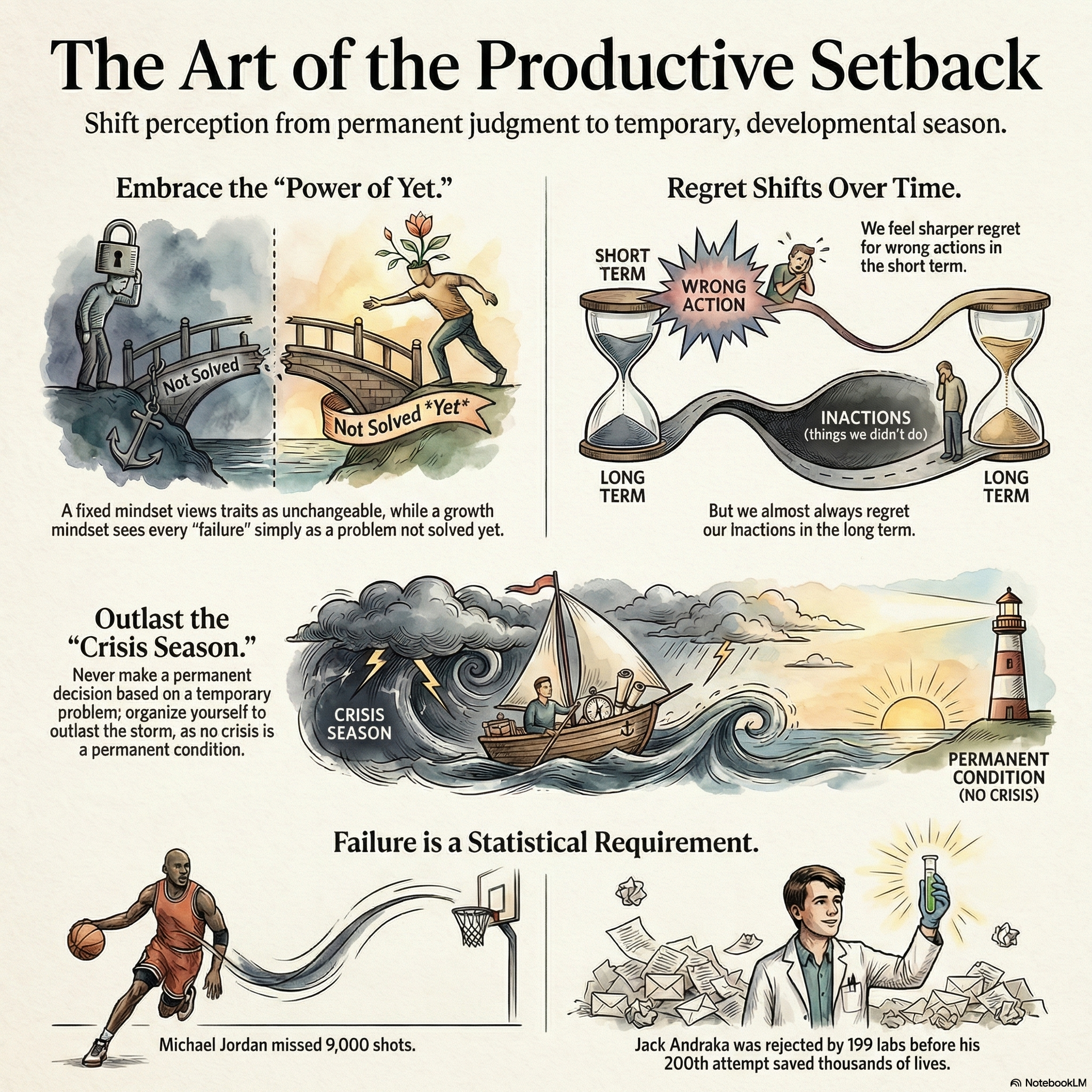
Our current global landscape is in a constant state of flux. Traditional crisis management often falls short because it focuses solely on temporary disruptions—the “hurricane”—while neglecting the enduring, fundamental principles—the “rock” that provides stability. To lead effectively today, leaders must undergo a significant psychological shift. This means moving away from the “tyranny of now,” where failure is perceived as final, towards the “power of yet,” where challenges are recognized as temporary steps on an ongoing learning journey.
The core objective of this resilience framework is to transform your organization. Instead of a group of “job-holders” who merely exchange time for money, the goal is to cultivate a community of “full-fledged beings” who are empowered to express their maximum potential. True resilience isn’t just about enduring a storm; it’s about evolving through it. To guide your team through periods of intense change, you must first master the inherent, seasonal nature of change itself.
2. The Seasonal Paradigm: Understanding Organizational Crisis
One of the most crucial cognitive shifts a leader can make is viewing a crisis as a “season” rather than a permanent state. A crisis is simply a human label for an experience beyond our control. By recognizing that everything operates within seasonal boundaries, you provide your organization with the psychological stability needed for peace and innovation during challenging times.
The Power of Seasons in Organizational Resilience
Organizational resilience is built upon four fundamental seasonal truths:
- Guaranteed Change: Impermanence is a universal law. Whether a period is prosperous or lean, it is always in motion. This understanding offers a strategic foundation, ensuring that the logic of a “winter” period does not dictate a permanent trajectory for your organization.
- The Provision of Hope: Common sense dictates that you don’t discard your summer tools simply because it’s winter. In leadership, “winter” is the critical time to protect the vision and resources essential for the upcoming “summer” phase.
- Temporal Boundaries: A crisis signifies a period of transition, not a final destination. Recognizing these boundaries prevents leaders from making permanent, potentially destructive decisions based on temporary environmental pressures.
- Incentive for Future Planning: The “off-season” is the primary window for high-level innovation. Just as the best time to invest in summer resources is during the winter, a downturn or crisis period is the optimal time to strategically plan and architect your next phase of growth.
The Rock vs. The Hurricane: Navigating Stability and Flux
Understanding the difference between permanent foundations and temporary fluctuations is vital for resilient leadership.
| The Rock (Permanent Foundations) | The Hurricane (Temporary Fluctuations) |
|---|---|
| The Rock of Ages: Principles and systems that remain steady across centuries, providing enduring stability. | Moving Storms: Environmental shifts characterized by specific velocity and duration, eventually passing. |
| Foundational Human Needs: The unchanging constants of water, food, security, and purpose that drive human action. | Market Trauma: Fluctuations in stock prices, consumer anxiety, and external volatility that create short-term disruption. |
| Internal Peace: A foundation of faith, conviction, and clarity that remains independent of external events and circumstances. | Emotional Noise: Fear, anxiety, and the “tyranny of now” that often lead to impulsive, reactionary decision-making. |
The “Hurricane” as a Strategic Filter
The “hurricane”—the crisis—serves a vital strategic purpose: it reveals weaknesses and identifies structural flaws. A crisis acts as an incubator for development, exposing inefficient internal structures and compelling innovation. Outlasting such a season requires organizational “insulation” and adaptation rather than outright “evacuation.” By remaining steadfast on the “Rock” of core principles, you allow the storm to unveil the solutions it was meant to catalyze.
3. The Infrastructure of Growth: Mindset and the “Full-Fledged Being”
Internal perception is the ultimate competitive advantage. It’s crucial to differentiate between “social success”—the often superficial desire to surpass others—and “true success,” which is defined by the full expression of one’s unique potential.
Fixed Mindset vs. Growth Mindset in Leadership
Leadership resilience is largely determined by which of two primary mindsets governs your perspective:
- The Tyranny of Now (Fixed Mindset): This perspective treats intelligence and character as static, unchangeable traits. Leaders with a fixed mindset feel an incessant need to prove themselves. Every challenge becomes a judgment: Will I appear smart or foolish? Am I a winner or a loser? In a crisis, they tend to conceal deficiencies and shy away from acknowledging errors.
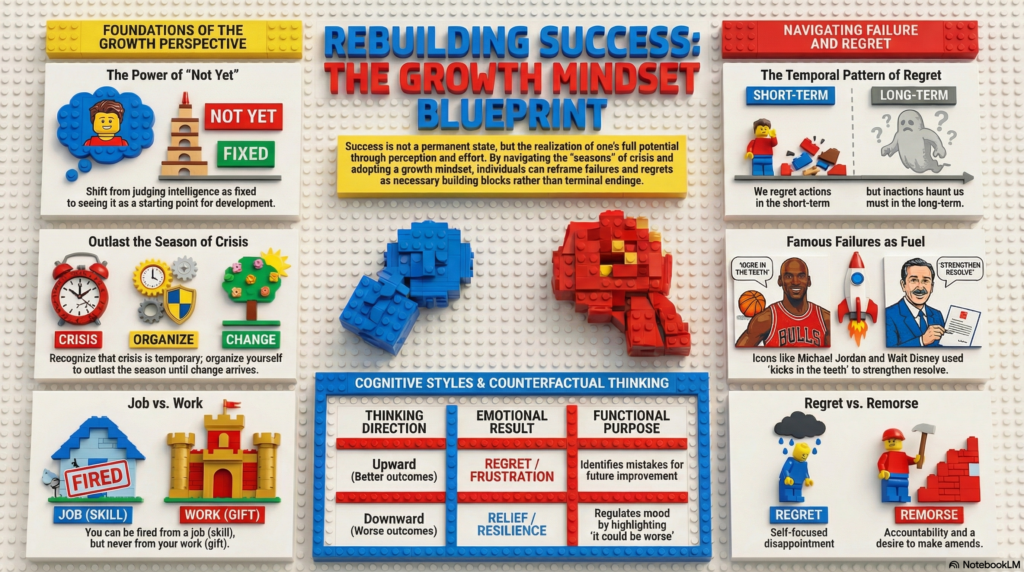
- The Power of Yet (Growth Mindset): This perspective views one’s starting point as merely a foundation for development. Traits are cultivated and improved through dedicated effort. Much like a “Not Yet” grading system, this mindset signals that the team is on a continuous learning curve, not at a dead end.
The Sickness of Intelligence Without Perception
High intelligence, when coupled with a lack of clear perception, can be detrimental. If a leader possesses sharp intellect but struggles to see reality objectively, their intelligence can inadvertently work against them. They might use their cognitive abilities to distort facts, leading to unnecessary misery for themselves and their teams. To achieve genuine success, leaders must enhance their perception, stripping away the distortions of ego or fear. When perception is clear, leadership transforms into a “play” that can be conducted joyfully, even amidst the most intense crises.
The Hallmark of Growth
Thriving through challenges is a result of “stretching” beyond one’s comfort zone rather than hiding from difficulty. A growth mindset enables leaders to process failure as a problem to be solved and learned from, rather than a personal condemnation. By recognizing and praising the process—the effort, effective strategies, and perseverance—you foster a robust, resilient workforce capable of continuous improvement.
4. Navigating the Emotional Landscape: Regret, Responsibility, and Resilience
A leader’s capacity to convert setbacks into future triumphs hinges on their psychological framework for processing regret and responsibility.
Defining the Emotional Bridge
It’s important to understand the distinctions between key emotional responses to past events:
- Regret: A cognitive reflection on past choices and the contemplation of alternative outcomes. It is typically self-focused and often short-term in its impact.
- Remorse: A deeper emotional state involving profound moral accountability and a sincere desire to make amends. This is outwardly focused and carries a significant, long-term emotional burden.
- Guilt: The emotional bridge between regret and remorse. Tied to a sense of wrongdoing, unresolved guilt can transform a temporary disappointment into a persistent, lingering state of remorse.
The Temporal Pattern: Action vs. Inaction
To make decisive choices, leaders must master the “Temporal Pattern of Regret.” In the short term, teams often experience the “Action Effect”—the immediate, sharp pain of regretting a specific decision or change. However, over the long term, the “Inaction Effect” becomes far more impactful. Individuals and organizations suffer a deeper, more enduring sense of rot from the opportunities they missed and the risks they failed to take. A truly resilient leader guides their team through the “short-term action pain” to prevent the more profound “long-term inaction rot.”
Catalysts for Development: Learning from Setbacks
Often, a significant setback or “kick in the teeth” proves to be the most effective catalyst for growth and innovation. History provides compelling examples:
- Jack Andraka: Faced rejection from 199 research laboratories before his groundbreaking idea for a significantly cheaper pancreatic cancer test was accepted by the 200th.
- Walt Disney: Was fired from an ad agency and experienced bankruptcy with his first studio. He leveraged the setback of losing his first successful character to build a world-renowned global entertainment empire.
- Steve Jobs: Was famously fired from Apple, the company he co-founded. He used this profound failure to refine his vision, ultimately returning to lead Apple to become one of the most profitable companies globally.
5. The Great Pivot: From Job-Based Skills to Gift-Based Work
There is a substantial strategic risk inherent in “Job-Based” thinking, where an organization owns an individual’s time and skillset. In contrast, “Work-Based” thinking empowers individuals to own their “assignment” and purpose, aligning their efforts with their innate talents.
The Job vs. The Work: A Fundamental Distinction
Understanding the difference between a job and one’s true work is key to unleashing potential:
- The Job:
- Origin: What you are trained to do (a skill).
- Security: Controlled by the employer; you can be fired.
- Durability: You can retire from a job.
- The Work:
- Origin: What you were born to do (a gift).
- Security: Self-contained; you cannot be fired from yourself.
- Durability: Your life’s assignment; it is permanent and evolving.
We can adopt the “Moses Model” of development: Moses held the “Job” of a shepherd, which taught him the terrain of the desert, but his true “Work” was leading a nation. Resilient leaders help their teams utilize their current jobs as a means to refine the inherent gifts required for their ultimate, impactful work.
The McCann Vision: Seeing Potential Beyond Circumstance
Where others might only perceive the immediate “poverty of bare feet,” the resilient leader possesses the “McCann Vision”—the ability to look past surface-level limitations and identify the inherent gifts, or the “shoe business,” waiting to be developed within the team. This involves seeing potential and opportunity where others only see scarcity.
5-Step Strategic Command for Gift Deployment
To guide employees in transitioning from mere “job-holders” to “full-fledged beings,” leaders can facilitate the “Seed to Forest” cycle:
- Identify the “Idea that won’t go away”: Help individuals pinpoint the recurring passion or idea that persists within them, regardless of economic conditions or external circumstances.
- Distinguish “Evening Work” from the “Day Job”: Encourage employees to use their current job to provide financial stability while dedicating their “off-season” or free time to cultivating their innate gift.
- Execute the “Drug Strategy”: Advise them to test their gift by initially giving it away. Offering the “first taste” for free can generate undeniable market demand and valuable feedback.
- Refine the Gift through the “Job”: Encourage the use of the current career as a practical laboratory to acquire and hone the skills necessary to scale and professionalize their gift.
- Scale the Forest: Understand that every “seed” (gift) contains the potential for an entire “forest.” Once the gift is refined and validated, strategize how to scale it into a sustainable enterprise or factory of potential.
A workforce operating from a gift-based mindset is inherently recession-proof, as “seeds are never in recession.” A seed doesn’t consult the stock market before it grows; it only requires the right environment and cultivation to flourish.
6. Framework Synthesis: The Resilient Leader’s Mandate
The mandate of a resilient leader is firmly built upon three interconnected pillars: Seasonal Awareness (understanding change as temporary), Growth Perception (cultivating a growth mindset), and Gift Deployment (empowering individuals to activate their innate talents).
Leaders must operate from a higher perspective, recognizing that “a crisis on earth is an incident in heaven”—a temporary challenge within a larger, unfolding purpose. Your primary role is to be the “Man of Wisdom” who “draws out the deep waters of purpose” from the hearts and minds of your team members. This requires reframing every obstacle, not as a threat to immediate survival, but as a profound opportunity for collective and individual evolution.
Do not pursue “social success” by attempting to rise at the expense of others. Instead, strive to become a “full-fledged being,” fully expressing your maximum potential and planting seeds that will grow and bear fruit long after the current season has passed. When you embrace this approach, the world will inevitably recognize your efforts as true and enduring success.